
After Three Decades of Emergency Relief, Food for the Poor Guyana Pivots to Capacity Building as Guyana’s National Needs Shift
FOR more than three decades, Food for the Poor Guyana Inc. has been providing relief to the less fortunate across the country, establishing itself as one of Guyana’s oldest non-profit organisations. Recently, however, the charity has shifted its focus from relief and brought down the curtain on its housing initiative. This is not a troubling sign, nor an indication that the organisation is shutting down. On the contrary, the organisation’s strategic retreat highlights and emphasises the country’s substantial leaps forward. This week, Pepperpot Magazine sat down with Chief Executive Officer Andrea Benjamin to learn why the closure of relief and housing projects reflects well on the nation, and how the charity is now shifting its focus towards capacity building.
While she has held the title of CEO for only a few years, Andrea Benjamin has been with Food for the Poor for almost two decades. During that time, Benjamin says she has seen the organisation continuously transform, beginning with a primary focus on relief. “Food for the Poor began just over 30 years ago as a relief organisation. The original objective was to bring in in-kind items such as food, clothing, and toiletries, and distribute them to families in need, with the aim of ensuring food security and basic comfort,” she explained. “Over time, we recognised that food alone was not the solution to most challenges, and the organisation shifted towards development-focused interventions.”
Historically known for its housing initiative, Benjamin shared that the organisation’s shift to capacity-building and development was motivated by changes taking place in Guyana. The last five years have seen the rollout of numerous housing and relief projects, particularly by the Government of Guyana—a push that Benjamin says has profoundly affected the needs of Guyanese families. “Guyana has expanded housing, agriculture, and livelihood enhancement programmes. Within the past five years, we also recognised that Guyana as a country is changing, particularly with the development of the oil and gas sector,” she said. “As the country develops, the organisation must evolve as well. We examined where Guyana is heading and aligned our programmes with the country’s development trajectory.”
Guyana’s development trajectory is moving upward rapidly. To match this growth and the nation’s changing needs, Food for the Poor has shifted its main focus towards capacity building, development, and eventual independence. While the organisation still conducts relief missions occasionally, most of its programmes now focus on education, upskilling, and training. As Benjamin shared, while immediate relief may no longer be a primary need for many families, the organisation is targeting long-term stability—taking Guyanese from relief to resilience. “While we continue to provide relief, our focus has shifted to moving families from relief to resilience. The emphasis is now on teaching families to become independent through capacity-building and development. Instead of simply providing food support, we examine why families need assistance. Is it unemployment? Lack of skills? If so, how can we network to connect them to jobs or training opportunities?”
At its core, Food for the Poor’s focus remains on aid and development, a commitment highlighted through several projects the organisation has pioneered in recent years. Among the most impactful is the Youth Enhancement Programme. “Our Youth Enhancement Programme focuses on building young people’s capacity for employment and sustainable livelihoods. We have worked with 30 youths so far, most of whom are now employed or pursuing further skills training,” she said. Another youth-focused project currently being developed is Braids of Hope. “This upcoming initiative targets unemployed and out-of-school young women. The programme will train 15 women and girls in hair braiding, equipping them with an income-generating skill.”
The organisation is also taking a holistic approach, working with families in agriculture to provide sustainable solutions. “Rather than providing food supplements, we decided to teach families how to grow food where they live. This led to the creation of our urban agriculture project in Festival City, which currently supports 20 families from the community and surrounding areas.”
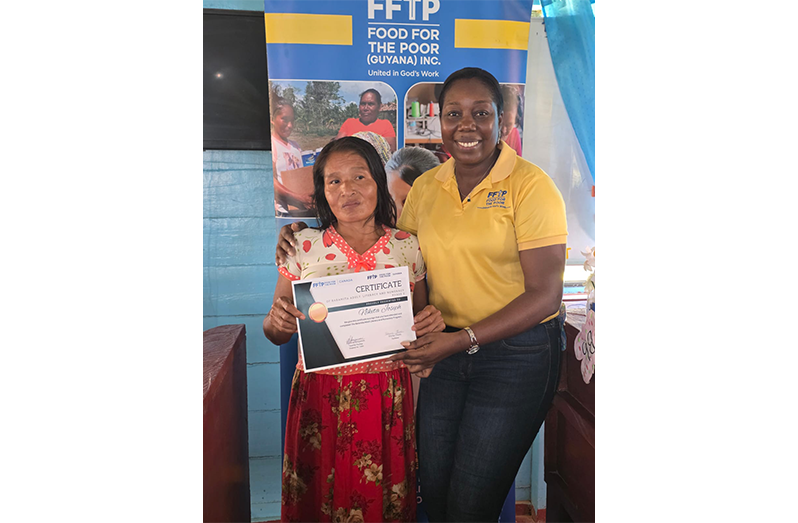
Food for the Poor’s work extends far beyond the capital city, with impactful initiatives reaching Guyana’s hinterland regions. One of the organisation’s most successful ventures in the interior has been its literacy programme for women. “We also operate literacy programmes in the hinterland, recognising that the needs there differ from those on the coast. In communities such as Baramita, we identified a critical need for adult literacy among women,” Benjamin stated. To date, Food for the Poor has worked with 47 women, teaching them to read and write independently—a project that has had far-reaching, positive impacts, particularly in their access to services and healthcare. “Beyond literacy and numeracy, the programme significantly boosted women’s confidence. They are now more engaged with their children’s schools, more confident interacting within their communities, and better equipped to advocate for themselves. For Indigenous women in remote communities, this is critical to personal growth and development.”
Another area the organisation has stepped away from is its housing programme, which closed in 2023. According to Benjamin, this decision was influenced by the government’s housing push, which she describes as impressive and commendable. “Food for the Poor has traditionally been known for food distribution and housing. In 2023, we closed our housing programme after recognising the government’s aggressive and effective housing initiative. We did not want to duplicate efforts and commended the government for its work,” she said. “As a result, our core focus is now on building the capacity of vulnerable individuals, families, and communities so they can take advantage of the opportunities Guyana has to offer.”
In alignment with this approach, the organisation has ensured its work complements Guyana’s national development strategy. “Food for the Poor maintains a strong relationship with the Government of Guyana and aligns its work with the national development strategy. We ensure that our efforts complement rather than duplicate government initiatives,” Benjamin noted.
Looking ahead, Food for the Poor will launch its 2026 programme appeal, outlining projects available for funding, including costs and implementation plans. While the organisation continues to change and evolve alongside the country, Benjamin emphasised that it remains very much active. “Food for the Poor is alive and well. While our focus is no longer heavily on relief, we remain committed to building capacity at the individual, family, and community levels, in line with Guyana’s changing development landscape.”