.jpg)


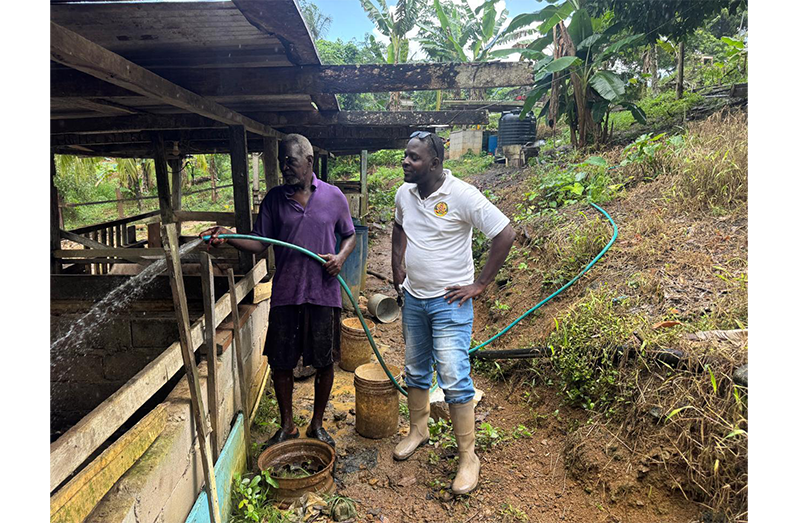
ON the quiet slope of Hosororo Hill in Mabaruma, Region One, 70-year-old swine farmer, Nigel Peters, moves through his pig pens with the steady confidence of a man who has spent a lifetime among animals.
The soft grunts of piglets and the rhythmic splashing from his automatic water system create a familiar soundtrack to mornings on his farm—a modest but vital operation that supports pork supply and food security across the Barima-Waini region.
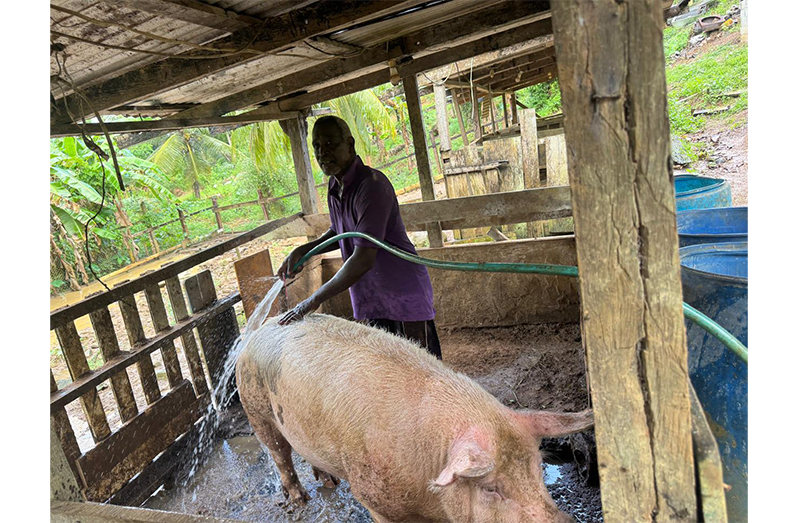
Peters’ love for livestock began in Lovely Lass Village, West Coast Berbice, where he reared pigs alongside his grandmother.
When he moved to Region One in 1975, he carried that early knowledge with him, but it was not until 2020—motivated by the PPP/C Government’s revitalised agricultural policies under President Dr Irfaan Ali—that he decided to restart his swine production formally.
Inspired by the renewed national focus on food security and livestock development, he took a leap of faith and began rebuilding his herd.
To restart his operation, Peters first purchased two pigs from local farmers and received one pig from the Guyana Livestock Development Authority (GLDA).
As GLDA continued to monitor and support the progress of his production system, the agency later provided two additional pigs to strengthen his genetic base.
This initial investment laid the foundation for a small but growing farm with solid breeding potential.
As his herd expanded, Peters began sharing offspring with fellow swine farmers in his community, helping them improve their own genetic lines.
This informal but impactful genetic improvement initiative was successful and strengthened the swine network in the region.
Today, most of Peters’ pigs are Large Whites, a breed he enjoys rearing for their adaptability, strong growth, and suitability for the local climate.
Still, he is eager to embrace the TN70, the preferred maternal line used for commercial pork production.
The TN70 is valued for its large, uniform litters, calm temperament, excellent mothering ability, and impressive feed efficiency—traits that make it ideal for farmers seeking high productivity with reduced costs.
Peters believes adopting the TN70 would elevate his herd’s performance and help Region One achieve stronger food production outcomes.
Despite his progress, swine farming in a remote region poses its own challenges. Peters currently struggles to access a mature boar for breeding and has had to borrow a young, undersized one from a neighbouring farmer.
During a recent GLDA field visit, he attempted to purchase one but was disappointed that only newly- weaned pigs were available.
He is now urgently appealing for support from GLDA to secure a suitable boar to keep his production on track.
Even with these challenges, Peters keeps his farm operating at a high standard. His pens are clean, well-ventilated, and equipped with an automatic water system fed by a black tank.
He hopes to upgrade to automatic feeders soon. He insists on humane treatment of his animals, saying, “I treat my animals like friends.”
His commitment extends to food safety as well: he slaughters his pigs himself and strictly adheres to all withdrawal periods, record keeping, and sanitary protocols.
Before each slaughter, he contacts Mr Alfred, GLDA’s dedicated Regional Co-ordinator and extension officer in Region One, for inspection and approval.
Peters praises Alfred’s expertise and support but believes the region urgently needs more technical staff, given the growing number of swine farmers.
Region One’s swine industry is expanding steadily, as households increasingly depend on pig rearing for income and food security.
The pork market is consistently strong, but farmers still grapple with high feed costs and steep transportation costs.
Peters currently purchases feed on the East Coast Demerara for $2,000 per bag, then bears additional shipping costs by boat to Mabaruma.
He hopes farmers will eventually receive priority ferry access for livestock feed, easing the financial burden on those who help supply the region with meat.
For Peters, the Artificial Insemination (AI) programme run by GLDA represents one of the most important opportunities for the future of swine production.
AI enables farmers to access elite genetics without the cost of maintaining multiple boars, while reducing disease risks and improving productivity.
Although this programme is available in several regions, Region One has not yet benefitted from it. Peters is hopeful that farmers will soon receive training and access to AI services, which he believes will enhance the region’s genetic stock and significantly reduce operational costs.
Despite the hurdles, Peters remains proud and optimistic.
He is encouraged by the national investment in agriculture, grateful for the support he has received from GLDA, and determined to continue contributing to his region’s food supply.
In the quiet moments on his farm—while the piglets play at his feet and the sow rests in the shade—he reflects on how a small, committed operation can make a meaningful difference to an entire community.
His story is one of resilience, growth, and hope for a stronger, more modern swine industry in Region One.