.jpg)



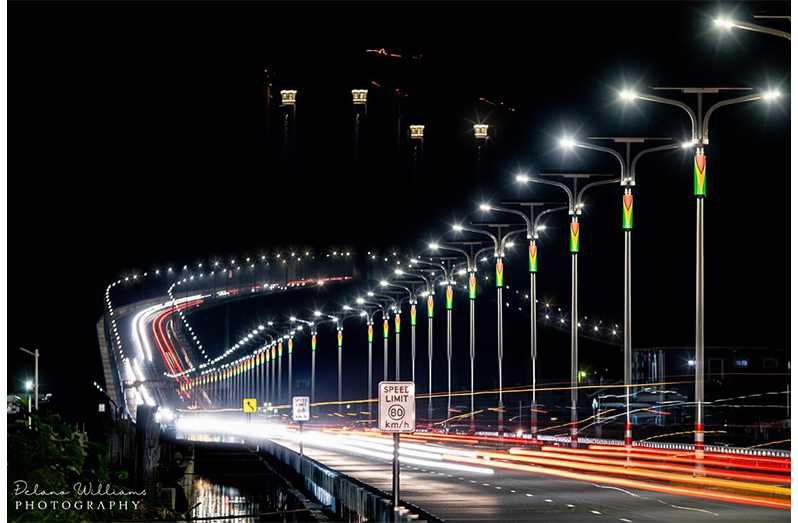
-says Bharrat Jagdeo Demerara River Bridge reducing travel time, improving logistics, setting stage for long-term national and regional commerce
WITH the average daily traffic volume now exceeding 50,000 vehicles traversing the recently commissioned Dr Bharrat Jagdeo Demerara River Bridge, regional trade and commerce are quickly expanding as commuters now have access to a safe and less congested thoroughfare.
This is according to Minister within the Ministry of Public Works, Madanlall Ramraj, who during a broadcasted video presentation said the multi-million-dollar investment in the country’s infrastructure is delivering measurable reduction in travel time, improved logistics flow and long-term resilience for national and regional commerce.

“This four-lane bridge replaced the aging Demerara Harbour Bridge and has transformed how people move between Regions Three and Four, have [sic] eased safety [and] has improved commerce flows without interruption. Since commissioning, average daily traffic volumes have exceeded 50,000 vehicles per day, reflecting both latent demand and improved network efficiency,” he said.
It was also reported that the new bridge, which offers toll-free travel has seen commuters saving as much as over $80,000 in toll charges that was previously paid to cross the old Demerara Harbour Bridge.
“This is money now going back into his household, towards groceries, school expenses and daily living. That is what infrastructure does when its people cantered.”
Guyana, he added, is undergoing a profound economic and social transformation driven by people-centred infrastructural investments.
“As Minister within the Ministry of Public Works, I have the responsibility and the privilege of translating this vision into action, ensuring that our success is measured not merely in projects completed, but in better lives, stronger communities and a more connected Guyana.
Further, the minister said that President, Dr Irfaan Ali’s five-year agenda offers “a clear road map” that places people, opportunity and national development at the centre of progress.
“Infrastructure in this vision is not abstract. It is tangible. It is progress you can see, touch, drive on and rely on every single day,” he stated.
In addition to the Bharrat Jagdeo River Bridge, other major projects include the 33.5 km East Bank Demerara road, now a modern corridor with sidewalks, cycle lanes, LED lighting and enhanced safety features.
“This is infrastructure that respect all users, pedestrians, cyclists, motorists and businesses, while supporting commercial growth along the corridor.”
In Region Six, the upgraded Corentyne Highway and 16 km of bypass roads, which have reduced spoilage of agricultural produce and strengthened cross-border trade with Suriname.
The transformation, he said, continues inland with the 72.43 km Soesdyke-Linden Highway, rebuilt as a resilient transport corridor with proper drainage, lighting and pedestrian bridges.
Farther north, the 121.2 km Linden–Mabura Hill Road, under full reconstruction, restoring reliable access for remote communities and supporting mining, forestry, tourism, education and healthcare.
2026 ROAD PRIORITIES
Looking ahead to 2026, the government is prioritising a series of projects to ease congestion and improve safety, including a major upgrade of the Essequibo Coast Public Road from Supenaam to Charity.
“This corridor is essential for linking agricultural zones, fishing communities and commercial centres with regional and national markets and upgrade to a four-lane dual carriageway is therefore critical to support increased traffic volumes, improve travel efficiencies and strengthen economic integration within the region.”
The road will be converted from a two-lane route to a four-lane dual carriageway, with sidewalks, bicycle lanes, bus bays, designated parking, clear separation of pedestrians and vehicles.
There will also be improved traffic management to cut congestion and accidents, particularly near schools and markets. These changes are expected to strengthen market access for farmers and riverine communities, lowering transport costs and improving competitiveness.
Minister Ramraj noted too that upgraded coastal roads will be linked to enhanced river transport, including the new government vessel MV Konawaruk 1899, creating a seamless road-to-river network that integrates inland and riverine communities into the national economy.
Alongside the Mandela Avenue bypass upgrade in Georgetown, these corridors form what the minister described as a “continuous national spine” from Moleson Creek in Region Six to Lethem in Region Nine and Pomeroon in Region Two, opening up trade with Brazil and Suriname.
The minister stressed that the administration is “not building for headlines,” but “building for generations,” vowing continued engagement with citizens as the five-year economic agenda is rolled out.