.jpg)





– aims to provide micro-loans to businesses at zero interest, PM Phillips says
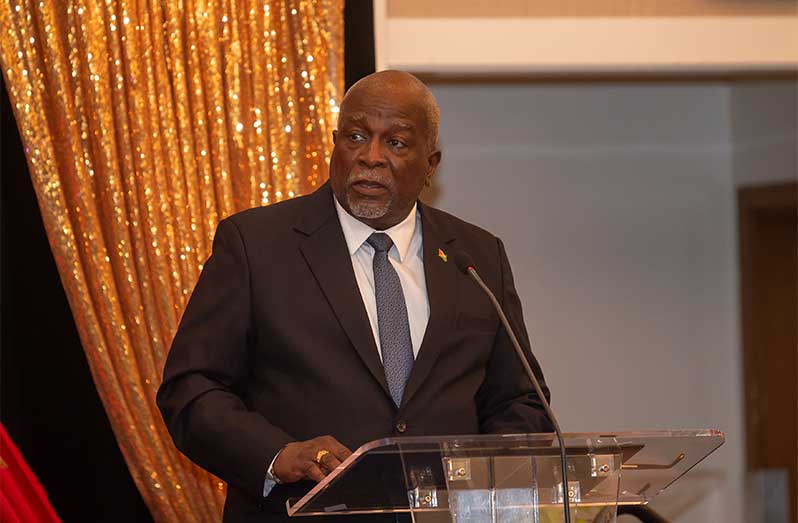
MAKING remarks at the Guyana National Bureau of Standards (GNBS) awards ceremony last week, Prime Minister Brigadier (retired) Mark Phillips has said that the responsibility for national competitiveness cannot rest only on companies, noting that government has a responsibility to develop the environment in which companies must operate.
He stated that a business can meet each internal standard but still struggle if the external environment does not support expansion.
According to the PM, it is for this reason that there must be a parallel development of government’s policy and business systems.
He highlighted that since taking office in 2020, the government has prioritised measures to support private sector with confidence.
Quoting the World Bank’s Global Economic Prospects Report, the Prime Minister said it indicates that investors respond positively when governments reduce uncertainty and maintain a clear economic direction. That principle, he said, guided government’s early decisions.
Both foreign direct investment and domestic investments have risen in Guyana.
The PM mentioned that these trends reflect a record of confidence in the business landscape in Guyana, adding that a significant focus has been placed on small and medium-sized enterprises in Guyana.
Noting that access to finance remains a significant constraint, he said the International Finance Corporation notes that almost half of these Micro, Small and Medium Enterprises (MSMEs) in emerging economies cannot access adequte credit.
He announced Guyana’s plan to establish the MSME Development Bank which is designed to address this gap. “This 200 million United States dollars initiative is set to become operational in 2026 and will provide micro-loans at zero interest.”
This bank will also guide entrepreneurs in preparing business plans, organising financial information and understanding compliance requirements. These measures, according to the PM, are designed to give small businesses a realistic chance to grow.
Training is another key area. Guyana’s investment in training programmes through various government and private sector partners, focus on basic financial literacy, planning, procurement requirements, and management skills. A business with well-trained staff is more likely to adopt and maintain quality systems, the Prime Minister said.
The PM related that our government has expanded technical education, and additional skills training which will prepare and guide workers for higher-value jobs and support businesses that operate in new sectors.
“But these aspects are incomplete without infrastructure development. Quality management requires reliable electricity, stable connectivity, and predictable transportation systems. Our government, therefore, continues to invest in energy projects, roads, bridges, and digital infrastructure, because a stable environment allows businesses to reduce risks and plan operations for greater success,” PM Phillips affirmed.
These measures are all part of government’s broad objective of building a diversified economy.
The PM underscored that over the next two years, government will continue to support investment in agriculture, manufacturing, services, hospitality, and other non-oil sectors.
The PM remarked, “A diversified economy is more stable and provides more opportunities for local businesses. As Guyana develops, opportunities for suppliers, contractors and exporters will increase. However, these opportunities will be accessible only to companies that can meet quality and safety requirements.”