.jpg)






PRINCIPAL Magistrate Judy Latchman on Wednesday delivered an extensive ruling in the ongoing extradition proceedings involving embattled businessmen Nazar and Azruddin Mohamed.
She denied their application to refer several constitutional questions to the High Court and affirmed that the substantive matter will continue before her, in accordance with Guyana’s extradition laws and binding judicial precedent, on January 6 and 7, 2026.

At the centre of the dispute was whether several constitutional issues arising from the Fugitive Offenders (Amendment) Act, particularly the 2009 amendments, had to be determined by the High Court before the extradition matter could proceed before the magistrate.
ARGUMENTS
Senior Counsel Roysdale Forde, supported by Senior Counsel Rajiv Persad and attorneys Siand Dhurjon and Damien Da Silva, had mounted a broad constitutional challenge.
The defence argued that sections 8(3)(a) and 8(3)(b) of the amended Act raised serious concerns about the legality of the extradition framework and were in conflict with the Constitution of Guyana, breaching their clients’ fundamental rights, including the right to liberty, life, and access to a fair legal process.
One of the principal issues highlighted was the scope of authority granted to the Minister of Home Affairs, whom the defence said now held powers to arrest, detain, and extradite citizens in ways that might infringe upon the separation of powers and judicial independence.
Another major concern involved Parliament’s decision in 2009 to effectively direct the courts to interpret the extradition treaty between Guyana and the United States “as if” it contained a re-extradition safeguard, even though that safeguard did not appear in the treaty itself.

The defence argued that this direction was constitutionally problematic and referenced the Barry Dataram case, in which the Full Court identified similar deficiencies in the treaty framework.
Additionally, the defence objected to a clause in the 2009 amendment that restricted individuals facing extradition from challenging irregularities in the treaty or extradition arrangements, arguing that this infringed on constitutional rights related to liberty, due process, and fair legal procedures.
According to the defence, preventing them from challenging the extradition proceedings was fundamentally unfair, as their clients could ultimately be freed once the process concluded. Their concerns were compounded when the prosecution submitted a United States (U.S.) diplomatic note containing assurances on re-extradition. The defence maintained that such a note “had no legal validity” under the current legislative scheme.
The prosecution, led by Jamaican King’s Counsel Terrence Williams and supported by attorneys Glenn Hanoman, Herbert McKenzie, and Celine Deidrick, strongly rejected the defence’s constitutional challenge. They contended that the application was “frivolous and vexatious” and should be dismissed, arguing that the issues raised by the defence did not arise for the magistrate’s consideration at this stage of the extradition proceedings.
Williams emphasised that extradition hearings have specific legal parameters, and many of the constitutional rights cited by the defence—such as liberty, due process, and fair hearing—either do not apply within the context of extradition or are explicitly excluded by law.
He stressed that the magistrate’s role is statutorily defined and does not extend to considering issues outside the legal scope of the extradition process.
The prosecution also relied heavily on judicial precedent, particularly Justice Jo-Ann Barlow’s ruling in the Marvin Williams (Troy Thomas) case, which interpreted the 2009 amendments to the Fugitive Offenders (Amendment) Act. Williams argued that this decision, together with earlier rulings in King v Director of Prisons, confirmed that the amended provisions were legally sound and that the magistrate was obliged to act in accordance with them.
On the issue of specialty—the rule that prevents an extradited individual from being sent to a third country—the prosecution noted that the defence had raised the matter publicly but not formally in court. To address it, the prosecution submitted a U.S. diplomatic note providing assurances that the Mohameds would not be re-extradited to a third state. Williams maintained that such issues, if contested, must be raised after the conclusion of the extradition proceedings, and entertaining them at this stage would serve only to delay the process.
COURT’S RULING
In opening remarks, the magistrate reflected on international law principles guiding treaty compliance, emphasising that states cannot invoke domestic law to escape obligations.
Citing Article 27 of the Vienna Convention on the Law of Treaties, she emphasised that a state cannot rely on its domestic laws to avoid fulfilling its treaty obligations.
She explained that each contracting state must align its internal laws with its treaty commitments, stressing that treaty obligations take precedence over local legislation.
Turning to the case before her, Magistrate Latchman stated, “In the present matter before the court, the United States of America, which is the requesting state, is seeking the extradition of Nazar and Azruddin Mohamed from Guyana. Guyana is the requested state.” She said the U.S. seeks their extradition to have them tried for a plethora of criminal offences.
She recounted the procedural history, noting that the court acted on an authority to proceed issued by the Minister of Home Affairs on October 30, 2025. “Nazar and Azruddin Mohamed were arrested the next day in compliance with the warrants of arrest, which were issued by this court.”
According to her, the defence asked the court to invoke Article 153 (3) of the Constitution, which empowers a magistrate to refer constitutional issues to the High Court. Latchman summarised the five issues raised, including whether the minister can order extradition under the 2009 amendment to the Fugitive Offenders (Amendment) Act, and whether the magistrate is required to apply sections 8(3)(a) and 8(3)(b) of that amendment even if key treaty provisions are absent.

She outlined section 8(3)(b) of the Act, which the defence argued provides a “shield” against extradition. According to the section, a citizen cannot be extradited unless the foreign state has arrangements ensuring that the person will not be sent to another country for offences committed before the extradition without the minister’s consent. Counsel for the Mohameds submitted that this protection applies to their case. The defence also argued that several fundamental rights were under threat, including “personal liberty,” “the right to life,” “protection of the law,” “private and family life,” “freedom of expression,” and “fair hearing,” among others. In response, the United States submitted diplomatic note “number 458,” which it said contained assurances that the Mohameds would not face additional charges or onward extradition without consent from Guyana. However, Magistrate Latchman found that diplomatic note is not binding or concrete as a treaty is. She reasoned that “a diplomatic note is not set in stone, but a treaty arrangement is binding upon the party state and must be performed by them in good faith.”
The requesting state (the U.S.) further argued that Article 153 (3) had not been properly triggered because the issues “do not arise in the proceedings,” were already “settled by binding decisions,” or could be raised at the end of the committal proceedings. They contended that the application was “frivolous and vexatious.” In her ruling, the magistrate relied heavily on precedent.
She cited Sobers v Director of Prisons, King v Director of Prisons and another, and the Marvin Williams (Troy Thomas) v the Attorney General extradition decisions, which she said had already settled the issues raised by the defence.
Regarding the specialty rule and re-extradition to a third state, she held that those matters rest with the Executive, not the courts. Quoting Justice of Appeal Bishop, she noted that a prisoner “has no locus standi to plead before us his fear of breach of the specialty rule.”
“Clearly then, extradition is treated as a state-to-state obligation, and the individual [the Mohameds] plays no part in the contractual agreement,” the magistrate stated.
She rejected reliance on the Barry Dataram decision, noting, “This court will not rely on the Dataram authority since that matter was dealt with prior to the Fugitive Offenders (Amendment) Act of 2009.” Principal Magistrate Latchman concluded that the defence’s issues had already been adjudicated by Guyana’s superior courts and that “this court sees no basis to activate the referral article.” She declared, “This court is not about to resurrect what has been put to rest. Having judiciously examined all the issues levelled by the defence and the request for a referral to be triggered, this court sees no basis to activate the referral article [Article 153(3)], since it is guided by the principles of stare decisis. This court, therefore, denies the application to engage the referral article of the Constitution of the Co-operative Republic of Guyana.”
She noted that, under the Fugitive Offenders (Amendment) Act, her role is akin to that of a magistrate conducting a preliminary inquiry, and she will continue to perform her duties in that capacity. Reaffirming the court’s limited role, she added, “The court is mindful that magistrates derive their authority from statute… and will continue to exercise its functions accordingly.”
Consequently, the magistrate is scheduled to begin hearing evidence in the extradition committal proceedings on January 6 and 7, 2026, at the Georgetown Magistrates’ Courts.
Before Wednesday’s hearing concluded, Dhurjon, representing the Mohameds, challenged the authority to proceed under which the magistrate was acting, arguing that it was legally null for lack of jurisdiction and did not confer upon her the power to properly hear the case.
REACTIONS
Reacting to the ruling, King’s Counsel Williams welcomed the decision and said the prosecution was eager to proceed with the case.
“We’re happy to move along with the case. They [the defence] have had their chance to raise their objections. They raised them. The court has ruled,” he told reporters.
While the law does not permit an appeal against the magistrate’s decision, Senior Counsel Forde indicated that constitutional proceedings would soon be filed directly in the High Court.
Forde stated that they believed the court had improperly exercised its discretion by deciding that the application should not be referred to the High Court for proper determination.
He added that the Mohameds intend to pursue the matter all the way to the Court of Appeal and the Caribbean Court of Justice (CCJ), Guyana’s highest court of appeal.
Speaking with reporters, Forde said, “We intend to go to the High Court. It is our right, it is the clients’ right to go to the High Court, and we will be going there as part of this process.”
BACKGROUND
The Mohameds—owners of Mohamed’s Enterprise—remain on $150,000 bail each, have surrendered their passports, and must report weekly to the Ruimveldt Police Station as the extradition proceedings continue. They were taken into custody on October 31 following a U.S. request for their extradition.
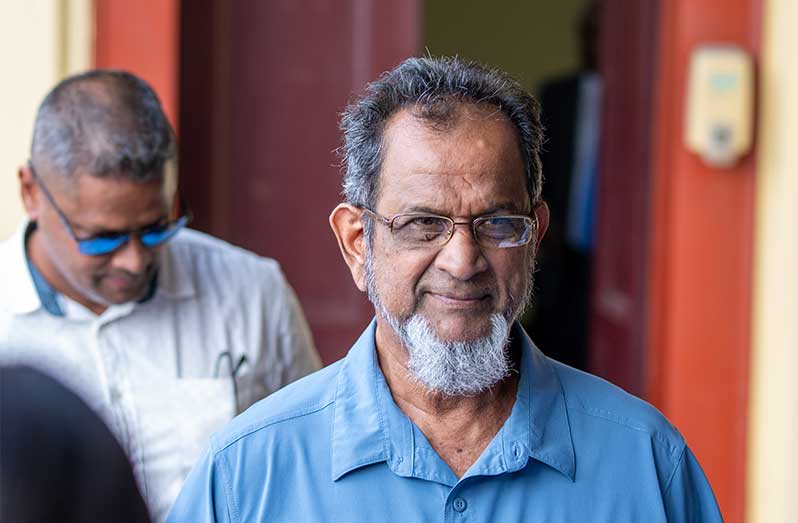
U.S. prosecutors have accused the father and son of running an international criminal network with alleged links to high offices in Venezuela and the Middle East.
The pair face 11 criminal counts in the U.S. Southern District of Florida involving alleged wire fraud, mail fraud, money laundering, conspiracy, and customs violations tied to what authorities describe as a US$50 million gold export and tax evasion scheme.
The U.S. Treasury’s Office of Foreign Assets Control (OFAC) sanctioned both men in June 2024 for alleged gold smuggling and public corruption.
The U.S. investigation dates back to the mid-2010s and involved multiple agencies, including the Federal Bureau of Investigation (FBI), Drug Enforcement Administration (DEA), and Department of Homeland Security.