—Authorities could sell seized vehicles, vessels, machinery, virtual assets and other property as heirlooms, items of sentimental value protected from forced sale
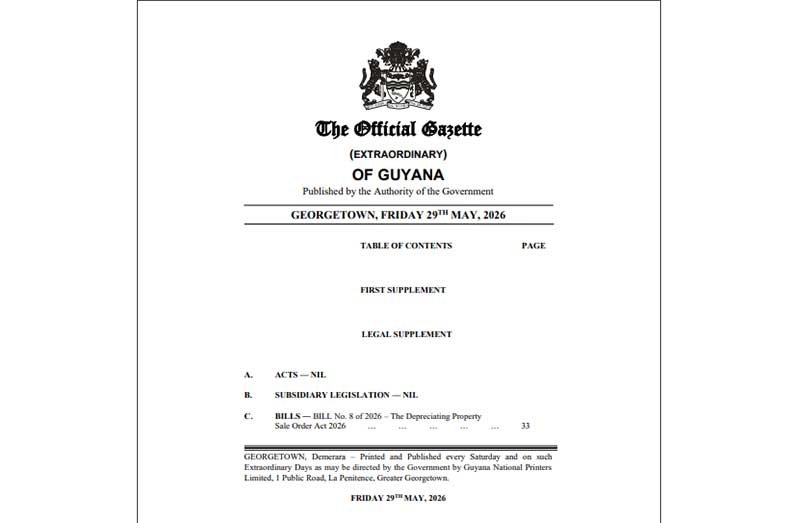
A NEW bill introduced in the National Assembly last Friday seeks to establish a legal framework for the sale of seized property that is rapidly losing value while recovery and forfeiture proceedings remain ongoing.
The Depreciating Property Sale Order Bill 2026 proposes a mechanism through which competent authorities can apply to the High Court for permission to sell certain categories of property that have depreciated significantly, are subject to unpredictable changes in value, or have become costly to maintain.
According to the bill, it is intended to provide for “the sale of depreciating property and for connected matters.”
Under the proposed legislation, a number of agencies would be empowered to initiate applications for sale orders. These include the Attorney General’s Chambers, the Director of Public Prosecutions (DPP), the Special Organised Crime Unit (SOCU), the Financial Intelligence Unit (FIU), the Commissioner of Police, the Guyana Revenue Authority (GRA) and “any other authority empowered by law to seize or restrain property”.
The bill defines depreciating property as qualifying property “that is declining in value since the date of seizure or after a restraint order was granted against the property” or property “that is subject to unpredictable changes in price, valuation or deterioration”.
A broad range of assets would fall within the scope of the legislation. These include jewellery and precious metals, vehicles, vessels, aircraft, virtual assets and virtual currencies, furniture, manufacturing machinery, digital devices, commercial property, securities such as stocks and shares, and other property that has lost value or become expensive to manage.
Notably, the bill specifically addresses virtual assets, defining them as “any digital representation of value that can be digitally traded, transferred, or used for payment or investment purposes”, including cryptocurrencies, stable-coins and non-fungible tokens (NFTs).
The proposed law would permit an application for a sale order where the property is in the possession of a competent authority and “the average value of the qualifying property has depreciated, or the cost of retaining and managing the qualifying property is disproportionate to the property’s value”.
The legislation also allows applications where the legitimate owner provides written consent for the sale of the property.
However, several safeguards have been included before a court can authorise a sale.
The bill states that the Court shall not grant a sale order unless notice is given to the person from whom the property was seized, as well as any person or entity with an interest in the property. Additionally, a notice of seizure must be published in a newspaper with wide circulation in Guyana for at least two consecutive weeks.
The legislation further requires that the property be valued by a nominated expert before any sale order is granted.
Importantly, the bill provides that the Court may only issue a sale order if it is satisfied that certain conditions have been met. These include situations where a criminal investigation has commenced and there are reasonable grounds to believe an alleged offender benefitted from criminal conduct, where proceedings for an offence have already been instituted, or where the property is believed to be an instrumentality of an offence or tainted property.
At the same time, the proposed legislation contains protections for property owners.
The court would be prohibited from granting a sale order if the person from whom the property was seized can establish that the property is “unique”, “of great sentimental value”, or “an heirloom”.
The bill also gives the court discretion to refuse a sale order where it determines that such an order would be disproportionate or unjust to an interested person.
In those circumstances, the court could instead return the property subject to preservation conditions, appoint a receiver to manage it, release the property upon payment of its equivalent value, or make another order considered appropriate, including allowing for the social reuse of the property.
Where a sale order is granted, the court would require the competent authority to arrange for the sale “immediately but no later than three months after the issuance of the sale order”.
Several sale methods are contemplated under the legislation, including online sales, private treaty arrangements, public auctions, public tenders and sealed-bid sales.
The bill defines an online sale as one in which members of the public may browse, bid and pay for property online. Public auctions, meanwhile, would require at least seven days’ notice and public access to the sale process.
Another key feature of the legislation concerns the handling of proceeds generated from sales.
The bill provides that proceeds from the sale, after the deduction of approved reasonable costs, are to be deposited into an interest-bearing account and held on trust for the person in respect of whom the seizure or restraint order was made, or that person’s representatives.
The legislation also protects the interests of innocent co-owners by requiring that any excepted joint owner’s share be paid to that individual or their designee.
To promote accountability, the bill establishes limits on costs associated with the sale process. It provides that the total value of reasonable costs “shall not exceed ten per cent of the gross sale price of the qualifying property” and stipulates that any remaining costs must be borne by the State. The proposed law forms part of a wider framework dealing with restrained, seized and recoverable property, including assets linked to criminal conduct, money laundering, terrorist financing and other serious offences.
If passed, the legislation would create a dedicated legal process allowing authorities to preserve the value of assets that might otherwise deteriorate or become expensive to maintain while related court proceedings continue.
The bill has now been laid before the National Assembly and is expected to undergo further parliamentary consideration before any final decision is made on its enactment.
Attorney General and Minister of Legal Affairs, Anil Nandlall, SC, explained that the proposed legislation seeks to preserve the value of vehicles, boats, gold and other assets seized during criminal investigations while related court matters remain before the judiciary.
He explained that such property is often stored for years in unsuitable conditions, resulting in significant deterioration, leaving the State with little value when assets are forfeited and exposing it to costly lawsuits when property must be returned to acquitted persons.
The proposed legislation, he noted, was developed through the Regional Security System (RSS) and the Caribbean Financial Action Task Force (CFATF), is designed to protect property owners while addressing a longstanding problem affecting law enforcement agencies and the justice system.