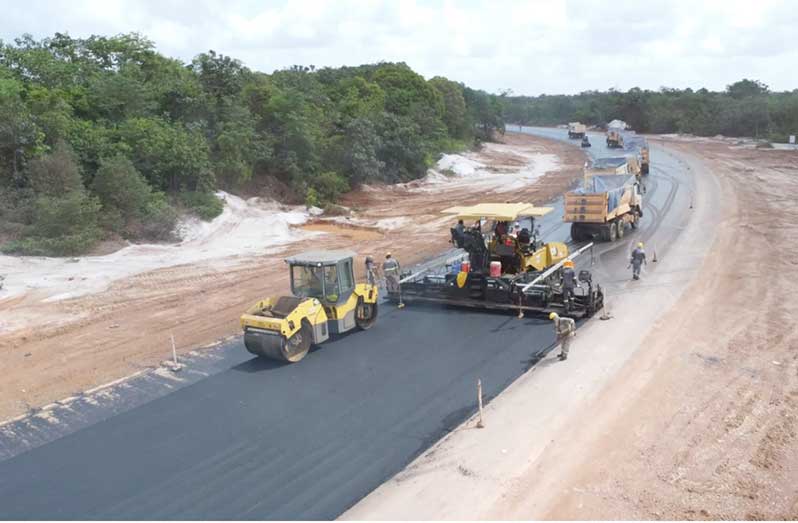
–President Ali says, highlights investments to bring hinterland communities into economic mainstream
THE government has reaffirmed its commitment to inclusive national development, emphasising that infrastructure investment is being pursued as a necessity rather than a convenience.
Addressing the importance of connectivity, President Dr. Irfaan Ali recently highlighted that access to modern infrastructure is essential for commerce, social development, and economic participation across the country.
“We do not invest in infrastructure because it is easy. We invest because this is necessary. We invest because every community, no matter how remote, deserves access to the lifeblood of connectivity and commerce,” he said on the sidelines of commissioning a nearly $800 million airstrip at Paramakatoi, Region Eight earlier this week.
Special attention was placed on remote and hinterland communities, including Paramakatoi, which the government views as integral to Guyana’s broader development agenda.
The President underscored that geographical distance should not be regarded as a limitation but as an opportunity to expand inclusion and unlock economic potential in areas rich in culture and natural resources.
“We do not see distance as a disadvantage. We see it as an opportunity for greater inclusion and enhanced opportunity, but I also want you to ask yourselves a much broader question. I want you to ask yourselves, what kind of Guyana do we want to build? Do we want the Guyana where only the easy-to-reach places prosper? Or do we want a Guyana where remote communities rich in culture and natural beauty also share in the benefits of development and connectivity? A Guyana where no child’s future is constrained by the fact that they were born in a distant corner of the land,” he added.
The People’s Progressive Party Civic (PPP/C) administration, he reiterated, maintains that national development must extend beyond easily accessible regions.
The vision is a Guyana in which prosperity is shared equitably and where remote communities benefit from the same development opportunities as coastal and urban areas.
He reiterated that improved connectivity can transform access to education, healthcare, and economic opportunities.
Public Works Minister, Juan Edghill recently outlined major plans to improve connectivity between Regions Eight and Nine, noting that the initiative will significantly reduce the impact of limited access to services in hinterland communities.
Minister Edghill said the government’s focus is not only on improving infrastructure in the coastland but also on ensuring equitable access to essential services across the country.
He explained that a major component of the plan involves improved physical links between Regions Eight and Nine, including new air and road infrastructure.
“So, there’s a major plan for the connecting of Region Eight to Region Nine. The Karasabai airstrip will be constructed. We have just moved in that direction. So just like Aishalton, we’re moving to Karasabai, upgrading that airstrip, and then we have to build all 29 bridges between Karasabai to Monkey Mountain, and then getting that road pushed all the way down to Paramakatoi, connecting all of the villages,” the minister stated.
He highlighted how poor connectivity directly affects the cost of living in hinterland areas, particularly due to transportation costs.
Minister Edghill noted that Region Eight, in particular, stands to benefit from expanded road infrastructure capable of accommodating larger vehicles, which would allow goods to be transported more efficiently.
“So, Region Eight will experience greater development. Historically and traditionally, from the Ministry of Public Works, we have engaged the communities of Region Eight. The community contracts to maintain their roads and to improve their roads, but those roads are mainly for ATVs and small vehicles, maybe pick-ups, but now we want to be able to expand that road, to take the trucks, so that in the economy of scales, we be able to bring the price down,” he explained.
According to the minister, improved roads will lower transportation costs, reduce vehicle wear and tear, and shorten travel times, with direct benefits for residents.