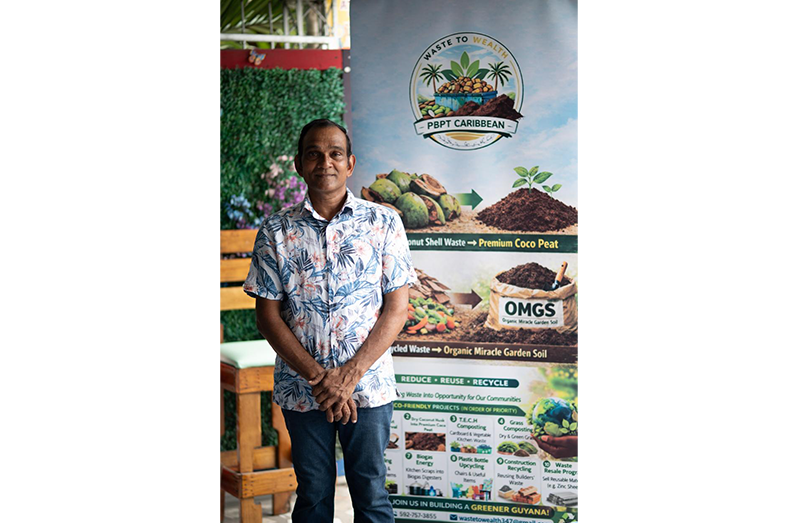
—Entrepreneur leads push to cut landfill waste, promote cleaner household habits
ON a humid morning in Guyana, as the familiar scent of burning rubbish and overflowing drains hangs faintly in the air, Rampertab Etwaria is quietly staging a revolution.
Etwaria, the founder and Managing Director of Waste to Wealth PBPT Caribbean (W2W), has spent more than 15 years composting. He knows better than most that, for the average family, composting is often seen as a messy, smelly, and inconvenient task.
Yet, in a modest workshop filled with plastic drums and eager participants, he is proving that it does not have to be that way, and that food scraps and other waste might just help reshape Guyana’s environmental future.
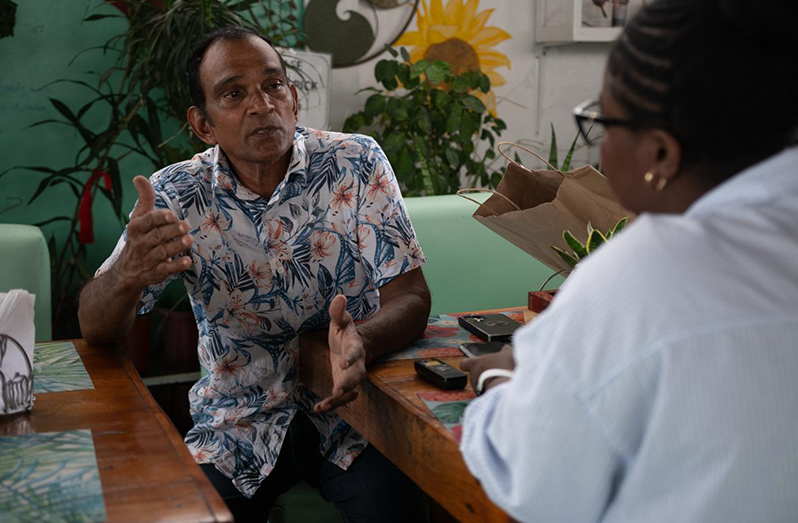
“I realise all of us can assist in reducing the amount of garbage that goes to the landfill. Yearly, the landfill is building up, so I came up with the idea that, you know what, I alone cannot do this, or a couple of us cannot do it. The whole country can do it; we as a people can do the composting at home,” he said, adding, “This will come into the whole idea of us taking care of our country and the environment in which we live.”
Etwaria held a family composting workshop last weekend.
A SIMPLE DRUM, A BIG IDEA
At the heart of Etwaria’s workshop is a deceptively simple concept: A “half-drum” home composting system designed to make composting cleaner, easier, and more practical for ordinary households.
Traditional composting, he explains, can quickly become “kind of messy to do”. His design uses two half-drums, both drilled with holes, mounted over a drain pan to collect liquid residue. One drum is kept in active use while the other is left to rest and mature.
“You have one filled and one empty,” he explained. “When it’s filled, you transfer it to the other drum.”
The system reduces odour, controls leakage, and keeps the process contained, thus removing three of the most common excuses families make for not composting at home.
The workshop, which focuses on this method, aims to simplify composting, turning it from a chore into a manageable household practice.
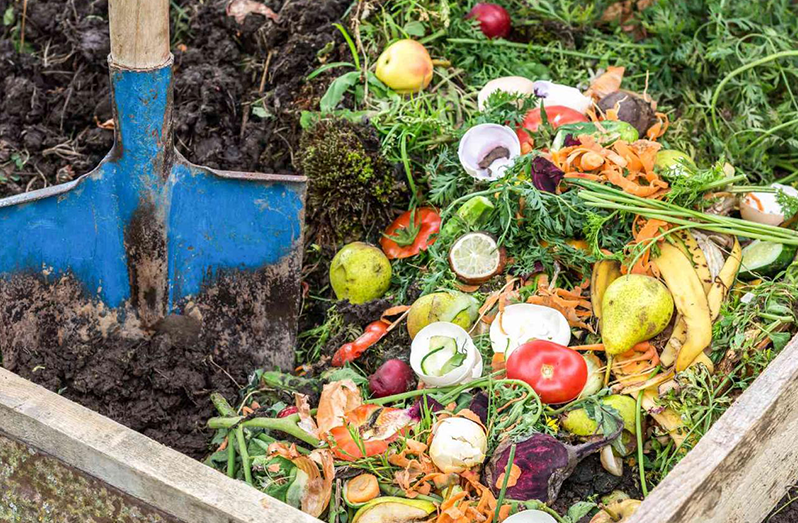
TACKLING A NATIONAL PROBLEM FROM THE BACKYARD UP
For Etwaria, composting is not just about garden soil; it is about climate resilience, public health, and national responsibility.
He was blunt about Guyana’s waste habits. While private companies are increasingly being used to collect rubbish, poor disposal practices persist.
It is still common to see bottles, cans, and food packaging hurled from vehicle windows, and drains choked with plastic and other debris. The consequences are visible with every season of prolonged rainfall: Flooded streets, blocked waterways, and mounting frustration.
The waste that clogs drains and canals is often the same material that could have been recycled, composted, or repurposed.
“If, as a family unit, we can separate the garbage and redirect it, then that will be avoided. And also, we have individual responsibility not to throw garbage but to put it in the bin.”
Beyond household composting, Waste to Wealth PBPT Caribbean has its sights set on one of Guyana’s most visible waste streams: Coconut shells.
Anyone who has walked past a coconut vendor in Georgetown knows the scene: Mounds of husks and shells piled on street corners or heaped into ‘skips’ destined for landfill or open dumping. Etwaria sees something else: Raw material for a new circular economy.
Starting next month, his organisation plans to roll out a coconut-shell waste project aimed at vendors.
“This waste; this coconut waste will be a redirected resource that could go back to the farmers,” Etwaria said.
If successful, he believes the model could be replicated for other waste streams, creating small business opportunities while reducing pressure on landfills.
The organisation has set a clear target to help reduce Guyana’s landfill usage by 25 per cent by 2030, through several projects targeting households, vendors, and smaller communities across Georgetown.
“We want Guyana to be greener and cleaner,” Etwaria stressed.