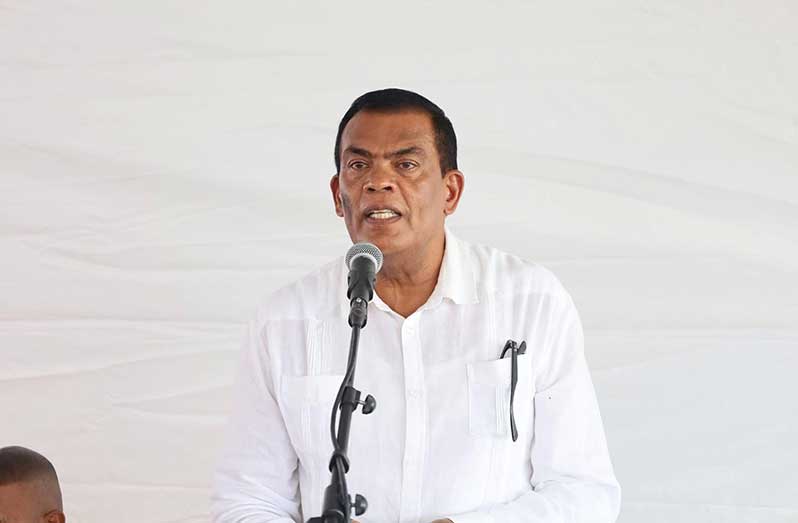
MINISTER within the Ministry of Public Works Madanlall Ramraj has reaffirmed that the Government of Guyana has consistently stepped in to protect rice farmers through targeted and impactful measures aimed at safeguarding their livelihoods and ensuring the sustainability of the rice industry.
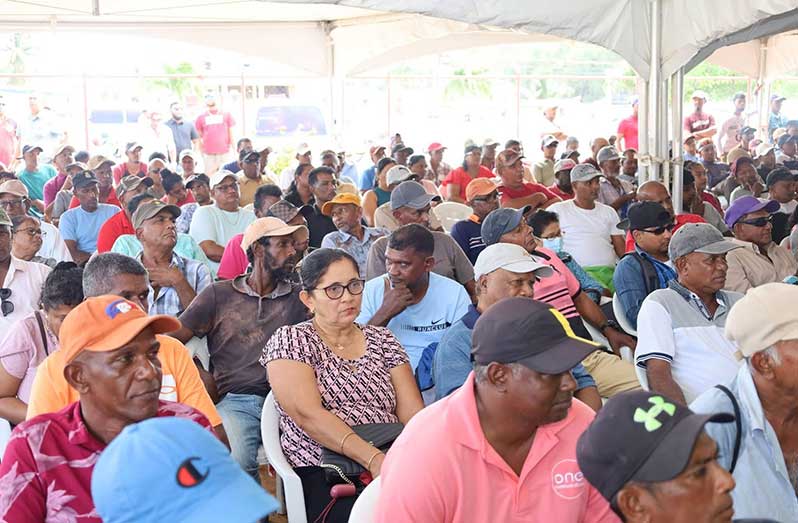
The Minister made the disclosure during a meeting at the Anna Regina Town Council compound, where rice farmers gathered for the distribution of the $300 per bag paddy subsidy.
The atmosphere at the engagement was one of relief and reassurance, as farmers welcomed the intervention. Addressing the gathering, Minister Ramraj underscored the government’s firm commitment to standing with farmers, particularly in times of market instability and rising production costs.
Since 2020, he noted, the government has rolled out a series of strategic interventions designed to shield rice farmers from escalating input costs, volatile prices, and logistical challenges.
These measures, supported by billions of dollars in public investment, have been critical in maintaining productivity and protecting farmers’ incomes.
One of the most significant forms of assistance came through fertiliser support. As global prices surged, the government distributed urea fertiliser valued at $3.1 billion, from a total allocation of $3.8 billion, easing the financial burden on farmers and allowing uninterrupted cultivation.
In addition, 19,164 bags of seed paddy, valued at $96.2 million, were provided to support planting, while chemical assistance totalling $3.9 million was extended to help farmers combat paddy bug infestations on dams and meres.
To reduce post-harvest losses and improve grain quality, the government also invested heavily in infrastructure, constructing 12 drying floors across rice-producing regions at a cost exceeding $211 million.
Minister Ramraj said the government’s decisive role was most evident during the first crop of 2025, when low market prices posed a serious threat to farmers’ livelihoods. With millers offering as little as $3,700 per bag, the government intervened with a $300 per bag subsidy, ensuring farmers received no less than $4,000 per bag.
This move injected $1.9 billion into the sector and restored market stability.
Additional support was extended specifically to Region Two, where the government purchased 71,075 bags of paddy valued at $244.2 million, preventing crops from being damaged in the fields due to harvesting and marketing challenges.
Transportation constraints were also addressed through the Ministry of Public Works, with the removal of the ferry toll from Supenaam to Parika and the introduction of an additional ferry, significantly reducing the cost and time required to transport paddy out of the region.
Looking ahead, Minister Ramraj said support has continued into the first crop of 2026, with seed paddy from the Rice Research Station in Burma being offered at subsidised rates—$4,000 per bag for C1 and $2,000 per bag for C11—resulting in estimated savings of $12 million for farmers.
In Region Two alone, subsidies provided between 2024 and 2025 amounted to approximately $990 million, covering fertiliser, paddy price intervention, transportation, seed paddy, and chemical assistance. With the current $300 per bag subsidy, farmers across the region are set to benefit from more than $252 million in additional support.
“Through these comprehensive interventions, the Government of Guyana continues to safeguard the rice industry, empower farmers, and reinforce national food security—ensuring that those who feed the nation are protected every step of the way,” Minister Ramraj said.
Rice farmers in Region Two expressed appreciation for the assistance, thanking the government and President Dr. Irfaan Ali for the continued support extended to the sector.