
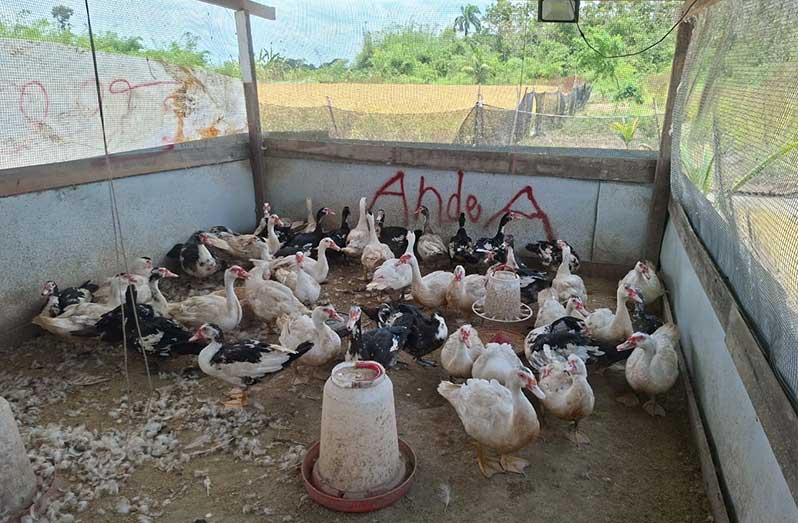
EACH morning in Sandvoort, West Canje, Berbice, Diane Leitch-Hinds releases ducks into her rice field.
As they forage for insects, snails, and weeds, the birds perform tasks that would otherwise require additional farm inputs—a routine she says is lowering production costs and opening a new path for her business.
Although this is her first rice crop under the integrated rice-duck initiative, the encouraging results have already prompted the 47-year-old farmer to consider her next investment.
With ducklings demand growing, she wants to establish an incubation and hatchery operation, turning an innovation on her farm into an opportunity to supply other producers.
That ambition reflects the approach behind her diversified enterprise: combining practical experience with training, embracing new production methods, and identifying opportunities for growth.
For the mother of five, whose activities span rice, poultry, cash crops, beekeeping, agro-processing, and construction, agriculture has become both a livelihood and a platform for building a family business.
Her agricultural roots run deep. A former student of Berbice High School, Leitch-Hinds grew up in a family of cash-crop farmers, learning from the work of her parents and grandparents.
She joined the Guyana Police Force (GPF) at 18 but returned to agriculture after one year, choosing the industry that would eventually help her support her family and educate her children.
At 25, she began cultivating rice on a single acre. Over time, she expanded her operation to 30 acres dedicated to rice production.
Those years in the field gave her experience of evaluating new methods and the confidence to adopt them when an opportunity arose.
That opportunity came when a friend introduced her to the rice-duck initiative. Recognising the potential to combine crop and livestock production, she identified a one-acre plot near her home and received training from the Guyana Rice Development Board (GRDB).
To help translate that training into practice, the GRDB provided mesh for fencing, feed, and feeding and watering equipment ahead of implementation on June 7, 2026.
Leitch-Hinds thanked teams from both the GRDB and the Guyana Livestock Development Authority (GLDA) for their guidance, which helped her establish and manage the project.
DAILY MANAGEMENT ROUTINE
With the plot prepared, the ducks were introduced to the field at 21 days. They are released early each morning to forage and receive minimal supplemental feeding in the evening, creating a daily management routine that aligns the birds’ needs with those of the rice crop.
According to Leitch-Hinds, that integration has lowered her production costs by reducing the need for fertiliser, pesticide and weedicide applications.
While her assessment is based on this first crop, she describes the progress as encouraging and successful.
The results, she reports, reflect the initiative’s principles, introduced by the Ministry of Agriculture, the GRDB, and the Food and Agriculture Organization of the United Nations (FAO). Ducks consume insects, snails, and weeds in flooded rice fields, and their droppings contribute organic nutrients to the soil.
Farmers can therefore produce rice and ducks on the same plot, while potentially reducing input costs.
Supporting those relationships requires appropriate livestock management, an area in which GLDA provides assistance alongside access to suitable breeding stock.
For Leitch-Hinds, this technical support adds scientific guidance to knowledge gained through years of farming, helping her manage the land differently.
The prospect of lower expenditure is particularly valuable amid fluctuating paddy prices. Alongside production decisions such as selecting the GRDB’s 18-rice variety, which she said takes about four months to mature, the integrated system gives her another way to manage costs and strengthen the business.

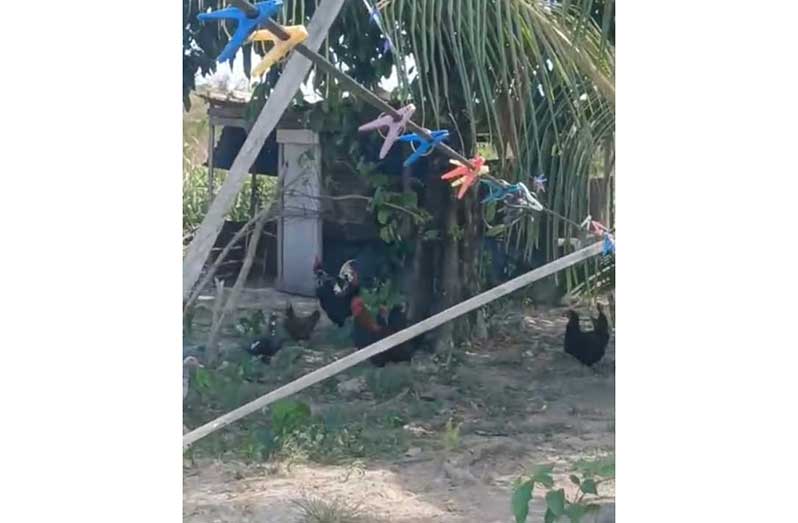
Her existing involvement in poultry also provided a useful foundation for the project. She initially invested in 100 ducks, of which 98 survived, and purchased 100 Black Giant chickens from the GLDA.
Integrating ducks into rice production allowed her to connect two branches of the enterprise rather than manage them entirely separately.
Now, she sees an opportunity to build that connection. Establishing an incubation and hatchery operation would enable her to supply ducklings, and she is confident that support from the Guyana Development Bank and GLDA could help her build a successful venture.
Her interest in a hatchery follows a pattern already evident in her entry into beekeeping: acquire practical knowledge, take the initiative, and develop an activity into a business.
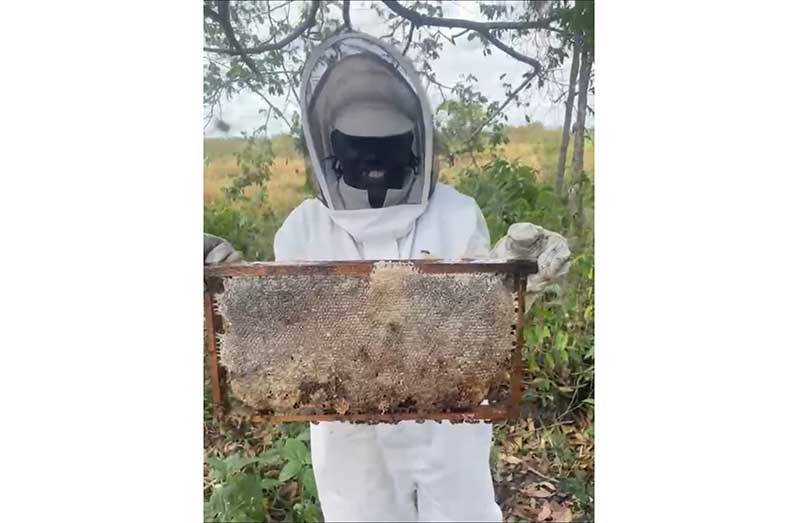
Chuckling as she recalled her first bee removal, Leitch-Hinds explained that she undertook it alone after receiving only hands-on training. Its success encouraged her to continue capturing bees and to establish her own apiary.
To house the colonies, her brother built the first five hive boxes, and GLDA later provided another five.
Located in her backyard, the hives benefit from diverse vegetation, including Long John trees, adding another productive activity to the family’s agricultural enterprise.
PERSISTENCE AND INITIATIVE
The venture has required persistence and initiative. Vandalism interrupted her first seasonal honey flow, but she persisted and later extracted honey during the second flow. Today, she said, she has no regrets about becoming a beekeeper.
That determination also earned recognition. At last year’s Honey Fest, held at the GLDA’s Mon Repos headquarters, she won the category for the darkest honey on her first appearance at the event.
Participation gave her an opportunity to market hair and skincare products alongside honey and to establish business connections.
Those connections helped extend the value of her agricultural work beyond production. Honey and other farm products provide goods for sale, agro-processing broadens her offerings, and exhibitions introduce the business to potential customers.
Her construction work, including the pavilion at the Lochaber Ball Field, provides another income stream.
Across these activities, family participation remains central. Agriculture has helped finance her children’s education, and they continue to contribute to the enterprise while pursuing their tertiary studies.
One daughter is completing a Bachelor of Science in Environmental Management, while her son is pursuing aeronautical engineering.
Their involvement is practical and consistent. Leitch-Hinds explained that whenever labour is short, the entire family, including her daughters, helps broadcast paddy, fertiliser and manage the fields.
That shared effort keeps the farm operating while preserving the children’s connection to the livelihood that supported their education.
For Leitch-Hinds, her daughters’ contribution also reflects the changing role of women in agriculture. She sees the industry as one in which women can lead production, make investment decisions, and build successful enterprises.

Her own experience demonstrates those possibilities through the daily work of managing a diversified business and planning its expansion.
That combination of initiative, family effort, and institutional support gives practical meaning to the October 2026 Agriculture Month theme, “Nourish, Grow: Building a Strong, Sustainable Guyana.”
Through the Ministry of Agriculture and its agencies, training and production support are helping her integrate traditional knowledge with modern agricultural science.
The next step could build on that progress beyond her own fields. If her proposed hatchery becomes a reality, Leitch-Hinds would supply ducklings to other farmers looking to expand their production.
For a woman who began growing rice on a single acre, the ducks now foraging among her plants represent both an encouraging first crop and the start of another business opportunity.