–as Magistrate Latchman moves ahead with hearing after dismissing U.S.-indicted Mohameds’ bid to stall proceedings
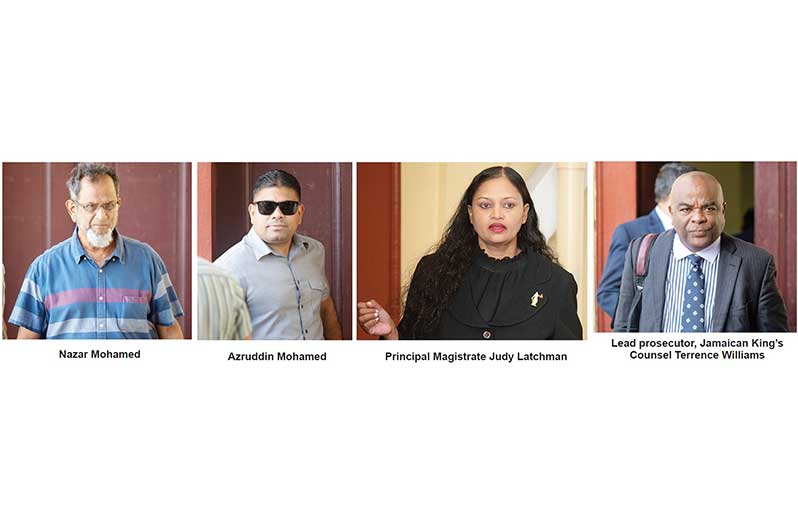
PRIOR to the first witness’ testimony in the extradition committal proceedings against United States-indicted businessmen Nazar Mohamed and his son Azruddin Mohamed, another attempt by the defence to stall the process was shot down by Principal Magistrate Judy Latchman.
On Tuesday, the defence, in its attempt to delay the process, urged Principal Magistrate Judy Latchman to adjourn the proceedings, citing a series of pending legal challenges, including a constitutional motion, a judicial review application, and a notice of appeal filed with the Full Court.
The Mohameds are contesting their extradition to the United States, where they face charges of serious financial crimes, including money laundering, in a Florida court.
Senior Counsel Roysdale Forde, alongside attorneys Siand Dhurjon and Damien DaSilva argued that the committal hearing should be delayed until the High Court has addressed their constitutional motion and judicial review application, insisting that significant constitutional issues remain unresolved.
The defence also highlighted that on Monday, Acting Chief Justice Navindra Singh refused to grant a stay of the extradition proceedings. Justice Singh ruled that while the Mohameds are entitled to pursue their constitutional challenge in the High Court, they had not satisfied the stringent legal threshold required for interim relief.
He emphasised that the mere filing of constitutional proceedings does not automatically suspend concurrent statutory extradition processes, noting that stays in extradition matters are “exceptional, not routine.” Acting Chief Justice Singh is scheduled to hear arguments on the substantive constitutional matter next Wednesday.
Dhurjon further pointed out that the Mohameds’ legal team has sought a stay of the proceedings through multiple avenues, including their notice of appeal to the Full Court against the Chief Justice’s ruling, as well as through the judicial review application, both aimed at halting the extradition process.
In response, Jamaican attorney and prosecutor Herbert McKenzie submitted that filing an appeal does not trigger an automatic stay. Citing authorities from the Caribbean Court of Justice (CCJ), Guyana’s highest court, McKenzie urged the magistrate to allow the extradition committal hearing to proceed without delay.
Prosecutor McKenzie also contended that no stay order had been issued by a higher court that the magistrate was required to follow.
CALL YOUR FIRST WITNESS
After hearing arguments from both sides, Magistrate Latchman ultimately refused the defence’s request for a stay. She instructed the prosecution to proceed with the case, stating: “There is no stay granted in this matter. Prosecutor, call your first witness.”
Before the first witness was called, the prosecution was asked to outline the local equivalents of the offences for which Nazar and Azruddin Mohamed are facing charges in the United States.
Lead prosecutor, Jamaican King’s Counsel Terrence Williams, detailed the alleged offences, while key diplomatic and extradition-related documents were tendered and marked as exhibits on Tuesday as the extradition committal proceedings against the embattled businessmen, formally commenced at the Georgetown Magistrates’ Courts.
The prosecution’s first witness, Sharon Roopchand-Edwards, Permanent Secretary at the Ministry of Foreign Affairs and International Cooperation, testified as to her handling of documents received from the United States Embassy in Guyana, including a diplomatic note and accompanying materials linked to the extradition request.
Roopchand-Edwards told the court that she is responsible for “the financial, operational and technical matters at the ministry,” a portfolio that extends to Guyana’s foreign missions. She stated that the ministry is headed by Minister Hugh Todd.
While under examination by McKenzie, the witness was asked whether she recalled receiving any correspondence from the United States Embassy.
She testified that on October 30, 2025, she received an envelope containing a bundle of documents which, upon review, included diplomatic note number 417 indicating a request from the United States for the extradition of the Mohameds.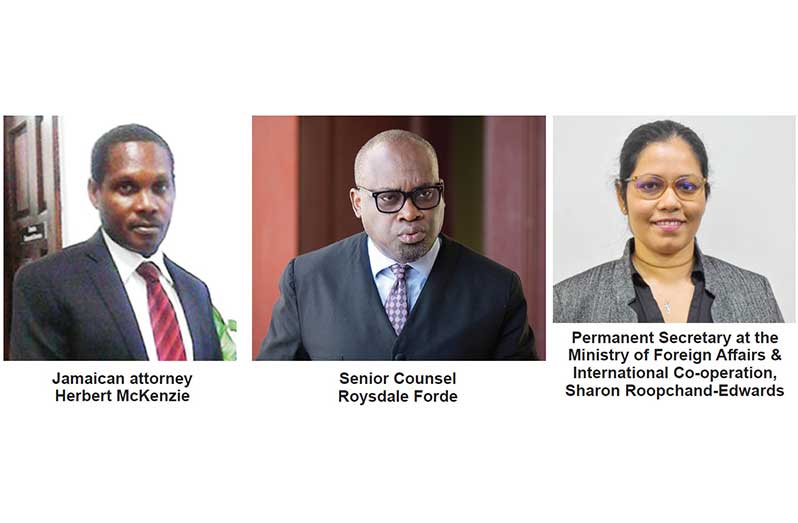
Roopchand-Edwards testified that once she confirmed the nature of the documents, she notified then Minister of Home Affairs Oneidge Walrond and delivered the documents to her on the same day. She added that she could not say what the minister did after receiving them.
The witness further testified that she also saw an Authority to Proceed (ATP), which she said she recognised from the minister’s signature.
An Authority to Proceed in extradition is a formal ministerial approval confirming that a foreign request meets legal requirements and signalling the transition of the matter from the executive or political level to the judicial process for committal proceedings.
She said that she was familiar with Walrond’s signature, having known her in a professional capacity. The ATP was subsequently shown to the court.
At that stage, one of Mohamed’s attorneys, Dhurjon, objected, contending that the prosecutor was leading the witness.
He argued that Walrond was not Roopchand-Edwards’ subject minister and that insufficient foundation had been laid for the document to be shown to the court. Dhurjon questioned how the witness could be “so intimately familiar with the minister’s signature” and pointed out that she was not the author of the ATP.
He further asked whether the prosecution intended to tender the ATP through the Permanent Secretary. When Prosecutor McKenzie confirmed that this was his intention, Dhurjon objected, arguing: “This witness cannot tender this document. Nowhere in her statement is there mention of the ATP.”
In rebuttal, McKenzie submitted that the document could properly be tendered through the witness, relying on provisions of the Evidence Act and the Fugitive Offenders (Amendment) Act.
He also cited common law principles, arguing that documents may be identified by persons familiar with an author’s signature, noting by way of example that if the author of a document is deceased, someone familiar with the signature may still identify it in court.
The court then heard further testimony from Roopchand-Edwards regarding her familiarity with Minister Walrond. She said that she had previously worked under Walrond when Walrond served as Minister of Tourism, Industry and Commerce, during which time Roopchand-Edwards was Permanent Secretary of that ministry.
She testified that she had seen the minister sign several documents. Despite this, the magistrate again declined the prosecution’s request to have the documents tendered even for identification purposes, ruling that they had not been properly identified.
In response, Prosecutor McKenzie pursued a further line of questioning aimed at satisfying the court on identification. He asked Roopchand-Edwards whether she was aware of Minister Todd generating any documents.
She replied that she was aware he had signed off on a document. She said that she had become familiar with Todd’s signature through working closely with him over the past three months, and stated that she had also known his signature from the period when they both worked as lecturers at the University of Guyana.
Despite this, Magistrate Latchman refused the prosecution’s initial request to tender the ATP.
Prosecutor McKenzie then shifted focus, asking the witness to describe the documents that accompanied the diplomatic note.
Roopchand-Edwards stated: “I can identify the documents through the yellow and red ribbons, a seal from the United States Department of State and the Secretary of State’s signature.”
She further testified that she perused the documents to ensure that they “synchronised with the diplomatic note.”
The prosecution again sought leave to show the diplomatic note and accompanying bundle to the witness. This application was met with further objection from Dhurjon, who argued that the documents bore no unique markings attributable to the witness.
McKenzie responded that there was no requirement for the witness to make the documents “her own” in order to identify them. He submitted that this was not the only way a document could be conclusively identified and maintained that she had sufficiently identified the document.
The magistrate ultimately granted the application to have the documents shown to the witness. McKenzie then applied to have the diplomatic note and the bundle tendered and marked as exhibits.
Dhurjon again objected, this time on the basis that the chain of custody and nexus of evidence had been broken. He argued that after Roopchand-Edwards delivered the documents to the minister, she did not see them again until they were produced in court.
“These documents could have come from anywhere,” he contended.
In response, McKenzie argued that there was no requirement to establish a chain of custody in this type of proceeding.
Magistrate Latchman ultimately overruled the objections and admitted the diplomatic note along with the accompanying documents, which were tendered and marked as exhibits in the extradition committal proceedings against Nazar and Azruddin Mohamed.
Roopchand-Edwards is expected to continue her testimony when the matter resumes on Thursday, as the prosecution indicated its intention to call under five witnesses, including a few police ranks.
The Mohameds—owners of Mohamed’s Enterprise—remain on $150,000 bail each, have surrendered their passports, and must report weekly to the Ruimveldt Police Station as the extradition proceedings continue. They were taken into custody on October 31, 2025 following a U.S. request for their extradition.
U.S. prosecutors have accused the father and son of running an international criminal network with alleged links to high offices in Venezuela and the Middle East.
The pair face 11 criminal counts in the U.S. Southern District of Florida involving alleged wire fraud, mail fraud, money laundering, conspiracy, and customs violations tied to what authorities describe as a US$50 million gold export and tax evasion scheme.
The U.S. Treasury’s Office of Foreign Assets Control (OFAC) sanctioned both men in June 2024 for alleged gold smuggling and public corruption.
The U.S. investigation dates back to the mid-2010s and involved multiple agencies, including the Federal Bureau of Investigation (FBI), Drug Enforcement Administration (DEA), and Department of Homeland Security.