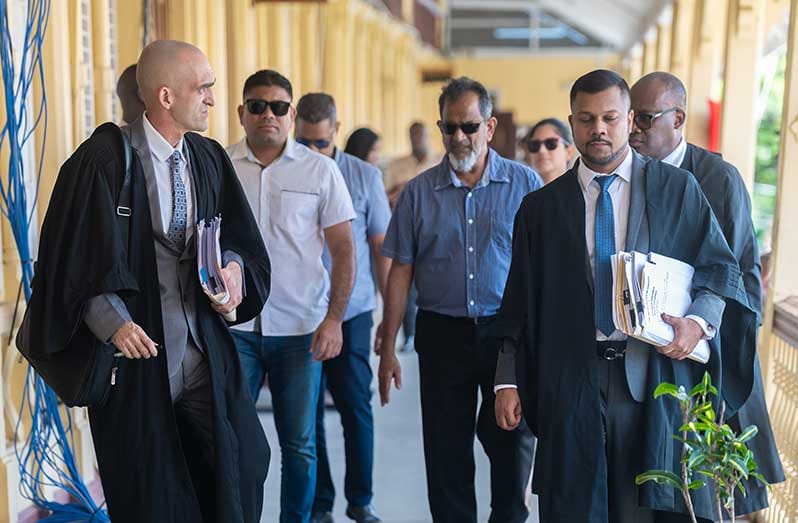
ATTORNEY General Anil Nandlall, SC, has exposed the plans of US-indicted businessmen Nazar and Azruddin Mohamed to delay the extradition proceedings with what their lawyers claim to be “strategic steps,” including an appeal of the recent High Court ruling.
The High Court in Demerara, on Monday, refused an application seeking to stay extradition proceedings for the Mohameds.
In referencing an interview done by Attorney-at-Law, Roysdale Forde, who is one of the lawyers representing the Mohameds, Nandlall said: “Forde said his clients plan to appeal the decision of the learned Chief Justice. Again, I say, these are attempts at delaying the hearing and determination of the commital proceedings.”
Principal Magistrate Judy Latchman is set to begin the committal proceedings today, which will decide whether the father and son can be formally extradited to the United States to face the pending indictments.
According to the Attorney General, the plan outlined by Forde, is part of a broader plan expressed publicly by one of the “fugitive offenders,” to stretch this matter out for five years.
“Forde telegraphed that the filing of the appeal is part of and will be accompanied by strategic steps. It is not the merits of the law that is being prosecuted, but it is a strategy, and that is coming from the horse’s mouth: the client himself and now the lawyer,” the Attorney General said during a recent interview.
The strategy, Nandlall emphasised, is to delay and protract the commital proceedings from being concluded.
Magistrate Latchman had already denied an application by the Mohameds to refer several constitutional questions to the High Court and affirmed that the substantive matter would continue before her, in accordance with Guyana’s extradition laws and binding judicial precedent, on January 6 and 7, 2026.
The magistrate, in her ruling, reflected on international law principles guiding treaty compliance, emphasising that states cannot invoke domestic law to escape obligations.
Citing Article 27 of the Vienna Convention on the Law of Treaties, she emphasised that a state cannot rely on its domestic laws to avoid fulfilling its treaty obligations.
She explained that each contracting state must align its internal laws with its treaty commitments, stressing that treaty obligations take precedence over local legislation.
Principal Magistrate Latchman concluded that the defence’s issues had already been adjudicated by Guyana’s superior courts and that “this court sees no basis to activate the referral article.”
She declared, “This court is not about to resurrect what has been put to rest. Having judiciously examined all the issues levelled by the defence and the request for a referral to be triggered, this court sees no basis to activate the referral article [Article 153(3)], since it is guided by the principles of stare decisis. This court, therefore, denies the application to engage the referral article of the Constitution of the Co-operative Republic of Guyana.”
Considering the magistrate’s ruling and the recent ruling in the High Court by Acting Chief Justice, Navindra Singh, Nandlall said: “If the magistrate has already ruled and the Chief Justice has ruled similarly, I can’t imagine the magistrate can have a basis for delaying the matter because an appeal has been filed, since the magistrate has already made a finding of law that those very questions from which there is now an appeal are frivolous and vexation.”
The Attorney General lamented that the actions of the Mohameds is a classic case of “abuse of process.”
The legal framework governing extradition in Guyana is the Fugitive Offenders Act of 1988, as amended by the Fugitive Offenders (Amendment) Act 2009.
Nandlall contended that the attempt by the lawyers to challenge the commital proceedings is part of an effort to “upturn the law” to suit their clients, given that the law operates with a machinery of procedure by which it is administered, and it has a chronological way in which it unfolds.
“Many persons have been committed and extradited based upon that law…as late as 2018, a judge of the High Court who is now in the Court of Appeal examined those very arguments and challenges to that very legislation and dismissed them.
“So that is the state of the current law of Guyana having been examined by courts and pronounced upon. If that is the state of the law, that is the law that must be applied. Every judicial officer has a duty to apply that law until a court pronounces otherwise… and you have to follow the procedures set out for the court to pronounce otherwise.”
The Attorney General went on to note: “The law wouldn’t be turned upside down to suit one or two litigants. The law must be applied in the same way to all persons. So the “Mohameds'” strategy ought not to yield any success because it is contrary to the law.”
He further explained that an appeal itself is not a stay, reiterating that the stay they pursued was already rejected by the High Court.
The Mohameds—owners of Mohamed’s Enterprise—remain on bail, have surrendered their passports, and must report weekly to the Ruimveldt Police Station as the extradition proceedings continue.
U.S. prosecutors have accused the father and son of running an international criminal network with alleged links to “high offices” in Venezuela and the Middle East.
The pair face 11 criminal counts in the U.S. Southern District of Florida involving alleged wire fraud, mail fraud, money laundering, conspiracy, and customs violations tied to what authorities describe as a US$50 million gold export and tax evasion scheme.
The US Treasury’s Office of Foreign Assets Control (OFAC) sanctioned both men in June 2024 for alleged gold smuggling and public corruption.
The US investigation dates back to the mid-2010s and involved multiple agencies, including the Drug Enforcement Administration (DEA), Federal Bureau of Investigation (FBI), and Department of Homeland Security.