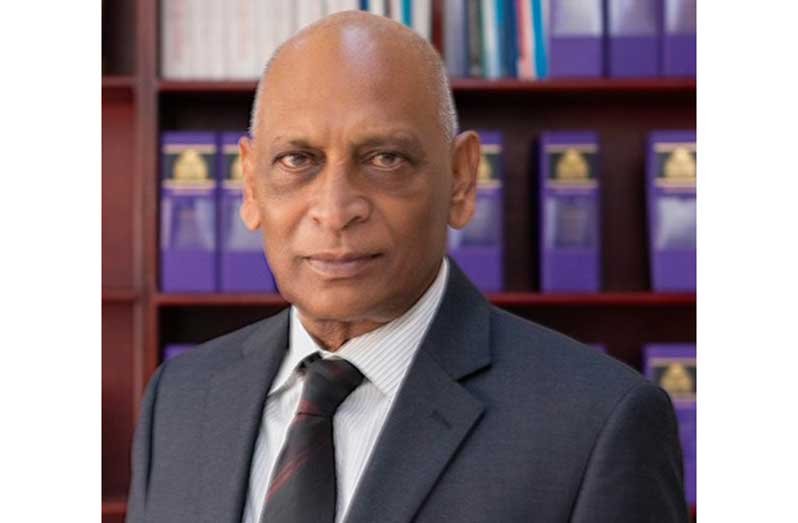
PROMINENT Guyanese politician, public health advocate, and Guyana’s Permanent Representative to the United Nations Office in Geneva, Dr. Leslie Ramsammy, has welcomed the Government’s intention to pursue legislation aimed at regulating social media and online gambling, describing the move as timely and necessary to curb growing abuse in the digital space.
In a commentary issued this week, Dr. Ramsammy endorsed President Dr. Mohamed Irfaan Ali’s announcement that the Government will begin broad national consultations this month on possible legislative action to regulate social media platforms.
The consultations, he noted, are intended to maximise the positive benefits of social media while reducing harmful effects such as online abuse, disinformation, and risks to children.
“Social media is a double-edged sword,” Ramsammy said, acknowledging its role in communication and social engagement while cautioning against its darker impacts. “It is incumbent on governments to regulate the landscape in order to optimise the positive impacts and reduce or eliminate the negative impacts.”
President Ali made the announcement during a media engagement with five leading women journalists, indicating that the consultations would inform legislation designed to address social media abuse.
The initiative is expected to complement legislative measures on online gambling announced by Vice President Bharrat Jagdeo, which are slated for introduction later this year.
Ramsammy argued that relying on self-regulation by platform operators, or leaving oversight solely to parents and guardians, has proven inadequate. He said a clear “gatekeeping role” by the State is necessary to protect vulnerable users, particularly children, from online harm.
He placed Guyana’s proposed approach within a wider international context, noting that several countries have already moved to regulate social media access for minors. France, Denmark and Greece are leading efforts within the European Union to restrict children’s access to social media, while Australia has enacted legislation barring users under 16 from creating accounts on platforms such as TikTok, Snapchat and Instagram.
Similar measures are under consideration or have been introduced in countries including Malaysia, Türkiye, Canada, the United Kingdom, India, Brazil and South Korea.
Under Australia’s law, which took effect on December 10, 2025, social media companies are required to take “reasonable steps” to enforce age restrictions, with penalties for non-compliance ranging from AU$9.9 million to AU$49.5 million. The law does not penalise children or their caregivers and exempts platforms deemed to have significant educational value, such as YouTube.
Ramsammy also pointed to growing global consensus on addressing online harm. He cited the first Global Ministerial Conference on Ending Violence Against Children, held in Colombia last November, where 120 governments pledged to strengthen legislative frameworks to combat social media abuse.
In addition, he highlighted the United Nations Convention against Cybercrime, adopted by the UN General Assembly in December 2024, which includes provisions addressing online child sexual abuse, grooming and non-consensual image sharing. The treaty is scheduled to come into force on January 25, 2026.
While welcoming the Government’s initiative, Ramsammy acknowledged that public consultations in Guyana are likely to raise concerns about censorship and the potential stifling of innovation.
He said such concerns are legitimate but should not be used to avoid addressing the risks posed by unregulated digital platforms.
“We must work together to craft a regulatory framework that balances free speech, data privacy and platform accountability,” he said, adding that President Ali has invited all stakeholders to collaborate in shaping a model suited to Guyana’s needs.
Ramsammy concluded by expressing confidence that Guyana can develop a balanced and progressive approach, drawing on its history of bipartisan co-operation on complex social issues. He urged stakeholders to engage constructively in the upcoming consultations, with the aim of ensuring that social media contributes positively to a more informed, safe and equitable society.