.jpg)





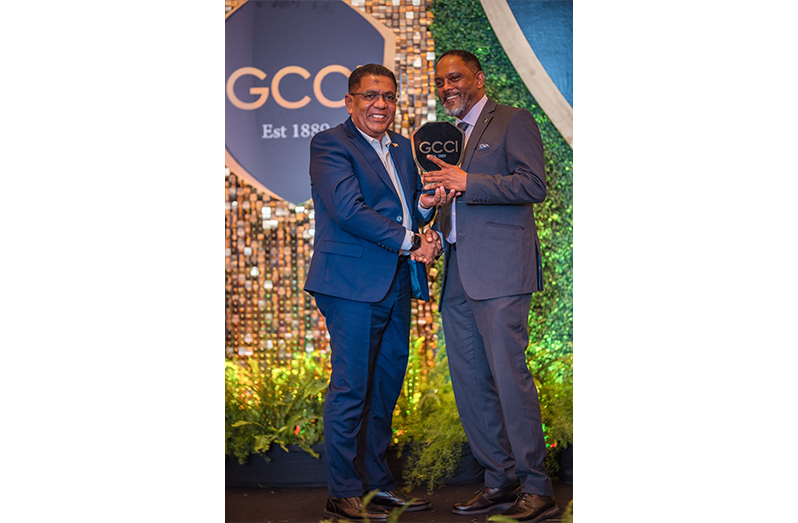
MINISTER of Agriculture, Zulfikar Mustapha, has been recognised for his leadership in strengthening national food security and advancing agricultural development at the Georgetown Chamber of Commerce and Industry 135th Annual Awards Presentation and Gala Dinner. The recognition was conferred under the strategic direction of President Dr Irfaan Ali’s administration.
The award, presented alongside recognition for the Ministry of Agriculture, acknowledged leadership and innovation in advancing Guyana’s agricultural systems, with particular emphasis on ensuring the country’s ability to feed its population while contributing to regional food security efforts.
Guyana has historically played a central role in CARICOM’s push for agricultural self-reliance and the reduction of the region’s food import bill. Over time, changes in political leadership slowed this momentum and diminished the country’s influence within the regional food security framework.
That trajectory shifted in 2020 with the return of the PPP/C to government under President Ali. Since then, the administration has restored policy focus on agriculture, revived stalled initiatives, accelerated production targets and repositioned Guyana at the forefront of CARICOM’s agricultural agenda.
Minister Mustapha, who has served as Minister of Agriculture since 2020, has been a key implementer of the President’s vision. His leadership has focused on modernising the sector and strengthening food sovereignty at both the national and regional levels.
Under this renewed policy direction, the Ministry of Agriculture has made strategic investments in drainage and irrigation, farm to market roads, climate resilient infrastructure and farmer support programmes. These initiatives have contributed to expanded acreage, increased yields, greater crop diversification and improved resilience across the sector.
Agricultural output has increased significantly in recent years, particularly in staple crops. Rice production surpassed 725,000 metric tonnes in 2024, reinforcing its role as a cornerstone of national food security. With continued policy support, production targets are now set at one million metric tonnes in future cycles.
Growth has also been recorded in corn, soya and other non-traditional crops. Expansion plans and targeted investments are being implemented to increase soya cultivation, to position Guyana as a net exporter within the Caribbean.
Guyana’s progress was further highlighted in a recent global study published in Nature Food, which assessed food production capacity in 186 countries. The study found that Guyana was the only country capable of producing sufficient quantities across all seven major food groups to fully feed its population without reliance on imports. These groups included fruits, vegetables, dairy, fish, meat, plant-based proteins and starchy staples.
While the study noted that 65 per cent of countries globally overproduce meat and dairy relative to dietary needs, Guyana stood out for balanced food production. China and Vietnam followed, producing enough food in six of the seven categories. This milestone reflects the administration’s policy emphasis on agriculture, supported by increased budgetary allocations, diversification strategies, farmer-focused interventions and climate resilience planning.
According to Minister Mustapha, Guyana’s emergence as a food secure nation is the result of deliberate leadership, strong policy direction and the commitment of local farmers, aligned with President Ali’s vision of agriculture as a pillar of national development.
Beyond domestic self-sufficiency, Guyana has also reasserted its leadership within CARICOM’s food security agenda. As Chair of the CARICOM Special Ministerial Task Force on Food Production and Food Security, Minister Mustapha, supported by President Ali’s diplomatic and policy leadership, has advanced collaborative efforts aimed at reducing the regional food import bill and expanding intra-regional agricultural trade.
Guyana’s renewed role reflects a national vision in which the country not only feeds its own population but also plays a leading role in strengthening food availability and resilience across the Caribbean, consolidating its position as a regional agricultural leader.