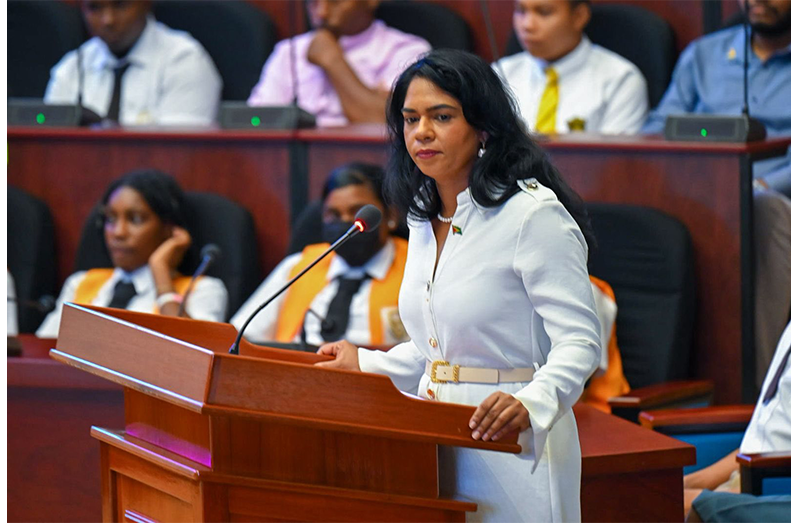
-programme to be expanded to younger students by early next year, Minister Parag says
THE Guyana Digital School, officially launched on Friday at the Arthur Chung Conference Centre, has already registered 20,368 students from Grades 10 and 11 across Guyana and the wider Caribbean region, Minister of Education Sonia Parag revealed.
The programme, which will expand to Grades Seven through Nine by early 2026, represents a transformative step toward providing equitable, technology-driven learning for all students, regardless of geography or circumstance.
Minister Parag described the launch as a historic moment, emphasising the critical role education plays in shaping the nation. She reflected on her experience as former Minister of Public Service, noting how national initiatives like the Guyana Online Academy of Learning (GOAL) scholarship programme demonstrated the power of opportunity on a broad scale.
“I saw firsthand how access can change the trajectory of a country. GOAL was a landmark achievement in our government’s first term as an expanded learning into places and into lives that have been long overlooked,” she said, highlighting how such programmes allowed tens of thousands of Guyanese to reimagine their potential.
She explained that the Digital School is designed to continue this tradition of access and opportunity. “The Digital School recognises the geography of our country and ensures that the child in a riverine village receives the same level of instruction as a child in Georgetown or in Anna Regina. That is what true access means,” she said.
The platform is intended not only for local students but also for learners across the Caribbean, reflecting the government’s commitment to regional collaboration and development.
According to Minister Parag, the school provides an holistic, quadrant approach to learning that combines technology, content, engagement, and hands-on experience.
This includes interactive online classes led by trained educators, a rich library of on-demand digital resources, programmes to develop skills beyond the standard curriculum, and practical, activity-based projects that allow students to apply what they learn.
She stressed that these features would unlock new opportunities for students, supported by artificial intelligence tools that personalise learning and help strengthen areas of weakness.
Underscoring the innovative nature of the programme, Minister Parag said the Digital School does not replace traditional schooling but strengthens it.
“This is not an abandonment of the traditional schooling technology. It introduces new avenues for learning so that no child falls behind because of distance, circumstance, or pace,” she said.
She recalled the challenges faced during the COVID-19 pandemic, when students experienced interruptions in learning due to reliance on a single mode of instruction. “In Guyana, the Digital School is designed to guard against that vulnerability. It stands beside our classrooms as a resilient, flexible partner, giving teachers, parents, and students consistent support, even in times of uncertainty,” she added.
The minister highlighted the importance of digital literacy in today’s world, noting that it has become a fundamental requirement. She praised the adaptability of young people, observing that students can navigate technology with remarkable ease. “Our children can move through technology with an ease that tells us they’re ready for a world that rewards curiosity, confidence, and adaptability,” she said.
She emphasised that the Digital School allows the education system to keep pace with this rapidly changing environment, adopting technology responsibly and deliberately to prepare students for the future.
Minister Parag also outlined the government’s broader achievements in education since 2020. She noted that free education has been instituted from nursery through tertiary institutions, including the University of Guyana (UG), and that over 13,000 students have benefited from the University of Guyana loan write-off programme. The teaching workforce has been strengthened, with over 1,345 teachers graduating in 2025 alone, and nearly 92 per cent of teachers in hinterland regions now fully trained. Learning spaces across the country have been expanded and upgraded to ensure that no child’s education depends on where they live.
She highlighted improvements in the administration and management of schools through the Education Management Information System, which tracks attendance and performance, frees teachers from administrative delays, and identifies learning gaps early.
Additionally, the upcoming rollout of the National Anti-bullying App for schools is intended to create safer learning environments where students feel protected and supported.
“The modern education system is not only about technology; it’s also about safety, accountability, and clear support for every child,” Minister Parag said.
She emphasised that the Digital School is part of a broader effort to build an education system that matches the nation’s aspirations. “Together, we are shaping a future where every child can stand tall, and guided by the leadership of His Excellency Dr. Irfaan Ali, we will deliver world-class education to our people as they deserve,” she said.
The launch also included a demonstration of the Digital School platform, showing how students can access teachers, resources, and practical learning experiences at any time. Minister Parag invited all students to register, highlighting the global potential of the platform. “I look forward to all of you registering on the Guyana Digital School because it is the future of education, not only in Guyana but globally, and you will be a part of that journey,” she said.
In her remarks, Minister Parag reflected on the broader vision of the government’s education agenda from 2025 to 2030. She noted that the Digital School aligns with the People’s Progressive Party/Civic government’s manifesto commitment to world-class education for all, translating policy promises into concrete action.