.jpg)



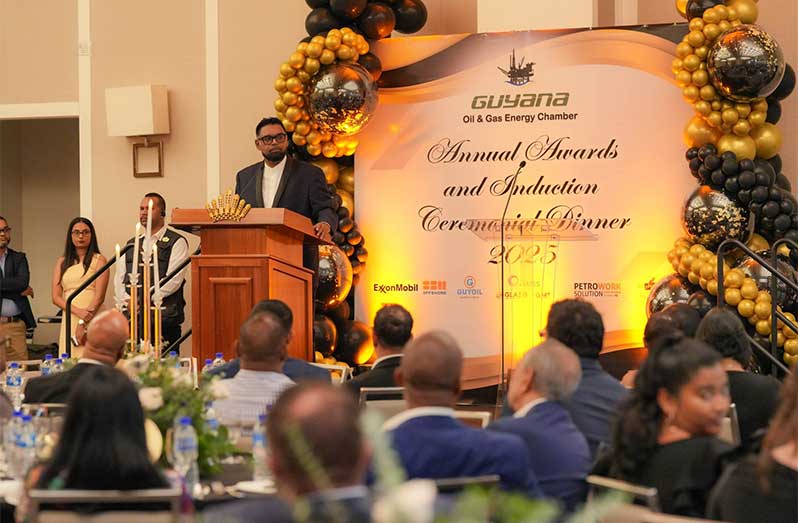
IN order to sustain the rapid pace of Guyana’s development, the country’s human capital must become more mature to thrive in a dynamic and digital economy, President, Dr Irfaan Ali has said.
While addressing a recent gathering at the Guyana Oil and Gas Energy Chamber’s Annual Awards Presentation Dinner at the Marriott Hotel, President Ali disclosed the government’s plan to intensify investments to stimulate growth in the country’s energy, industrial, and manufacturing sectors.
He said, however, if the country is to reach its full potential, simultaneous investments must be made in human capital.
The President urged stakeholders and key private-sector players to take advantage of existing policies and programmes to support upskilling and greater access to tertiary education.
“We have to ensure that our human capital is being developed and matured at an equivalent pace. And what do I mean? Maturity of the human capital is understanding what is required in level of effort and level of commitment in this phase of our development,” he said, adding: “If our human capital put the same level of effort in advancing themselves, whether it’s upskilling themselves and actually optimising the opportunities available for them to make money, then we will have a very broader growth trajectory.”
Dr Ali stressed that the country’s human capital needs to maintain a competitive, agile workforce by eliminating the existing mentality of how work is done across several private and public offices.
“If we have human capital that gets accustomed to earning the same level of resources in four days that they would earn in two weeks; and then believe the remainder of the two weeks is just to throw back and relax… we must be mature enough to address these issues. If we are not mature enough to address these issues, a culture would creep in that will kill productivity, kill competitiveness and destroy our ability to be the best we can be,” he said.
The President further acknowledged that while a change in culture will not be easy, it is achievable.
He emphasised that the country’s transformation will not only accelerate, but will also become cemented in systems that can deliver services efficiently, promote competitiveness and enable continuous upskilling.
“It is not easy. But we have to, as a collective, work towards changing this. The greatest complaint in the private sector today is on human-capital management. Every single business complaint. Businesses complain they can’t find workers. We, therefore, must understand that our human capital must be developed at the equivalent pace at which the economy requires them to perform,” Dr Ali said.
Just last month, President Ali launched a new public service upskilling platform, built in collaboration with Coursera, as a decisive shift away from outdated systems and towards digital adaptability and greater human-capital development.
The goal is to create a digitally integrated Public Service, enhance productivity and prepare for the next industrial revolution, ensuring that Guyana remains competitive globally.
President Ali had stressed the need to embrace a new way of working focused on agility, results, and accountability, backed by skilled human capital and advanced technology.
He underscored then that the aim is to build the best Public Service and public servants for the future by integrating all activities to make life easier for citizens.
However, the Head of State said that public servants must be ready to embrace technology and artificial intelligence, learning new tools to make their work more efficient.