






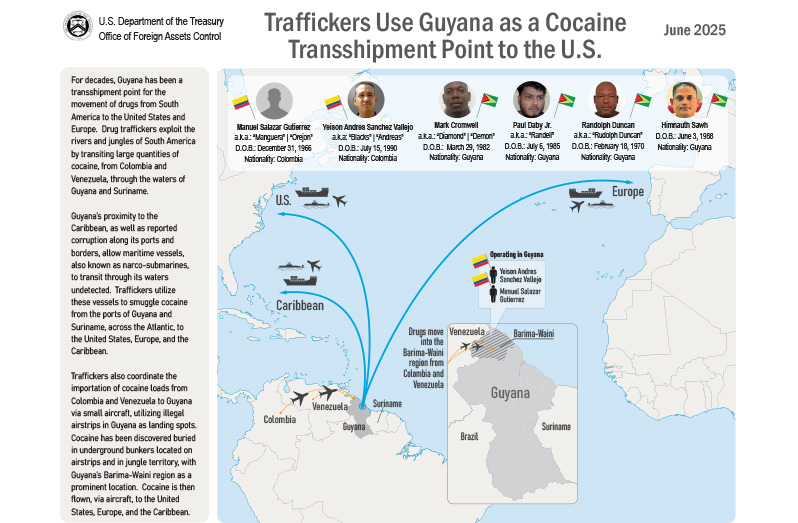
–Two Colombians with ties to Region One also named
IN a sweeping action targetting the transnational cocaine trade, the United States (U.S.) Treasury Department’s Office of Foreign Assets Control (OFAC) on Thursday designated four Guyanese nationals, including a senior police officer, as drug traffickers.
The designation places the individuals on the U.S. Specially Designated Nationals and Blocked Persons (SDN) list, effectively blocking them from accessing the U.S. financial system.
Any assets they hold within U.S. jurisdictions are frozen, they are barred from entering the United States, and U.S. persons are prohibited from engaging in any transactions with them.
The most prominent name among those sanctioned is Senior Superintendent Himnauth Sawh, 37, of the Guyana Police Force (GPF). He is attached to the Force’s Projects Office, and following Thursday’s disclosure, he was sent on administrative leave.
While serving as the officer-in-charge of Region One (Barima-Waini), Sawh, of Cane Grove, Region Four (Demerara-Mahaica), was connected to a major 4.5-tonne cocaine bust—cocaine estimated to be valued at €176 million (US$195 million)—that was hidden in four camouflaged, hand-dug pits.
Also sanctioned alongside Sawh are three civilians: 39-year-old Paul Daby Jr. of 127, D’Aguiar Park, Georgetown; former policeman Mark “Demon” Cromwell, 43, of Lot 40, Vigilance, and Lot 10, Buxton, East Coast Demerara (ECD); and 55-year-old Randolph Duncan of Georgetown.
Daby Jr.’s father, Paul Daby, passed away in Colombia in 2021 due to complications related to COVID-19. Also sanctioned along with the four Guyanese nationals are two Colombian citizens: Manuel Salazar Gutierrez, also known as “Manguera” and “Orejon”, born on December 31, 1966; and Yeison Andres Sanchez Vallejo, also known as “Andreas” and “Blacks”, born on July 15, 1990.
Both Vallejo and Gutierrez have ties to Guyana, and are linked to the Barima-Waini Region.
According to the U.S. Department of the Treasury’s OFAC, for decades, Guyana has served as a key transshipment point for the movement of illicit drugs from South America to the United States and Europe. It said drug traffickers exploit the region’s vast network of rivers and dense jungle terrain to move large quantities of cocaine originating in Colombia and Venezuela through the waters of Guyana and Suriname.
OFAC noted that Guyana’s geographic proximity to the Caribbean, combined with reported corruption at its ports and borders, enable maritime drug trafficking operations to thrive.
These operations often involve the use of semi-submersible vessels, commonly referred to as narco-submarines that transit undetected through regional waters, transporting cocaine from ports in Guyana and Suriname across the Atlantic to destinations in the United States, Europe, and the Caribbean.
In addition to maritime routes, traffickers coordinate aerial operations involving small aircraft to move cocaine from Colombia and Venezuela into Guyana.
These aircraft frequently land on illegal airstrips across the country.
OFAC highlighted that cocaine has been discovered hidden in underground bunkers located on remote airstrips and within jungle territories, particularly in Guyana’s Barima-Waini region.
From these remote locations, the narcotics are flown onward to international markets, including the United States, Europe, and the Caribbean.
This new wave of sanctions come in the wake of a United States investigation detailing gold smuggling, tax evasion, and corruption involving wealthy Guyanese businessmen Nazar and Azruddin Mohamed, as well as former high-ranking government official Mae Thomas, all of whom are currently under U.S. sanctions.
In June 2024, the U.S. Treasury Department sanctioned Nazar and his son, Azruddin, for engaging in public corruption, including the alleged defrauding of the Guyanese government of over US$50 million in unpaid duty taxes.
Thomas, the former Permanent Secretary at the Ministry of Home Affairs and Ministry of Labour, was also sanctioned for allegedly accepting bribes in exchange for facilitating the awarding of government contracts to the Mohameds.




