






From education and employment to accessible infrastructure, one disability advocate is pushing for a more inclusive Guyana
Written by Andrea Hendricks
GABRIEL Gilkes, 34, a disability advocate from Turkeyen, Sophia, Georgetown, is a founding member of the Stronger Together Disability Organisation. His advocacy began in the Turks and Caicos Islands, where a school installed a ramp to help him gain admission and continue his education. That experience set him on a path that continues today. The Stronger Together organisation focuses on advocating for people with physical disabilities, particularly those with mobility impairments.
Gilkes said he enjoyed a healthy childhood until he became a wheelchair user at age 10 because of cerebral palsy. He began his education at Happy Hearts Nursery and Redeemer Primary before moving with his parents to the Turks and Caicos Islands. He completed his primary and secondary education at Adelaide Oemler Primary and Raymond Gardiner High School.
He reported that some schools were unwilling to admit him at the time but his mother, a special-needs teacher, supported his education by leaving her job to be with him at his school until she was contracted to work overseas.
Moving to the Turks and Caicos Islands was challenging, particularly because of cultural differences. Gilkes also noted the positive impact of the territory’s generally flat buildings and infrastructure, which he associated with its hurricane-zone environment. By comparison, accessing school buildings in Guyana was more difficult.
On returning to Guyana to pursue university studies, Gilkes again encountered accessibility barriers. To use his time productively and continue empowering himself, he enrolled at the Open Doors Centre, which supports people with disabilities through independent-living and skills training in Georgetown. “I enrolled there to prepare myself for university,” he told this publication. “Before attending Open Doors, my only association was with non-disabled people.”
The opportunity at Open Doors helped Gilkes appreciate the support network around him. “It was an eye-opener that helped me realise how fortunate I was, particularly in my educational journey as a person with a disability. I had already received my high school diploma and Caribbean Secondary Education Certificate (CSEC) passes. For some, it was their first educational opportunity in their early 20s,” he said.
His experience at Open Doors also strengthened his determination to support people living with disabilities through a community built on shared interests and common goals. He saw people taking steps to prepare for careers while still facing barriers that prevented them from reaching their full potential and living independently. The experience also prompted him to consider his own future after completing information technology studies at university, particularly the challenge of inaccessible infrastructure.
Gilkes would like to see the systemic and societal changes that have benefitted people with disabilities overseas extended to the disability community at home. He admires people who continue doing their best despite less favourable circumstances and believes support and advocacy can have a significant impact.
Although transportation has not been a personal obstacle for Gilkes, he has observed the challenges others face because of high travel costs, particularly when taking part in religious and recreational activities. Accessing buildings as a wheelchair user has always been a barrier for Gilkes. “At one time, I couldn’t access my place of worship because there was no ramp available. However, at my request, one was eventually installed,” he said.
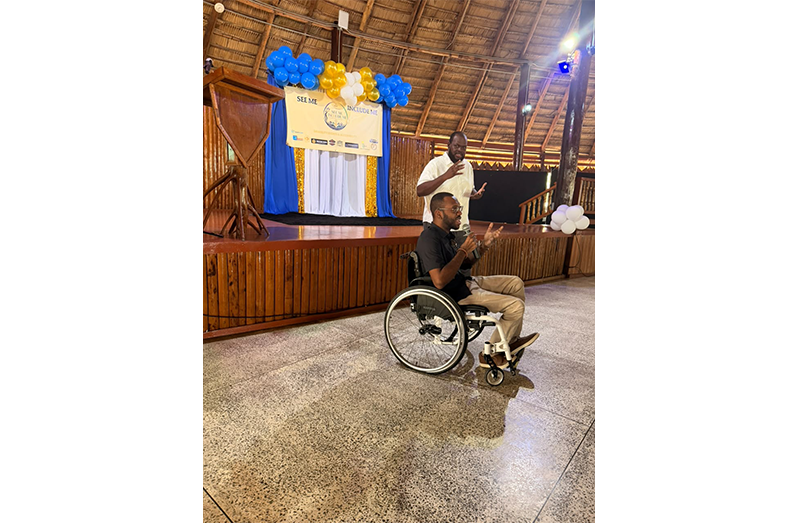
Despite the challenges he faces as a wheelchair user, Gabriel Gilkes has continued to lead an independent life. Since October 2025, he has been a communications apprentice in the GUYSOL/GPL apprenticeship programme. A previous participant in a similar role introduced him to the programme and helped with his transition. The opportunity exposed him to solar energy as an alternative power supply for Guyana’s electricity grid. “I was able to visit Linden and Berbice, where the GUYSOL solar farm projects have been active, and I am expected to visit Essequibo,” he told this publication.
“One of the main reasons for my successful apprenticeship programme was the accommodation and flexible working schedule,” he added. Gilkes praised the office team for showing extraordinary patience, even when project activities were fast-paced and demanding. Their approach helped him feel comfortable and enabled him to support the Women in Solar programme while building stronger working relationships.
“I have never considered myself a people’s person,” he said, reflecting on the programme’s impact on his personal and career development. His interactions with colleagues and stakeholders strengthened his confidence and showed him that every encounter could be a learning opportunity.
Although his career focus is mainly on information technology, Gilkes would like his work to remain centred on supporting others and working regularly as part of a team. He added that his growing open-mindedness would help him pursue opportunities where he can do his best.
As Gilkes continues to advocate for people with disabilities, he wants to see major improvements in infrastructure and technology to create more opportunities for inclusion and independence. He urges policymakers to consult people in the disability community so that changes are more effective and produce positive outcomes.
Gilkes encourages people with disabilities to find a community where they can share experiences and support one another. Such support, he noted, can help one cope when circumstances become difficult, while providing opportunities for socialisation as well as moral and emotional support.
He believes broader change will come through collective community efforts rather than individual advocacy alone.
Looking ahead, Gilkes hopes to complete his university degree, find a job he is qualified for and give back to society.
For the disability community, he wants to sit down with policymakers and help secure meaningful changes that advance inclusion for people with disabilities.
Gilkes was not always outgoing or open-minded. Today, his confidence is more evident, and his demeanour is welcoming and approachable. That is how he hopes to be remembered by the people he meets personally and through his advocacy. Drawing on his journey of resilience and the power of community support, Gilkes aims, through his advocacy, to break down barriers not just for himself but for others who face similar challenges. He believes that a more inclusive society benefits everyone.
Gilkes plans to continue his work with the Stronger Together Disability Organisation, focusing on initiatives that promote education and awareness to help people in this marginalised group access employment, education, and other social benefits. He envisions a future where accessibility becomes the norm, not the exception, and where individuals with disabilities are seen as valuable contributors to society. His message is clear: together, we can build a more inclusive and equitable future for all.




