






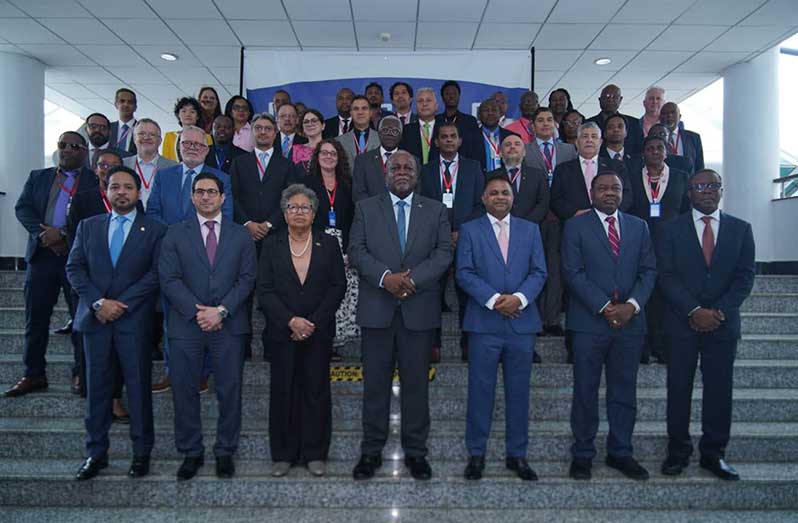
–regional leaders highlight aviation’s role in tourism, trade, investment, connectivity
REGIONAL aviation officials and industry leaders are linking a developed and secure aviation sector to the Region’s economy.
Aviation’s contribution to tourism, trade, investment and regional connectivity came into focus on Thursday as Caribbean leaders and development officials called for continued investment in the sector as a foundation for economic and social development.
Speaking at the Caribbean High-Level Symposium on Aviation Safety, Minister of Public Utilities and Aviation Deodat Indar highlighted Guyana’s expanding aviation infrastructure, including the modernisation of nearly 60 internal airstrips and expansion of its international gateway, while stressing the need for stronger oversight and technical capacity.
CARICOM Secretary-General Dr Carla Barnett highlighted that safe air transport remains essential to tourism, trade, investment, emergency response and social connections across the Region.
Caribbean Development Bank Division Chief William Ashby said aviation is a vital enabler of regional integration, connecting countries and supporting the movement of people and goods. ICAO Regional Director Luis Fernando Fiallos also underscored its wider economic and human importance.
Speaking on Guyana’s investment into the sector, Aviation Minister Deodat Indar, said Guyana’s investment in aviation infrastructure must be supported by development of the people and systems responsible for maintaining safety.
He highlighted the growth Guyana has seen in the sector in recent years, and emphasised the importance of reliable information and institutions that can respond to changing conditions and growth.
He also pointed to the need for trained inspectors, engineers, air navigation specialists and other aviation professionals.
“Guyana is investing in aviation infrastructure as it has never done before, including the modernisation of internal airstrips, close to 60 of them in total, and an expansion of our international gateway, and additional funding of 65 million U.S,” he said, adding: “But infrastructure alone does not deliver safety. It must be matched by capable people, sound oversight, dependable data, and institutions’ preparedness to adapt. Sustainable capacity means investing in inspectors, engineers, air-navigation specialists, and the next generation of aviation professionals, while ensuring that our systems can withstand economic and environmental shocks.”
The minister said regional co-operation will therefore be important as Caribbean countries seek to strengthen their aviation systems and respond to the changing demands of the industry.
“Our team is strengthening Caribbean aviation safety through regional co-operation, resilient oversight, and sustainable capacity development. It speaks directly to the choices before us. The Caribbean aviation future will depend on whether we can work across borders, strengthen our institutions, and build the expertise to keep pace with the changing industry,” he said.
Moreover, he said countries must be able to work together, strengthen institutions and develop the expertise needed to maintain safe air transport, particularly as aviation continues to support communities and economies across the Region.
“For our Region, aviation is not a luxury. It connects island and mainland communities, supports tourism and trade, and brings families together and helps deliver essential services. When hurricanes, floods, and other emergencies strike, reliable air transport can be a lifeline. That makes safety a public responsibility and a foundation for development. Connectivity that is not safe cannot be sustained.”
Sharing similar sentiments, CARICOM Secretary-General Barnett also linked aviation to the movement of people and goods and to the wider economic and social links between CARICOM countries.
She highlighted that the sector supports a range of activities, from tourism and trade to education, cultural events and family connections, making safety a necessary part of maintaining those connections.
“Air transport sustains tourism, trade, investment, emergency response, family connections, and the wider economic and social integration of our community. Safe transportation is essential for economic activity, and as you’ve heard previous speakers say, it is essential also for social and cultural connections and community building within our countries, especially the coastal countries with much larger land areas, and among our countries.” She added that with the Region being dependent on the movement of people, aviation safety must be prioritised.
“People moving, whether as families, students, tourists, artists [sic] coming to do concerts, traders moving goods across the community, we all depend on the vital assumption of aviation safety.”
For the Caribbean Development Bank, Ashby said the development of aviation cannot be viewed only through the movement of passengers, but also through its contribution to regional integration and economic participation.
He noted that the future of the sector will require countries to work collectively, rather than relying only on individual national efforts.
“The agenda before us reflects a recognition that the future of Caribbean aviation will depend not only on what individual countries do, but increasingly on what we choose to do together. The Caribbean Development Bank recognises that aviation is not merely a transport sector in the Caribbean.”
He added, “It is a vital enabler of regional integration. It connects our countries and coastal states, facilitates trade and tourism, supports investment and strengthens the movement of people and ideas across our community. In all of our countries, aviation is essential to economic participation and social connectivity.”
Furthermore, ICAO Regional Director, Fiallos, reinforced the sector’s importance in the wider regional and human context, noting that the benefits of aviation extend beyond passenger travel and commercial activity.
He pointed to the role of air transport in healthcare, connecting communities and taking local products to international markets, while highlighting the livelihoods that depend on trade and tourism.
“Aviation is not merely a convenience. It is an indispensable economic and societal bridge. It transports patients to critical care, connects communities across the Region, brings local goods to international markets and sustains livelihoods rooted in trade and tourism. The momentum across the Region is undeniable,” he said.
Fiallos shared that the Caribbean Tourism Organisation estimates that stayover arrivals reached 35 million in 2025, surpassing pre-pandemic levels and demonstrating remarkable resilience.
Across Latin America and the Caribbean, the Air Transport Action Group estimates that air transport supports 8.3 million jobs and $240 billion in economic activities.
He noted however, that behind these macroeconomic figures are individual lives, families, entrepreneurs and local communities whose well-being depends on safe, reliable and continuous air connectivity.




