By Bebi Shafeah Oosman
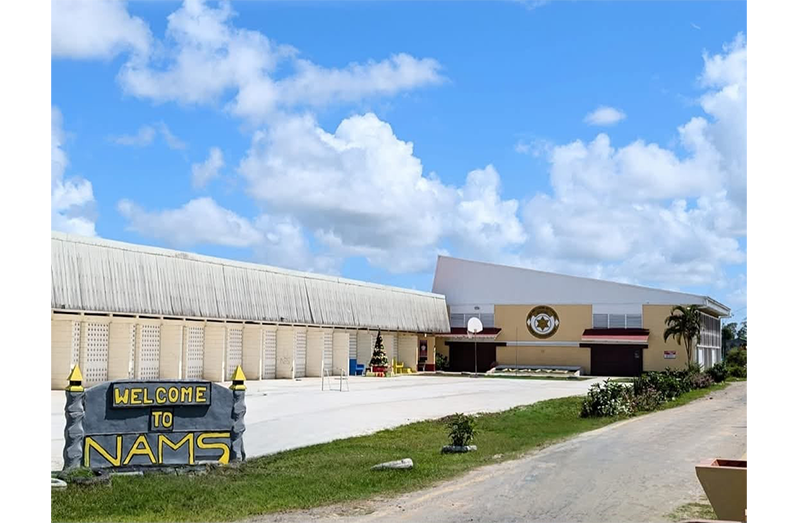
FIFTY-ONE years ago, 181 students walked through the doors of a new secondary school in New Amsterdam, entering classrooms that would become the starting point of an educational journey spanning generations.
There was no way of knowing then how far that journey would last. From those humble beginnings on September 15, 1975, to now, the New Amsterdam Secondary School (Multilateral) has grown into an institution deeply intertwined with the educational development of Berbice and the lives of thousands of young Guyanese.
Its classrooms have produced scholars, politicians, athletes, debaters, artists, skilled graduates and professionals. Its students have earned national and Caribbean recognition, while generations of teachers have dedicated their lives to educating and guiding those entrusted into their care.
Now, 51 years later, the school is celebrating not simply its longevity, but a legacy built around three words that have defined it for almost five decades: “Progress Through Co-operation.”
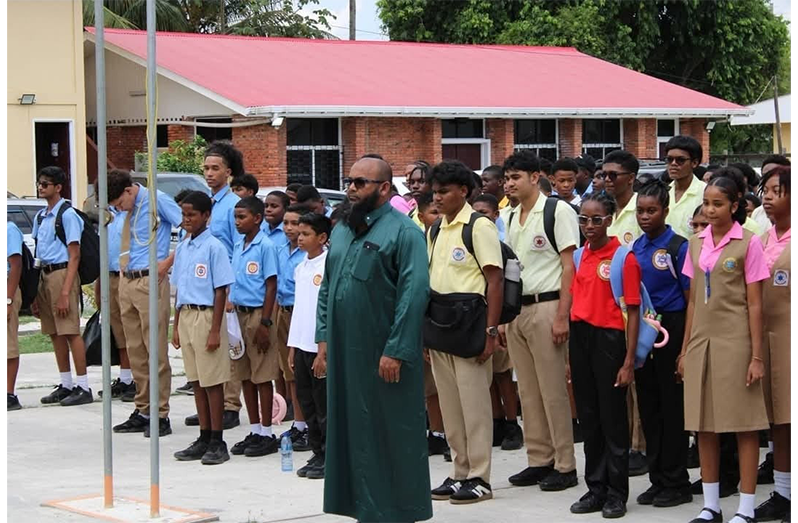
For Principal Wahid Omar, the September 15 anniversary is an opportunity to celebrate the institution’s achievements while paying homage to the people who laid its foundation.
“On behalf of the school community, I am deeply honoured to reflect on this extraordinary journey and to recognise the many individuals whose contributions have helped to shape this institution into what it is today,” Omar said.
According to Omar, at the helm was founding Headmistress Ms. Joyce A. Thomas, supported by Deputy Headmaster Mr. Reuben Dash, Senior Mistress Ms. Beverly Headly and Senior Master Mr. Michael Rambali.
The foundation teaching staff comprised six educators responsible for English, Social Studies, Home Economics, Integrated Science, Spanish and Agricultural Science.
But growth came quickly.
Less than a month after the school opened its doors, approximately 550 students were transferred from Berbice High School on October 13, 1975.
By the end of the 1975–1976 academic year, the student population had reached 861. The following year, enrolment surpassed 1,000.
Those early administrators and educators were doing far more than managing a rapidly expanding student population. They were laying the foundation for an institution that would eventually establish its own identity and traditions.
The school’s crest was introduced in February 1976. Then, in November 1977, came the words that would ultimately become synonymous with the institution: “Progress Through Co-operation.”
The motto captured an important philosophy that meaningful advancement in education requires students, teachers, parents and the wider community to work collectively.
In September 1978, the institution became known as the New Amsterdam Multilateral School, while January 1979 saw the inauguration of its Parent Teachers Association as the New Amsterdam Multilateral School and Community Council.
The foundation was firmly established and what followed was more than four decades of achievement.
“Those early pioneers were building more than a school. They were laying the foundation for an institution that would become an important part of the educational landscape of New Amsterdam, Berbice and Guyana”, Omar stated.
Over the decades, NASS has steadily built a reputation for achievement in academics, debating, technical education, culture and extra-curricular activities.
Its debating teams have captured several major competitions, including the Patrick Dargan, Prime Minister, Guymine and J.O.F. Haynes competitions, along with the Ministry of Agriculture’s National Agriculture Month debating competition. That tradition remains very much alive. In 2026, students of NASS again demonstrated their debating prowess when they emerged as Region Six champions of the J.O.F. Haynes Debating Competition.
Academically, the school’s students have also distinguished themselves nationally. Over the years, NASS students have earned Guyana Scholarship Awards for outstanding performances at the G.C.E. A-Level examinations.
In 1986, the school received two Ministry of Education National Awards, including first place for Outstanding All-Round Performance in Home Economics.
Recognition continued in later years with NASS being named the Most Improved Senior Secondary School, based on CXC results, in 1999 and again in 2018.
One of the institution’s major academic moments came in 2008 when Naomi Christie emerged as Guyana’s top CAPE student, while fellow NASS student Aliza DeNobrega secured the first runner-up position.
The school’s students have also gained Caribbean recognition in Agricultural Science and Technical and Vocational Education and Training (TVET). Kishan Critchlow earned a Caribbean award in 2014, while Anthony Sukra received similar recognition in 2020.
Then, in 2024, another student placed the institution firmly in the spotlight. Sohail Mohamad emerged as the top CSEC student for Region Six after securing an impressive 21 subjects, including 18 Grade Ones.
The accomplishment added another chapter to a history shaped by generations of students striving to excel. NASS has also demonstrated a willingness to move beyond conventional approaches to secondary education.
In 2004, the institution made history when it became the first school in Guyana to introduce Theatre Arts into its curriculum.
That pioneering spirit has continued through its emphasis on technical and vocational education. Since 2022, students have been able to pursue Caribbean Vocational Qualifications (CVQs), providing them with practical, competency-based training alongside traditional academic subjects.
The programme includes areas such as agriculture, agro-processing, construction, electrical installation, furniture making, metalwork, office administration, food preparation and data entry.
The significance of the programme was recognised beyond Guyana. Following an audit exercise in June 2024, the Caribbean Examinations Council named NASS a model institution for its CVQ programme.
It was an important recognition of the school’s efforts to ensure students leave secondary education equipped not only with academic qualifications, but with practical skills that can prepare them for employment, entrepreneurship and further education.
Meanwhile, Omar further explained that the school’s 2025 examination results provided another indication of its progress. NASS achieved a 90.6 per cent Grades One to Three pass rate at CSEC, placing sixth nationally for CSEC passes. The school also recorded an 85.6 per cent matriculation rate.
But there was another achievement that carried particular significance. For the first time in its history, NASS produced a cohort of dual-certified students – young people who successfully attained both CSEC and CVQ qualifications.
It represented an important development in the institution’s educational journey. Students were no longer being asked to choose between academic and vocational success. Instead, they were being provided with opportunities to pursue both.
That approach reflects the changing demands of education and the world of work, where academic knowledge, practical competency, creativity and adaptability increasingly complement each other.
ENDLESS TALENT
The NASS story, however, cannot be told through examination results alone, Omar noted adding that its sporting history is equally rich. Over the years, the institution has won the Castrol Under-15 Inter-County Cricket Tournament, the National Schools Cricket League New Amsterdam/Canje Division Championship and the YBG Division 2 Basketball Championship.
In 2012, NASS also captured the National Festival of Choirs title, demonstrating the diversity of talent among its students. The school has represented Guyana internationally through cricket, participating in the prestigious Sir Garfield Sobers International Schools Cricket Tournament in Barbados in 2011, 2012, 2013 and 2016. On each occasion, NASS emerged as the highest-placed Guyanese school.
Students Bryton Murray and Joshua Lalbachan also represented Guyana at the Under-13 Table Tennis Championships in Cuba in 2011.
Meanwhile, between 2013 and 2018, the school established a dominant presence in athletics, securing five consecutive Inter-Schools Athletics Championships. However, more recently, students have continued to excel in cricket, basketball, dance, dramatic poetry, costume competitions and other activities.
HONOURING ITS FOUNDERS AND EDUCATORS
These accomplishments have helped reinforce an educational philosophy centred on developing the whole student academically, physically, socially and creatively.
But anniversaries are not only occasions to celebrate achievements, rather they are also opportunities to remember. For Principal Omar and the NASS family, the 51st anniversary is therefore an occasion to recognise the people whose sacrifices may never appear on certificates, trophies or examination result sheets.
“The school honours its founding Headmistress, Ms Joyce A. Thomas, and the administrators and teachers who joined her in establishing the institution. It honours every Head Teacher and Principal who subsequently carried the responsibility of leading NASS through changing times.”
Additionally, “It remembers the educators who dedicated decades of their lives to preparing lessons, marking assignments, correcting mistakes, encouraging struggling students and celebrating their successes. The contribution of administrative and support staff is equally important, as is the work of successive Boards of Governors.”
Further, he said that parents and guardians have also remained essential partners in the school’s journey, entrusting generations of children to the institution while supporting teachers and administrators.
The wider New Amsterdam and Berbice communities, organisations and individuals who supported the school over the years are also part of that history.
“An anniversary such as this must never be about the present alone. It must also be an occasion to remember those whose vision, labour and dedication brought us here.”
However, Omar stressed that the greatest legacy of NASS cannot be placed inside a trophy cabinet but rather it is found in its people.
“It is found in the thousands of students who entered the institution as young boys and girls and eventually left its classrooms prepared to take their places in society. They have gone on to become professionals, educators, entrepreneurs, skilled workers, public servants, community leaders and contributors to Guyana’s development.”
“Every graduating class has carried a piece of NASS beyond the school compound. And every new student who walks through its gates becomes part of the next chapter.”
The school’s mission remains focused on developing the maximum potential of every student through meaningful learning experiences within a pleasant, stimulating and harmonious environment. Its philosophy similarly seeks to develop students’ abilities, skills and values so they can contribute meaningfully to their communities and country. “That responsibility remains as important today as it was in 1975”, Omar noted.
Omar took the opportunity to point out that much has changed since those first 181 students entered the school. “Education itself has changed. Technology has transformed the classroom. New career paths have emerged. Technical and vocational education has expanded, and the skills required by students entering the modern workforce continue to evolve and NASS has evolved with those changes.”
As the institution moves into another year, Omar said the focus remains on honouring its history while embracing the opportunities ahead.
“As Principal, I am proud to stand with the entire NASS family as we honour our past, celebrate our achievements and embrace the opportunities ahead,” he said.
“May we continue to strive for excellence. May we continue to serve our students and our nation. And may we continue, together, to live by the words that have defined this institution since its formative years: Progress Through Co-operation,” he added.