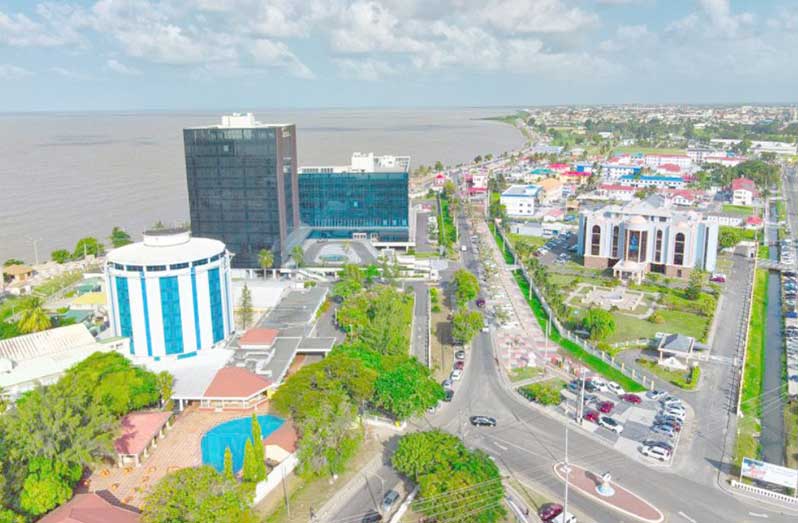
— tax exemptions, subsidies and increased social support help contain inflation amid higher global food and energy costs
THE International Monetary Fund (IMF) has recognised the Government of Guyana’s efforts to cushion households and businesses against rising global food and energy prices, noting that fiscal measures, subsidies and policies to expand the supply of goods and services have helped contain inflationary pressures.
In its 2026 Article IV Consultation Report, released on October 8, the IMF acknowledged that the government’s interventions have contributed to price stability while supporting economic activity and protecting consumers from the full impact of international price increases.
The Fund reported that average inflation remained contained at 3.3 per cent in 2025, even as global economic conditions placed additional pressure on the prices of essential goods and services.
Although inflation is projected to increase to 4.1 per cent in 2026, largely because of higher imported food and energy prices, the IMF noted that the impact of these increases on Guyana has so far been relatively muted compared with other countries.
According to the report, food prices remained the main driver of inflation throughout 2025 and the first half of 2026. However, the extent to which international price increases were passed on to domestic consumers was lower than in comparable economies.
The IMF attributed this outcome partly to government interventions, including Value Added Tax (VAT) exemptions, subsidies and measures aimed at increasing domestic production and the availability of goods and services.
The report stated that fiscal and supply-side measures have helped cushion near-term price pressures, while monetary operations have contributed to containing liquidity and exchange-rate pressures.
Significantly, the IMF estimated that VAT exemptions reduced VAT revenue by approximately 18 per cent over the 2021–2025 period, corresponding to an estimated annual inflation saving of about four per cent, assuming no demand effects.
The Fund also highlighted the government’s continued use of social transfers and other support measures to ease cost-of-living pressures.
Among these interventions is the G$100,000 cash grant, introduced in 2025 and renewed in the 2026 Budget.
The IMF noted that the government’s broader social support programmes, including assistance for pensioners, children, students and vulnerable households, form part of its strategy to support incomes while advancing national development.
According to the report, transfers since 2021 have contributed to significant improvements in real incomes for selected household groups, including pensioners and employed families receiving government assistance.
The Fund also recognised the government’s continued investment in housing development, healthcare, education and infrastructure as part of its wider approach to improving living standards and expanding economic opportunities.
In the energy sector, the IMF acknowledged the government’s policy of maintaining electricity tariffs through subsidies, helping to shield households and businesses from higher international fuel prices.
The 2026 Budget allocated G$25.6 billion to the Guyana Power and Light Inc. (GPL) to support the maintenance of existing electricity prices, according to the IMF’s assessment of public enterprises.
The Fund estimated that the subsidy associated with fixed electricity tariffs would increase from approximately 0.3 per cent of GDP in 2025 to 0.5 per cent in 2026, reflecting higher fuel prices.
However, the IMF also cautioned that broad-based subsidies and tax exemptions carry fiscal costs and can weaken price signals in the economy.
It recommended that Guyana gradually improve the targeting of subsidies and price-mitigating measures to ensure that support reaches those most in need while safeguarding long-term fiscal sustainability.
The report further emphasised the importance of maintaining prudent monetary and fiscal policies as the economy continues to expand.
Despite these considerations, the IMF maintained a highly favourable outlook for Guyana, projecting economic growth of 22.3 per cent in 2026, supported by expanding oil production and strong non-oil economic activity.
The Fund concluded that continued policy vigilance, alongside investments in productive capacity and economic diversification, will be essential to maintaining price stability and ensuring that Guyana’s economic growth translates into sustainable improvements in living standards.