







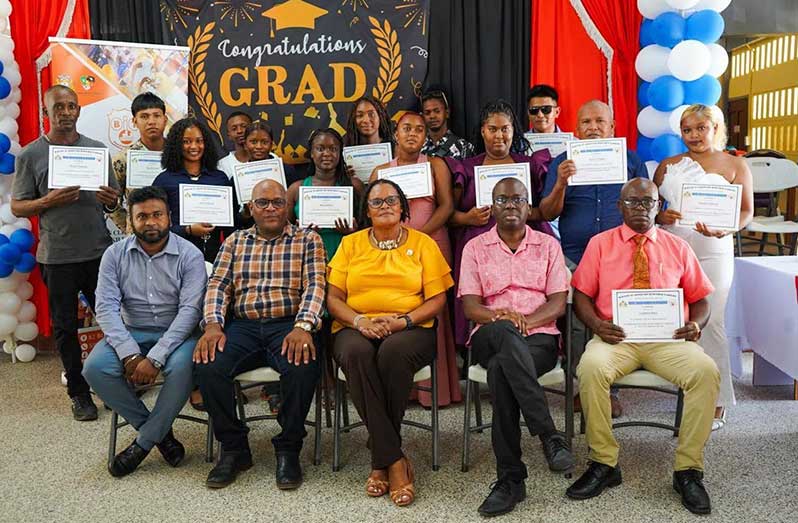
Forty-seven residents of the Essequibo Islands have graduated from Board of Industrial Training (BIT) programmes in four occupational areas, as the Government continues to expand access to practical skills training in Region Three.
The graduates comprise 31 trainees from Wakenaam and 16 from Caria Caria, with the programmes representing a government investment of $4.76 million.
The graduates from Wakenaam completed training in auto-electrical work, electrical installation, and welding and fabrication, while the Caria Caria trainees completed a Heavy-Duty Equipment Operation programme.
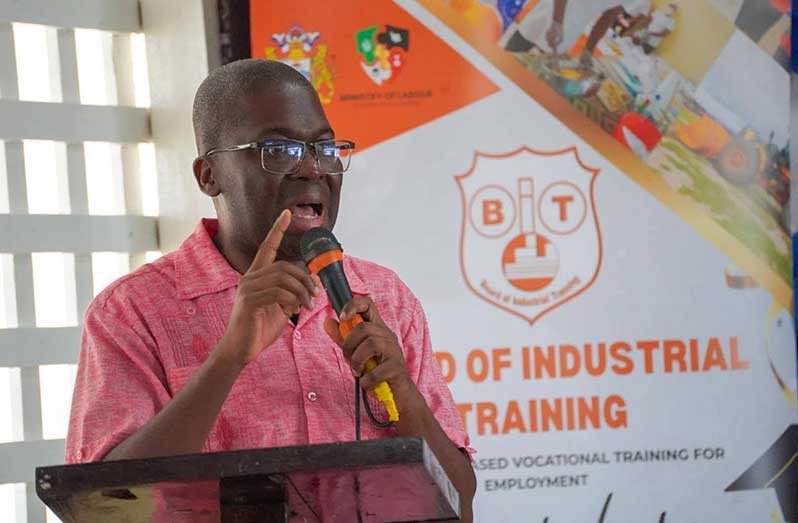
The graduation ceremony was held on Monday at Wakenaam Secondary School, where BIT Chief Executive Officer Richard Maughn urged the graduates to turn their newly acquired skills into employment, entrepreneurship and opportunities for others.
Maughn said the certificates were only the beginning, stressing that the graduates’ success would ultimately depend on how effectively they applied what they had learnt.
“Be disciplined. Be dependable. Continue learning. Take pride in the quality of your work,” Maughn told the graduates.
He also encouraged them not to allow their place of origin to limit their ambitions and urged them to assist others as they advance in their respective careers.
“When it is within your ability to do good, be willing to act,” he said.
The latest graduation forms part of a broader BIT skills development initiative that has benefited 285 people through 25 training projects across the Essequibo Islands between 2020 and 2026.
The programme has benefited 146 males and 139 females, with total expenditure amounting to $30,934,133.83.
Training over the six-year period covered a wide range of occupational areas, including information technology, electrical installation, garment construction, welding and fabrication, auto-electrical work, small engine repairs, boat building, cosmetology, heavy-duty equipment operation, general building construction and agro-processing.
Maughn said the government’s investment in workforce development must ultimately translate into tangible outcomes, including employment, improved quality of work, self-employment and greater contributions to local communities.
The 2026 graduates included nine persons in auto-electrical work, 12 in electrical installation, 10 in welding and fabrication, and 16 in heavy-duty equipment operation.
Of the 47 graduates, 29 are males and 18 are females.
The BIT CEO said the training initiative was part of the Board’s broader mandate to ensure that people, regardless of where they live, have access to practical skills capable of improving livelihoods while meeting Guyana’s growing development needs.
He urged the graduates to continue upgrading their skills and to use their training to create opportunities for themselves, their families and their communities.



