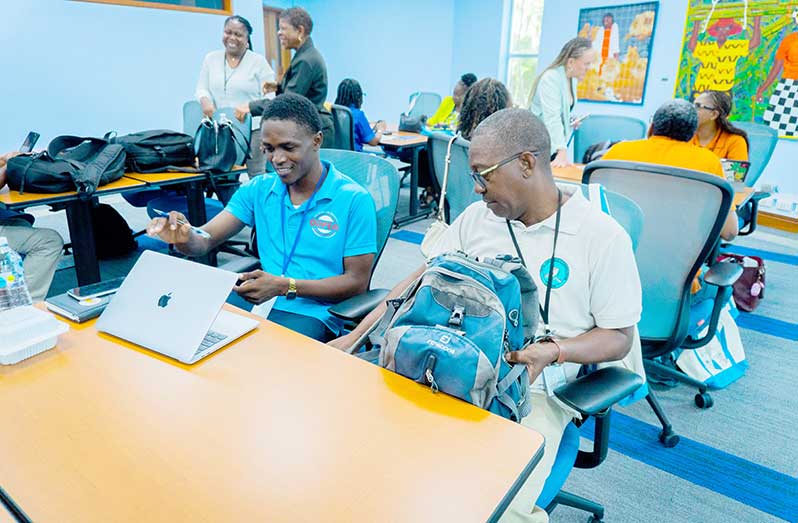
Guyana is strengthening its capacity to manage emergency shelters during disasters through the participation of two Civil Defence Commission (CDC) representatives in a regional Training-of-Trainers programme underway in Barbados.
The three-day Caribbean Advanced Emergency Shelter Training of Trainers began on Tuesday at the United Nations House in Bridgetown, bringing together 20 experienced shelter practitioners from seven Caribbean countries and territories.
Guyana is represented by Althea Stuart and Owen Paul of the CDC, the national agency responsible for disaster preparedness and response.
The training, which runs from July 21 to 23, is being delivered by the International Organization for Migration (IOM) in collaboration with the Caribbean Disaster and Emergency Management Agency (CDEMA), REACT Disaster Response and UN Women. It is funded by European Union Humanitarian Aid under the Resilient Caribbean Project.
The programme is designed to improve the region’s ability to operate emergency shelters safely, efficiently and with dignity when disasters force people from their homes.
Participants from Barbados, Grenada, Guyana, Jamaica, Saint Lucia, Saint Vincent and the Grenadines, and Sint Maarten are receiving advanced training based on the global Camp Coordination and Camp Management package, adapted to the Caribbean context.
The course covers data and information management, prevention of sexual exploitation and abuse, prevention of and response to gender-based violence, community engagement and information-sharing, and the respective roles of authorities and humanitarian organisations during disaster response.
It also includes intensive facilitation exercises to prepare participants to train other shelter personnel in their respective countries.
“This advanced, rights-based training package is designed to make a practical difference for families forced to leave their homes,” said Patrice Quesada, IOM Coordinator for the Caribbean.
“The next time a shelter opens, staff will be better prepared to register families quickly, identify those most at risk, and connect people to the support they need with dignity and care,” she added.
Each newly certified trainer is expected to deliver at least one follow-up shelter training in their home country within 12 months. The approach is intended to extend the impact of the regional programme and strengthen national preparedness ahead of future emergencies.
The training is also expected to improve the ability of shelter volunteers and staff to prevent and respond to sexual exploitation, abuse and gender-based violence, provide residents with clear information about available services and ensure that people know where to seek help or report concerns.
Particular attention is being placed on vulnerable groups, including older persons, persons with disabilities, children and single-parent households, who can benefit significantly from shelter systems capable of identifying needs early and providing appropriate support.
The training forms part of a wider series of regional capacity-building initiatives under the Resilient Caribbean Project, Fostering Collaborative Approaches to Disaster Preparedness in the Caribbean, implemented by the IOM with funding from European Union Humanitarian Aid.
Virginie Andre, Programme Manager for Disaster Risk Management at the EU Delegation covering Barbados, the OECS, Eastern Caribbean States and relations with Overseas Countries and Territories, said the European Union remained committed to strengthening disaster preparedness, anticipatory action and regional cooperation.
“With displacement caused by hurricanes and other hazards rising across the region, strong capacity to manage emergency shelters has become even more essential, and this investment is both timely and worthwhile,” she said.
The IOM Caribbean team expressed gratitude to EU Humanitarian Aid for its continued support for preparedness initiatives and for helping mobilise resources before disasters occur.
The regional effort is ultimately aimed at strengthening the ability of Caribbean countries to save lives, protect displaced populations and provide safe and dignified support to people affected by disasters.