






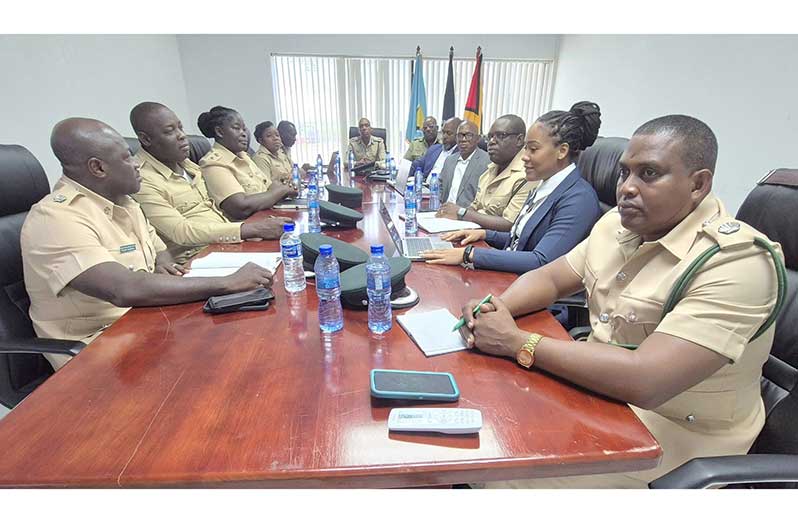
THE Guyana Prison Service (GPS) and St. Lucia’s Correctional Services have begun discussions aimed at strengthening regional co-operation in prison management, security, intelligence gathering and inmate rehabilitation as Caribbean countries continue efforts to modernise their correctional systems.
Director of Prisons, Nicklon Elliot and members of the Guyana Prison Service’s leadership team, on Monday, met with St. Lucia’s Acting Director of Correctional Services, Kerwin Albert, and Research Officers Dr Montelle Feliz and Dr Leonard Johnny to explore opportunities for closer collaboration between the two institutions.
According to the Guyana Prison Service, the engagement is intended to build stronger partnerships between the correctional agencies, enhance institutional capacity and foster a culture of mutual support and knowledge sharing.
The discussions focused on several key operational areas, including prison security, intelligence management and rehabilitation programmes designed to prepare inmates for successful reintegration into society.
The meeting comes at a time when correctional services across the Caribbean are increasingly shifting from traditional punitive approaches toward rehabilitation-centred models that emphasise reducing recidivism and improving public safety.
In Guyana, prison reform has become a major focus of the correctional system in recent years. The Guyana Prison Service has implemented a range of modernisation initiatives, including the digitisation of inmate records, expansion of vocational training programmes and upgrades to prison infrastructure. Officials have also been pursuing reforms aimed at aligning prison operations with international correctional standards and best practices.
The government has invested heavily in the prison sector, with more than $28 billion allocated since 2021 for infrastructure upgrades, officer training, security improvements and rehabilitation programmes. The reforms are part of a broader effort to transform prisons into correctional institutions focused on rehabilitation and reintegration rather than punishment alone.
Recent figures released by the Guyana Prison Service show that hundreds of inmates annually participate in rehabilitation and skills-training programmes, while more than 1,300 inmates received vocational, academic and behavioural training during 2025.
Officials have linked these programmes to efforts to reduce repeat offending and improve reintegration outcomes.
St. Lucia has similarly pursued reforms within its correctional system through the Bordelais Correctional Facility, the island’s main prison institution. The facility has expanded educational, counselling and rehabilitation programmes while also addressing challenges such as contraband smuggling, gang-related tensions and inmate reintegration.
Observers say increased collaboration among Caribbean correctional services is becoming increasingly important as countries confront common challenges, including prison security, overcrowding, rehabilitation, mental health services and the management of transnational criminal networks.
The latest engagement between Guyana and St. Lucia is expected to facilitate the exchange of best practices and strengthen regional approaches to corrections management, with both countries seeking to improve institutional effectiveness while enhancing public safety and inmate rehabilitation outcomes.




