






–rejects suggestions of US dominance
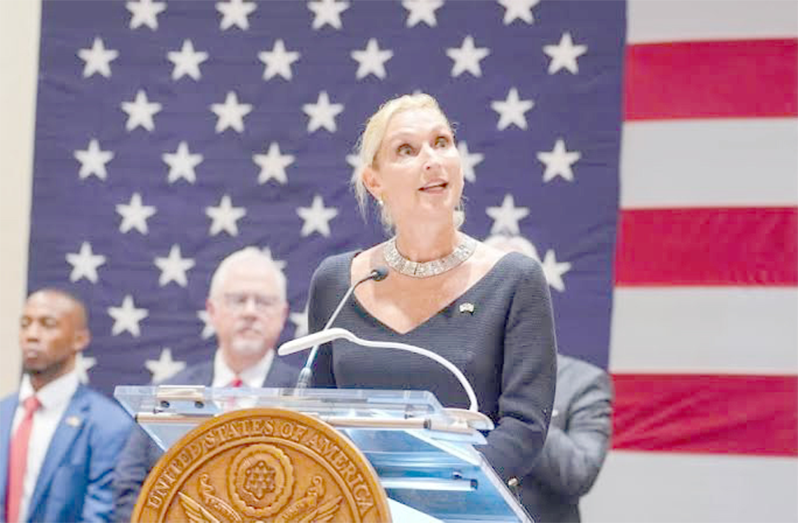
UNITED States Ambassador to Guyana Nicole Theriot has described relations between the two countries as a “50-50” partnership, rejecting suggestions that Washington seeks to dominate Guyana amid concerns about the Trump administration’s approach to the Western Hemisphere.
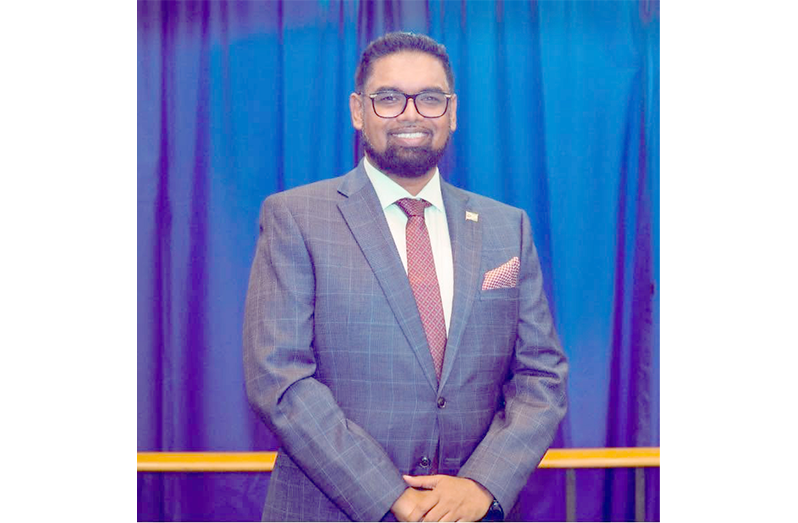
Theriot made the remarks during a recent interview when asked to characterise the relationship between the two countries following President, Dr Irfaan Ali’s appearance on CNN, where he was questioned about US influence, energy co-operation and the protection of Guyana’s sovereignty.
“It’s a partnership. It’s 50-50, absolutely. There is no dominance. It is very, very much a partnership,” Theriot said.
She added that Washington also benefits from its relationship with Guyana, emphasising that co-operation between the two countries should be mutually beneficial.
The ambassador said, “We feel like [sic] we benefit from our relationship with Guyana, hopefully as much as they benefit from us. It’s a true partnership in every sense of the word,”
Her remarks come amid heightened international attention on the United States’ regional policy under President Donald Trump, whose statements about expanding American influence in the hemisphere have prompted questions about the balance of power between Washington and smaller regional states.
During his CNN interview with anchor and Chief National Security Analyst Jim Sciutto, Dr Ali was asked whether he was concerned that the United States could seek to control Guyana rather than engage it as an equal partner.
Sciutto referenced Trump’s remarks about Greenland, Canada and Venezuela, noting that the US President had sometimes spoken in terms of acquisition and control rather than partnership.
Dr. Ali rejected the suggestion that Washington was seeking to impose its will on Guyana, pointing instead to shared interests and co-operation between the two countries.
“I don’t see the US as trying to force us or trying to be a dominant force with Guyana,” Dr Ali said.
The president said Guyana remained interested in strengthening ties with Washington, particularly in development and security, but insisted that the relationship must be grounded in mutual respect and shared objectives.
He added, “We have made it very clear that we are deeply interested in partnership, working together with the US. We see the US as an important ally of Guyana, and the partnership that we built must be built on shared values, shared benefit, and the joint development and prosperity of our Region.”
President Ali said that a relationship based on those principles could remain sustainable over the long term and benefit both countries as well as the wider Region.
“I can speak for Guyana. That is how we are pursuing this relationship,” he told CNN, adding that Guyana was working with the United States “as a partner in development, as a partner in security”.
“We are a sovereign state, and we are working with the US as a partner,” he said.
The US-Guyana relationship was also discussed in the context of the country’s expanding oil and gas sector, including the production-sharing agreement with ExxonMobil, which was signed by the previous administration.
Dr Ali acknowledged that the agreement might not offer Guyana the best possible deal, but said his government was focused on maximising the benefits available to the country, while respecting the existing contract.
He said, “Whilst it may not be a contract that offers the best deal to the country, it is a contract that we have entered into as a country.”
He explained that the government was seeking to transfer greater benefits to Guyanese citizens and businesses through its management of the petroleum sector.
The president also disclosed plans to develop investment vehicles that would allow ordinary Guyanese families to invest in energy-sector projects and earn returns, giving them a more direct stake in the industry.
He noted that Guyana’s petroleum investments involve several international companies, including ExxonMobil, Chevron and China National Offshore Oil Corporation (CNOOC), describing the sector’s global investment base as diversified.
ExxonMobil operates the Stabroek Block and holds a 45 per cent stake, while US-based Chevron holds 30 per cent and CNOOC holds the remaining 25 per cent.
The Guyanese leader also addressed Guyana’s long-standing territorial controversy with Venezuela over the Essequibo region, reiterating that the matter is before the International Court of Justice (ICJ).
He said Guyana anticipates a ruling in the case and would abide by the court’s decision, while encouraging Venezuela to do the same.
The United States has repeatedly reaffirmed its support for Guyana’s sovereignty and territorial integrity amid the ongoing border controversy with Venezuela.
Ambassador Theriot previously declared that the United States would stand “shoulder to shoulder” with Guyana in defence of its sovereignty.




