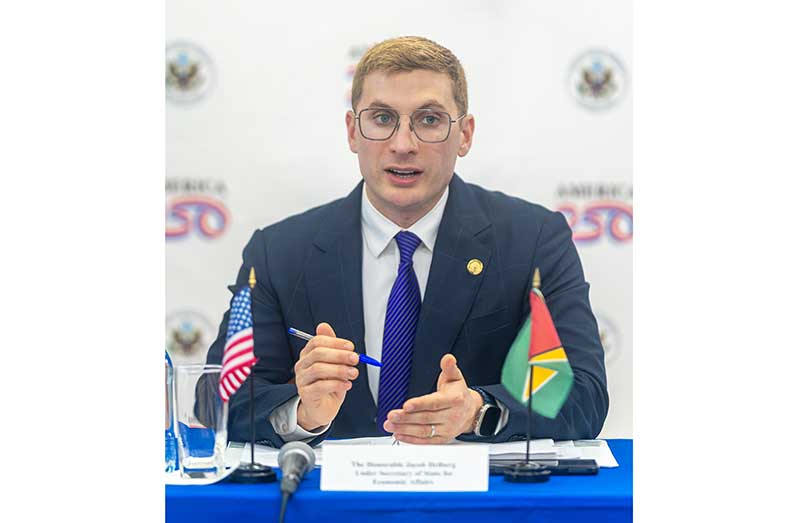
UNITED States Under Secretary for Economic Affairs, Jacob Helberg, on Wednesday, said Washington has taken note of Venezuela’s position rejecting the jurisdiction of the International Court of Justice (ICJ) in the border controversy with Guyana, and has since been engaged in “private conversations” on security.
“We’re monitoring events at the ICJ very, very closely. We understand and agree that security is a precondition for prosperity, and ultimately a lot of those conversations right now will be private, and we believe that we can make progress through private conversations,” he told reporters at a press briefing at the U.S Embassy in Guyana.
Venezuela’s Interim President Delcy Rodriguez had told the ICJ that Venezuela would not accept an ICJ decision which favours Guyana.
During recent hearings before the ICJ in The Hague concerning the longstanding controversy over the Essequibo region, Guyana had argued that Venezuela’s claims to the Essequibo region threaten the country’s territorial integrity, peace and development.
The ICJ had already issued provisional measures ordering Venezuela to refrain from actions that could alter the status quo in the territory while the case remains before the court.
Guyana has repeatedly maintained that it remains committed to a peaceful resolution of the controversy through the rule of law and the ICJ process.
As oral hearings concluded at the ICJ at the Peace Palace in The Hague, Netherlands, earlier this week Attorney General and Minister of Legal Affairs, Anil Nandlall, described the completion of proceedings as a triumph for international law and the rules-based global order, while warning that any refusal by Venezuela to comply with the court’s eventual ruling would place Caracas in breach of fundamental international obligations.
“The very fact that this case reached the ICJ, and that the written and oral phases of the proceedings were carried out to their completions, represents a triumph for the rule of law and the rules-based international order,” Nandlall said in a statement issued shortly after hearings ended.
“Disputes between States must be resolved peacefully, finally and in conformity with international law. They must not be allowed to fester indefinitely. They must never be resolved by threat or use of military force.”
The oral hearings, held between May 4 and May 11, saw Guyana and Venezuela present arguments in two rounds of pleadings before the ICJ — the United Nations’ highest judicial body.
The court will now deliberate before issuing its final judgment on the merits of the case, a ruling Nandlall stressed will be legally binding on both countries.
At the centre of the controversy is Guyana’s request for the court to affirm the legal validity of the 1899 Arbitral Award, which established the international boundary between then British Guiana and Venezuela.
Guyana argued the award conclusively settled the border more than a century ago, while Venezuela maintains its claim of invalidity.
Importantly, the ICJ has already ruled that it has jurisdiction to hear and determine the matter on its merits. In a December 2020 judgment, the court rejected Venezuela’s challenge to its authority and ruled it has the power to determine the validity of the 1899 award and the land boundary between the two neighbouring states.
According to Nandlall, Guyana entered the hearings confident in its legal position but emerged even more optimistic after presenting its case.