






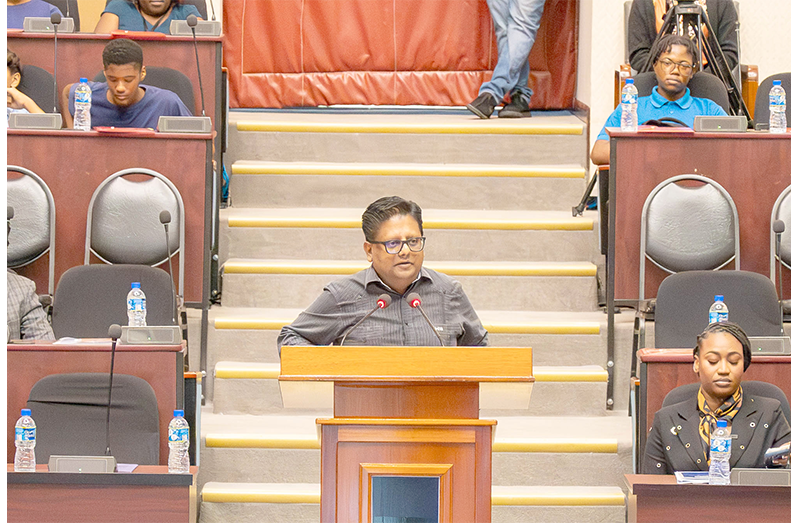
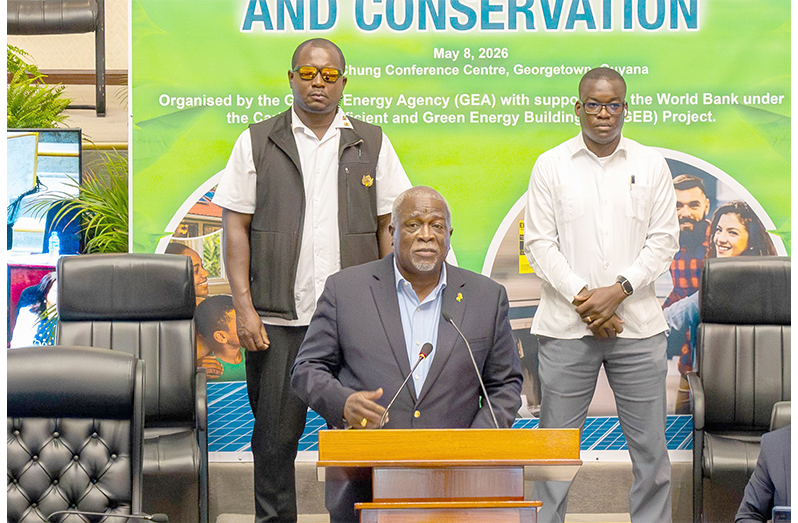
AT the opening of a National Seminar on Energy Efficiency held at the Arthur Chung Conference Centre, Liliendaal on Friday, Prime Minister Brigadier (ret’d) Mark Phillips highlighted the government’s focus on reduced energy usage and steps being taken to shield Guyanese from the unstable global energy markets.
The event, hosted by the Guyana Energy Agency (GEA) with support from the World Bank, formed part of Guyana’s continued efforts to advance energy efficiency as a cornerstone of the country’s Low-Carbon Development Strategy (LCDS), energy transition, and fiscal sustainability agenda.
Energy efficiency (EE) is globally recognised as a cost-effective and reliable means of reducing energy costs, improving system reliability, strengthening energy security, and supporting climate resilience. Further, it is an integral pillar of Guyana’s LCDS, and a critical enabler for not only reducing electricity costs and public expenditure, but also improving system reliability as electricity demand grows, easing energy imports and enhancing climate resilience and fiscal sustainability.
The World Bank recently elevated energy efficiency as a core corporate priority through its Energy Efficiency Scale-up Approach Paper which emphasises stronger policies, market creation, innovative financing, and utility-led demand side solutions.
Under the Caribbean Efficient and Green Energy Buildings (CEGEB) Project, the World Bank is lending its support to Guyana to scale-up EE investments in public buildings and facilities, strengthen regulatory frameworks and build local capacity.
The seminar aimed to share global World Bank experiences and lessons from successful EE programmes, present the World Bank’s EE Scale-Up Strategy and its relevance for Guyana, create awareness of the importance of EE in public buildings and facilities, discuss market and financing mechanisms to unlock EE investments, and identify practical next steps for scaling EE market transformation under CEGEB and beyond. The seminar targeted key government of Guyana agencies including GEA, the Ministry of Finance, GPL, GNBS, and the Ministry of Housing, to name a few.
Delivering the keynote address, Prime Minister Phillips posited that the CEGEB Project, supported by the World Bank, is the vehicle through which we are seizing opportunities in the public sector.
“In our public buildings, that is the schools, hospitals, offices, police stations, these are facilities operated by the government, so we must lead by example, retrofitting our public buildings, encouraging energy efficient standards, new construction, establishing building energy codes, setting minimum energy performance standards for lighting, air conditioning, refrigeration and future appliances are grounded, and programmes that the Guyana Energy Agency and our partners are advancing, and it has our government’s full and unambiguous support,” the Prime Minister said.
He noted that the current period of heightened geopolitical uncertainty being experienced around the world, along with ongoing international conflicts, tensions in major oil producing regions, disruptions to global shipping routes and instability in energy markets have driven fuel prices significantly higher.
However, Guyana has experienced an average of 74.8 per cent increase in fuel import costs since the start of 2026 alone. Gasoline acquisition costs rose by 62.4 per cent, diesel by 7.3 per cent, and jet fuel by an extraordinary 102.6 per cent the PM revealed.
These numbers, according to Prime Minister Phillips, translates directly to a higher cost for utilities, businesses and for each household in Guyana.
“Our government has taken steps to shield our citizens. The excise tax on fuel has been held at zero per cent since March 2022, and we continue to monitor markets and engage with local oil companies on mitigation measures. We are expanding fuel storage capacity and investing in infrastructure to reduce the risk of supply disruptions, but these are defensive measures. The strategic answer that addresses the root of our vulnerability is to reduce our dependence on imported energy through the twin pillars of renewable energy supply and energy efficiency,” he said.
Additionally, he said that Guyana must embrace energy efficiency, which is described as the cheapest, cleanest, and most immediately available energy resource in any country around the globe, with the same ambition and urgency we bring to our supply side investments.
The PM acknowledged the government’s strides in this regard with the addition of more than 186 megawatts of new generating capacity. Government has also constructed solar farms, completed a few hydro power plants, installed over 46 solar mini grids and distributed 37, 230 Solar Home Energy Systems. This adds more than 37 megawatts of renewable energy. The government is also advancing the 165 megawatts Amelia Falls Hydropower Project.
Sharing similar remarks, Senior Minister with Responsibility for Finance Dr. Ashni Singh said that when we speak on energy security, it is not merely about ensuring we have adequate energy but also ensuring that we use what we have as efficiently as possible.




