






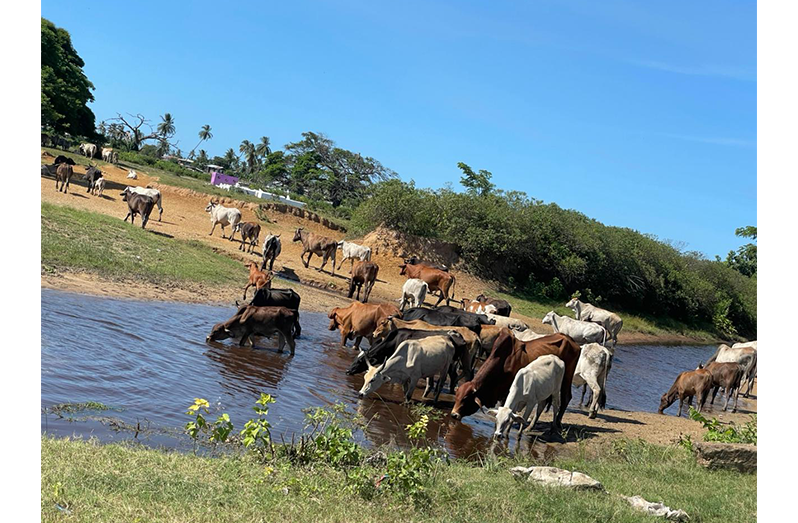
THERE is a particular kind of quiet confidence that comes not from books or boardrooms, but from years of early mornings, muddy boots, and watching life grow under your care.
At 22, Shakeem McCalmon of Bel Air Village, West Coast Berbice, carries that confidence like a second skin.
While most young men his age are still figuring out who they want to be, Shakeem already knows. He is a cattle farmer, and he would not have it any other way.
Shakeem’s education in livestock began long before any formal training. Growing up, he spent his days watching his father, Relvon McCalmon, tend to cows with a patience and precision that left a lasting impression.
There were no textbooks, no classrooms, just a boy, his father, and the rhythms of farm life.
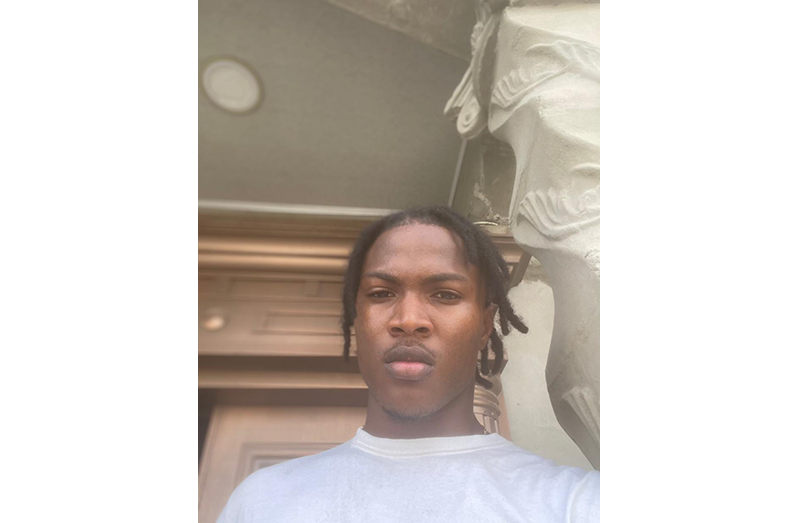
“Having my father’s support really encouraged me to buy more cows,” Shakeem recalled, noting: “I saved, kept buying, and he also funded me in purchasing more. He owned 80 percent of the farm at one point, and I am grateful for that push and motivation.”
When he had finished high school, Shakeem made a choice that surprised many around him. Rather than chasing a city job or an uncertain career, he turned back to the land he had grown up loving.
With $160,000 saved from construction work, money earned by the sweat of his hands, he bought his first cow. Not as an investment. Not as a business strategy. Simply as a pet.
That single animal would change the course of his life.
What started as affection gradually became ambition. Encouraged by his father, who contributed animals from his own herd and stood as both financial backer and moral compass, Shakeem’s modest beginning expanded steadily.
Today, he manages a herd of approximately 60 cattle, primarily Brahman and Holstein crosses, on land he has learned to work, protect, and stretch.
At its peak, the herd numbered 90 head. But farming, as Shakeem has come to understand, does not reward complacency.
The floods of 2021, devastating to many, briefly created lush grazing conditions that worked in his favour. Then came the dry season of 2024, which was far less forgiving.
Pasture quality declined sharply, and herd numbers followed. Yet Shakeem did not give up. He adapted.
FIGHTING FOR EVERY ACRE
Perhaps the most persistent challenge facing young farmers like Shakeem is one that rarely makes headlines– land. The communal pastures that once sustained livestock farmers across Region Five are slowly disappearing, swallowed by rice cultivation and the creeping expansion of housing developments.
Where cattle once grazed freely, fences and paddy fields now stand. For Shakeem, this is not an abstract policy problem. It is a daily reality. His response has been practical and creative: he splits his herd between semi-intensive feeding near his home and rotational grazing on backlands when conditions allow.
It is not an ideal system, but it is a working one.
SCIENCE MEETS TRADITION
What sets Shakeem apart from many of his peers is his willingness to embrace new knowledge without abandoning old wisdom.
Through the Guyana Livestock Development Authority’s (GLDA) national artificial insemination programme, he has introduced superior genetics, including Girolando, Brown Swiss, and Beefmaster breeds into his herd, improving both milk yield and animal quality.
“I am thankful to Mr Mahase, GLDA’s Region Five AI technician, and the entire extension team for their support. I am proud to say that this system works for me,” he said with quiet pride.
He is equally appreciative of the broader support network around him. Whether it is a disease-management workshop, a biosecurity training session, or a phone call to a GLDA veterinary officer, Shakeem treats every resource as an opportunity to grow.
His recent participation in GLDA’s farmer-sensitisation programme on Bovine Tuberculosis and Bovine Brucellosis has deepened his understanding of herd health.
“I am appreciative of the blended approach of incorporating the traditional knowledge I learned from my father and the constant training offered by GLDA,” he said.
The young farmer added: “These are helping me to develop better-quality animals and manage my livestock like a real business.”
Shakeem still picks up part-time construction work to supplement his income, but for the past seven months, he has managed the farm entirely on his own.
He speaks about the future, fenced land, better market access, improved herd genetics, and eventually export markets, not as distant dreams, but as the next logical steps in a plan already in motion.
The young farmer is confident that Guyana’s evolving agricultural infrastructure, including the new abattoir at Onverwagt, will translate into better prices for farmers like himself.
He believes, firmly, that the livestock industry is not a relic of the past, but a genuine and rewarding path for young people willing to put in the work.




