A $1.6 billion investment in a modern paddy drying and storage facility at Onderneeming, Essequibo Coast, is expected to strengthen Region Two’s rice industry, reduce post-harvest losses and provide farmers with greater flexibility in marketing their produce.
The sod-turning ceremony for the facility was held on Friday, October 16, 2026, with Minister of Agriculture, Zulfikar Mustapha; Minister within the Ministry of Agriculture, Vikash Ramkissoon; Permanent Secretary, Daun Ellis; Member of Parliament, Sonia Latchman; and Regional Chairman Devin Mohan, among those in attendance.
The project represents a major investment in agricultural infrastructure, as the government moves to expand the capacity of the rice industry and address challenges associated with inadequate drying and storage facilities during the harvesting season.
Addressing farmers, millers and other stakeholders, Minister Mustapha said Region Two remained one of Guyana’s leading rice-producing regions, contributing significantly to the country’s agricultural output and export earnings.
He said that the region has approximately 36,000 acres under rice cultivation, representing about 16 per cent of Guyana’s total rice acreage, and produces approximately 1.4 million bags of paddy per crop. In 2025, Region Two accounted for approximately 25 per cent of the country’s rice exports.
However, as production continues to expand, existing drying and storage infrastructure has struggled to keep pace with the growing demand.
Minister Mustapha said that the region’s eight rice mills can accommodate approximately 30,000 bags of paddy daily, leaving farmers vulnerable to delays during periods of peak harvesting.
He also highlighted the financial consequences of inadequate storage, noting that approximately 16,000 bags of paddy, valued at $64 million, were spoiled during the first crop of 2025.
“No farmer should have to watch a good harvest spoil because the necessary infrastructure does not exist,” Minister Mustapha said, underscoring the importance of the new facility in protecting farmers’ investments and livelihoods.
When completed, the facility will feature three modern storage silos with a combined capacity of 10,000 tonnes. It is expected to facilitate the drying and storage of approximately 500,000 additional bags of paddy per crop.
The infrastructure will also allow paddy to be preserved under controlled conditions for between eight and 12 months, giving farmers and millers greater flexibility to manage their produce and make marketing decisions without being pressured to sell immediately.
Minister Mustapha said the investment was part of the government’s broader commitment to building a stronger, more competitive and climate-resilient rice industry.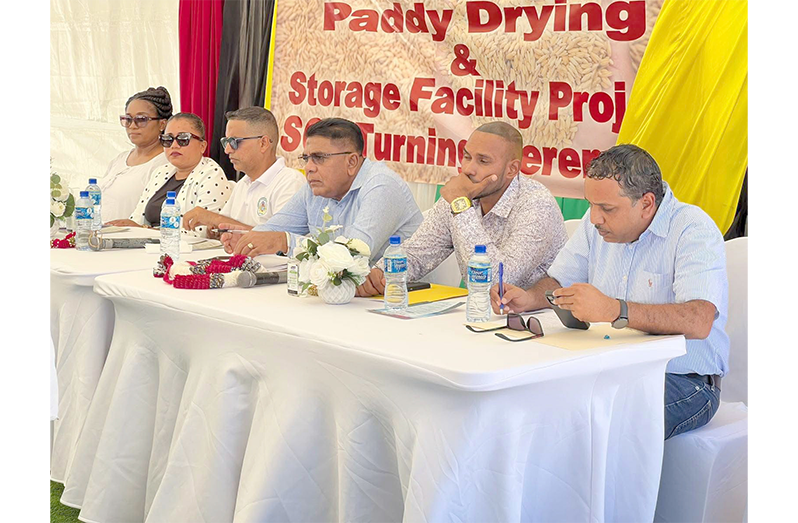
He noted that Region Two’s rice acreage is projected to increase to approximately 40,000 acres, with production potentially reaching 1.8 million bags per crop as yields improve from about 38 bags per acre to 45 bags per acre.
The facility is expected to directly benefit approximately 1,400 to 1,500 rice farmers, while creating employment opportunities in construction, operations, transportation and logistics.
Providing an overview of the project, Chief Executive Officer of the National Drainage and Irrigation Authority, Lionel Wordsworth, said that the facility is being developed on approximately 10 acres of land to accommodate the current infrastructure and allow for future expansion.
He said the initial development would establish 10,000 tonnes of storage capacity, while the overall design provides for a potential capacity of 20,000 tonnes through the addition of another row of silos.
Wordsworth outlined that the facility would be equipped with two mechanical dryers capable of processing approximately 900 to 1,000 tonnes of paddy daily, four wet bins, receiving silos, conveyors, elevators and cleaning equipment.
The storage system will also incorporate temperature monitoring and carbon dioxide controls to help preserve paddy quality over extended periods.
He said that the facility would operate through a centrally monitored Supervisory Control and Data Acquisition (SCADA) system, allowing the equipment to be monitored and managed electronically.
The project has been divided into two main components. The civil works, including foundations, access roads and buildings, were awarded to 4N Hardware, while Superbrick, a European company, was contracted to supply the engineering equipment and oversee its installation.
Wordsworth said the project is scheduled for completion within one year and assured stakeholders that the relevant agencies would work closely with the contractors to ensure the facility is delivered according to the agreed specifications.
Minister within the Ministry of Agriculture, Vikash Ramkissoon, described the sod-turning as a demonstration of the government’s continued commitment to farmers and the development of the agricultural sector.
He pointed to the significant increase in public investment in agriculture, noting that allocations have risen from approximately $18 billion in 2020 to $113 billion in 2026.
Ramkissoon said the government’s objective is to increase national rice production to one million tonnes by 2030, adding that achieving this target would require continued collaboration between the government and farmers.
He highlighted investments in fertiliser support, crop insurance and other interventions designed to reduce production costs and strengthen farmers’ capacity to remain productive.
The minister also pointed to the role of the Guyana Development Bank in providing financing to farmers, particularly those seeking to return to cultivation or expand their operations.
He said that improved storage capacity, coupled with access to financing, could give farmers greater control over when they sell their produce and help them secure better prices.
Regional Chairman Devin Mohan said the development is expected to strengthen Region Two’s position in Guyana’s rice industry while supporting the wider network of farmers, millers, exporters, transport operators and other businesses that depend on the sector.
For the Essequibo Coast, he said the project marks a significant step towards modernising agricultural infrastructure, reducing avoidable losses and ensuring that increased production is matched by the capacity to dry, preserve and market the region’s paddy.
Rice farmers expressed gratitude to the Governments of Guyana and President Irfaan Ali for listening to their request.
“We are thankful for this facility; we look forward to this for we can now dry and store our paddy for better prices” Narine Persaud said.
Other rice farmers expressed their gratitude to the government for listening to their concerns and ensuring they were being addressed.