







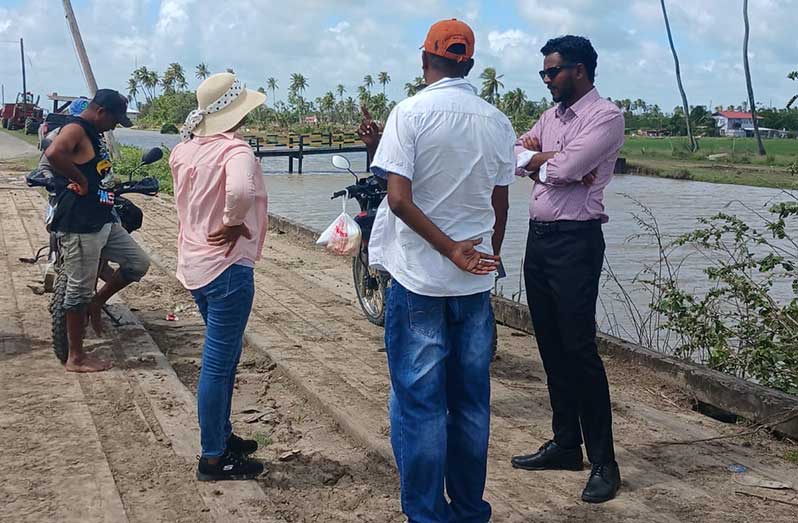
–water steadily receding, Regional Chairman says
REGIONAL Chairman of Region Six (East Berbice-Corentyne), Junior Basant, has assured residents and farmers that decisive interventions implemented by Minister of Agriculture, Zulfikar Mustapha, to address flooding in the region are yielding positive results, with all systems now fully operational and water levels steadily receding.
Several sections of the residential and farming areas in Black Bush Polder are no longer flooded, following immediate relief measures that were put in place by the ministry’s National Drainage and Irrigation Authority (NDIA) to assist affected farmers and residents.
Eight excavators were deployed to carry out immediate drainage works in Yakusari, Johanna, and Mibicuri.
Additionally, small mechanical pumps have been placed in affected residential areas, while an 80 cubic-feet-per-second drainage pump is being transported for installation at the Number 43 Village outfall to supplement existing pumps.
Engineers from NDIA continue to closely monitor the situation to ensure timely and effective interventions.
According to Basant, a comprehensive drainage plan has been successfully executed following recent flooding, with seven pumps currently operating across key locations including 43, Eversham and Lesbeholden.
These pumps are actively draining excess water from farmlands and surrounding communities, significantly easing the impact of prolonged rainfall.
“So far, 100 per cent of those plans have been implemented. In total, eight pumps are operating at 43, Eversham and Lesbeholden head, draining the lands here and taking the water out,” Basant said.
He highlighted: “Those plans are active, all the pumps are functional, and all the kokers are functional as well.”
The Regional Chairman commended the timely interventions spearheaded by Minister Mustapha, noting that the government has remained proactive in responding to the needs of affected communities.
“These interventions are working,” Basant stressed, adding: “As a government, we do not sit idly by and let things go. We come on the ground and get the job done, and we have always been doing that.”
Basant further disclosed that he continued on-the-ground engagement with farmers and residents on Monday and Tuesday, following Minister Mustapha’s visit to the affected areas on Sunday.
During those engagements, residents reported noticeable improvements in the flooding situation, with water levels gradually subsiding and access to farmlands being restored.
“The residents are very thankful for the swift intervention,” Basant said, adding: “They are also thankful that we are on the ground monitoring the situation, continuously interacting with them. What we said would happen has happened and is continuing to happen.”
He emphasised that regional and ministerial teams remain actively involved in overseeing drainage operations to ensure consistency and effectiveness.
Continuous monitoring, Basant noted, is key to preventing further disruptions to agricultural production and daily life.
“We are ensuring that the work is being done, that the water is coming off people’s farms, and that drainage is running smoothly,” he said, noting: “everything should be back to normal.”
The ongoing interventions form part of the government’s broader commitment to safeguarding agricultural communities and protecting livelihoods, particularly during periods of heavy rainfall.
Authorities have assured residents that all systems will remain on standby and under close supervision to respond swiftly should conditions change.



