-GWI Projects Director leads efforts to expand access, improve water quality nationwide
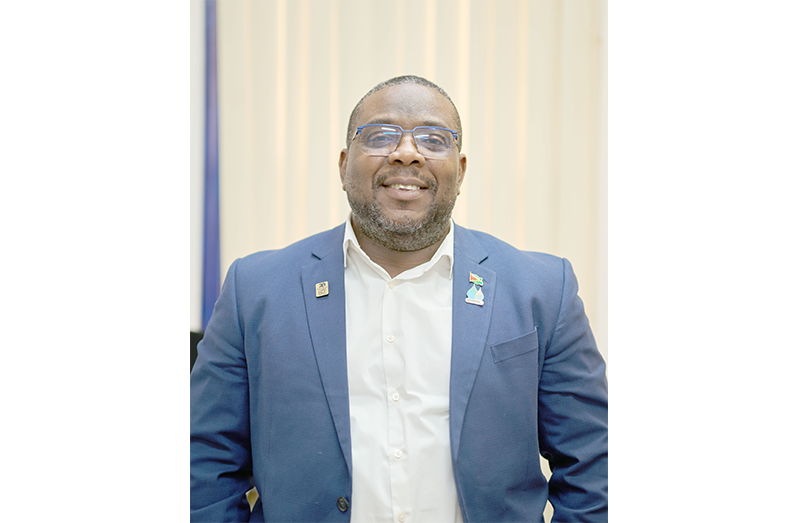
FOR almost 20 years, engineer Marlon Daniels has been at the forefront of Guyana’s effort to modernise its water sector, blending technical expertise with a deep sense of national service.
As Project Director at the Guyana Water Incorporated (GWI) and a long-time member of the Caribbean Water and Wastewater Association (CWWA), Daniels has helped steer the country’s ambitious programme to expand treated water coverage from 52 per cent to 90 per cent by 2025, upgrade dozens of treatment plants and pioneer regional best practices in water and wastewater management.
His leadership and research earned him two major honours at this year’s CWWA Conference in Belize; recognition that underscores his commitment to sustainable infrastructure, capacity building and positioning Guyana as a regional leader in the water sector.
Daniels joined Guyana’s water-management sector more than 17 years ago, but his passion for the field began at the University of Guyana, where he focused on his degree in water treatment and distribution. After graduating, he worked with the Social Impact Amelioration Programme, a project funded by the Inter-American Development Bank, where he helped deliver infrastructural projects such as health centres, schools, roads, and drainage systems. That early experience set the tone for his career. “I later got an opportunity to do a master’s degree in water management in Mexico. I jumped at that opportunity and specialised in water and sanitation management. That experience, living in another culture and learning another language, was remarkable,” he recalled.
Upon returning to Guyana in 2008, Daniels joined GWI where he has remained committed ever since. At the company, he plays a major role in developing systems that get clean water to homes across the country. That direct connection between technical work and human welfare keeps him anchored in the field. “From university to postgraduate study, water and sanitation became an area I cherished, and I don’t believe I’ll ever leave the sector. The simple things sometimes bring you the most joy. Somebody calls with a water-supply issue, and some minor intervention brings relief. That, in itself, is a very rewarding experience,” he said.
While Daniels is best known for his work in Guyana, his influence has extended across the Caribbean through his active role in the CWWA. Formed in 1990, the association is a vital forum where Caribbean engineers, utilities, and suppliers collaborate and share experiences. Having served on its board and as president, Daniels’ recent recognition at the CWWA Conference marked a career highlight. “Being recognised across the Caribbean as a very involved professional is extremely rewarding. This year, I wrote two papers: one won the Ron Williams Technical Award for Best Paper. I also received a recognition award for leadership and legacy, which was very touching,” he shared. That recognition, he added, reflects years of dedication. “Guyana has hosted two successful conferences in 2017 and 2023, and I believe the recognition I received came from the dedication and heart I’ve put into the sector since 2013,” Daniels said.
SIGNIFICANT GROWTH
Reflecting on recent progress, he noted that the sector has seen significant growth since 2020. Over the past five years, Guyana has been on track to increase treated water coverage across the coastline from 52 per cent to 90 per cent by 2025. The country’s main water source is groundwater, which is rich in iron and requires major investments in treatment infrastructure to improve quality and meet health standards.
Seven new treatment plants were funded by the government and five more by the Caribbean Development Bank, alongside existing facilities and the installation of inline treatment systems.
“Together, this was a novel programme, celebrated regionally as a first for Guyana in terms of scope and investment,” Daniels stated. Additional projects include drilling 14 new wells and laying over 200 kilometres of pipelines across coastal communities, a feat that required careful planning and coordination. The programme’s success, he said, has drawn regional attention. “The programme’s success was recognised across the Caribbean; it became a model for large-scale water-sector investment and implementation,” Daniels added.
Through the work of people like Daniels, Guyana has become a Caribbean leader in water-treatment technology, particularly in removing iron from groundwater, a challenge unique to the region. “We’ve always been at the forefront of cutting-edge technology in water treatment. Our water is rich in iron, and no one across the Caribbean can remove iron like we do in Guyana,” he explained. “The difference now is the pace. The scale of development post-2020 is unmatched.”
Beyond treated water, Guyana is also making strides in wastewater management. Plans are underway for a major sewage and wastewater treatment plant to serve Georgetown, with future expansion to other towns. Proper wastewater management, Daniels noted, protects public health, preserves the environment and supports sustainable urban growth. “There are plans for a major sewage and wastewater treatment plant to serve Georgetown, with future expansion to other townships. Not many cities in the Caribbean treat wastewater properly, and we are showing great leadership in addressing that,” he said.
Through initiatives such as these, and the work of dedicated professionals such as Daniels, Guyana is steadily building a modern, resilient water sector that not only meets local needs, but serves as a model for the Caribbean.