
-says end of commission’s life nullifies proceedings
GIVEN that the life of the Police Service Commission (PSC) ended on August 8, the case it has before the court cannot be allowed to continue, as any judgement rendered would be void, Attorney-General and Minister of Legal Affairs, Anil Nandlall, S.C., has argued.
Nandlall was, at the time, making oral submissions during a virtual hearing of his application to strike out the challenge which was filed by the commission .
High Court Judge Gino Persaud, who is hearing Nandlall’s matter, said that his judgement will be delivered before the end of the year.

During the hearing, Nandlall urged the court to discontinue the substantive matter which is also being heard by Justice Persaud. He argued that this step should be taken as the PSC is not properly constituted since its life came to an end on August 8.
“It is our submission that, as a result of that fact, these proceedings cannot be proceeded with by this honorable court,” he said.
It was explained to the court that the PSC is a body constituted in a manner prescribed by the Constitution of Guyana, and its functions are subjected to constitutional provisions.
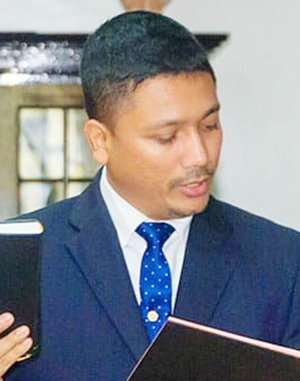
The Attorney-General went on to explain that according to Article 226 of the Constitution, the decisions of the PSC are made by way of votes and that the commission can only act if there is a “quorum.”
“The commission can only act if it has a quorum. Despite vacancies, decisions may be made but provided that there is a quorum… Inferentially, if the commission is not constituted, it cannot have a quorum in law, and therefore it cannot act,” Nandlall submitted.
According to the Attorney-General, when legal proceedings are launched, it cannot continue on “autopilot.”
He explained that legal proceedings, however, must be “continued as a result of the presence of the parties who have a capacity in law to continue those proceedings… That submission is two-fold: one, it affects the validity of the proceedings themselves, and secondly, it affects the capacity of the lawyers to continue appearing in the proceedings.”
He further explained that at the time his application was filed, the commission was already “dead and non-existent in law.”
As a result of the aforementioned, Nandlall said it would have affected the capacity of the PSC’s lawyers, Selwyn Pieters and Dexter Smartt, who could not have been authorised to appear since their [the lawyers] contracts came to an end upon the expiration of the life of the commission.
“When the life of the commission expired, it has the same effect to when a party who is before the court in the form of a human being dies. The proceedings in such an instance is not defeated but it is abated and unless someone is substituted, the proceedings become defective,” he added.
The Attorney-General listed a plethora of legal precedents and authorities to explain that this was decided by Guyana’s Full Court in 1956 in the case, Spence verses Hoppie in the British Law Report.
LEGAL DEFECTS
As it relates to the “dead” PSC, Nandlall explained that because the commission is a “constitutional creature” the court would not be able to appoint a substitute in its place.
According to him, the PSC is “uniquely and peculiarly constituted in a particular way and by a particular legal process, that is, by a process that involves the executive and the parliament — the two other arms of government– and the judiciary has no part to play in the constitution of the Commission.”
“ That fundamental principle would prohibit this court from doing what this court may have had the power to do were the parties ordinary regular citizens. That is to entertain an application from either party to substitute as we all know can be done but here the body, that is the applicant, is one that is a constitutional creature that has its own peculiar rules and laws that governs its composition and functioning…” he added.
The AG went on to explain that the case laws dictate that should proceedings continue with legal defects, the judgement that comes after is void.
“ The other limb of our argument has to do with the attorney-at-law relationship. A lawyer cannot join a case. It is a client that carries the case forward. The lawyer-client relationship is one of agency. You cannot have an agent if there is no principal. The lawyer is the agent of the client and the client is the principal. There is no principal anymore, ” Nandlall submitted.
He further explained that “After the expiry of the commission, ex-commissioner [Clinton] Conway purported to file and swear an affidavit- in-answer to this application. That application is [a] nullity because ex-commissioner Conway has no authority in law.”
“My learned friends [Pieters and Smartt] who are appearing here today has no one to instruct them to even speak in this case….Their client is dead,” Nandlall said as he explained that the attorneys, as they continue to appear, are opening themselves up for a loss.
“ They are on a frolic of their own in the most classic and purest form of the concept,” he added.
NEED FOR FINALITY
Meanwhile, in his reply to the AG’s submissions, Smartt said,“ I do admit that the commission expired on the 8th of August… It is our respectful submission to this court that matters to be dealt with are matters that need finality.”
According to Smartt, the PSC case touches on key issues such as the supreme power of the land, and the power of the president. “ It is a matter of public importance and interest,” the attorney said as he explained that the case is a “peculiar proceeding.”
After listening to both sides, Justice Persaud reserved his judgement, which he said is expected to be given before the end of the year.
In September, Justice Persaud ruled in favour of an interlocutory application filed by Nandlall, and ordered the removal of President Irfaan Ali as a respondent in the substantive case filed by the PSC.
The PSC’s application was filed in July, after President Ali, based on advice from Prime Minister, Brigadier (ret’d) Mark Phillips, and in accordance with Article 225 of the Constitution of Guyana, suspended the PSC Chairman and its members, pending the findings of a tribunal that was to be established.
The PSC is praying that the court grants a declaration that the purported June 16 suspension of its Chairman, Paul Slowe and commissioners, Michael Somersall, Claire Alexis Jarvis, Vesta Adams, and Conway, from performing the functions of their respective offices in the Commission, were in violation of the Constitution of the Co-operative Republic of Guyana Articles 225(6) and 210(3), and therefore of no force or effect.
Additionally, the applicant is seeking a further declaration from the court that the Prime Minister’s recommendations to the President for the removal of the PSC Chairman and its members from their respective offices at the commission were in violation of, and ultra vires, the Constitution and, in particular, Article 225(2), being made on grounds other than inability to discharge the functions of office or misbehaviour.
In June, Acting Chief Justice, Roxane George S.C., had struck out the legal challenge brought by five senior police officers against the PSC over the 2020 year-end police promotions. Following the CJ’s ruling, the Government of Guyana through the Attorney-General and Minister of Legal Affairs issued a statement rejecting the PSC’s promotion list as unlawful and illegal.
It noted that in the circumstances, the purported list of promotions will be ignored since the PSC was suspended. Finally, on August 8, the life of the five member PSC expired. The commission was sworn in by then President, David Granger, to serve for a period of three years – 2018 to 2021.