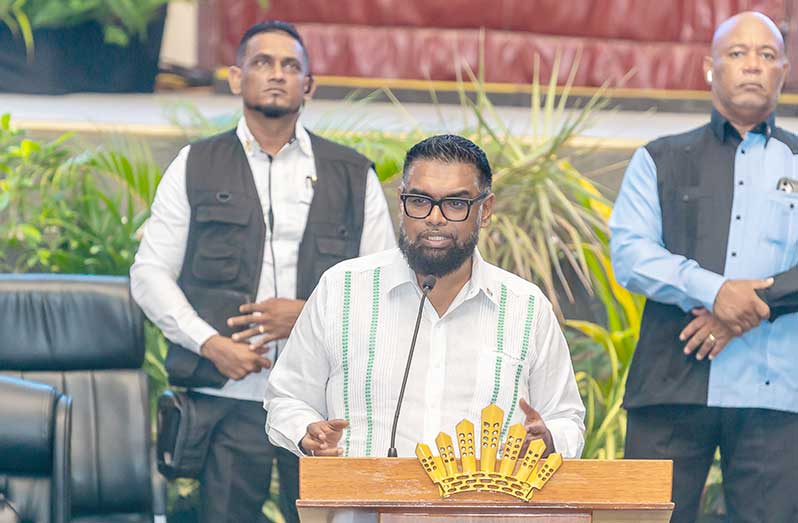
– Pres Ali calls for tighter regulation, regional co-operation and investment in capacity
PRESIDENT Dr Mohamed Irfaan Ali, on Tuesday, called for stronger regulatory systems, regional co-operation and investment in human and technological capacity to ensure aviation safety keeps pace with the rapid transformation of the aviation sector.
The Head of State, while addressing the opening of the ICAO/EASA Third Global Regional Safety Oversight Organisations (RSOO) and Regional Accident and Incident Investigation Organisations (RAIO) Forum for Aviation Safety at the Arthur Chung Conference Centre, said the global aviation industry was undergoing major changes which required regulators and policymakers to reassess how safety was approached.
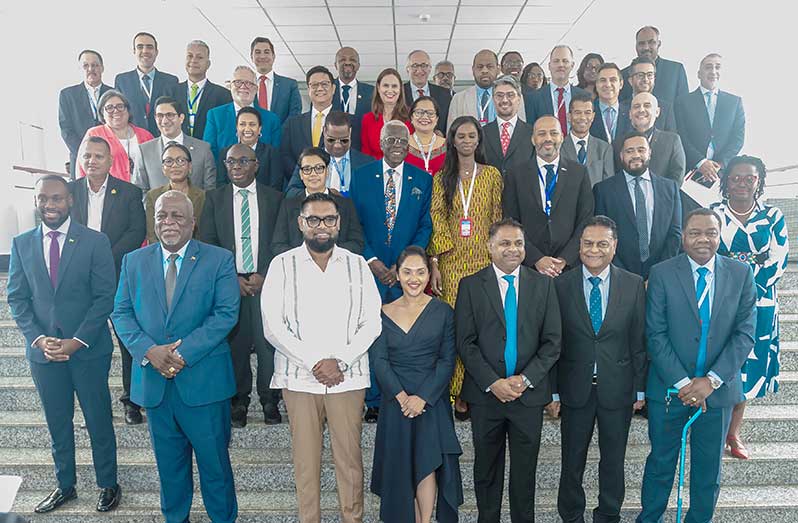
The two-day forum, which is being held under the theme “Optimising Resources through Coordination and Cooperation brought together aviation regulators, accident investigators, international organisations and industry representatives from nearly 60 countries.
President Ali said developments in demand, supply, equipment and technology meant the aviation ecosystem could no longer be viewed through the same lens as it was several months ago.
“We need to look at the entire ecosystem and really reorganise our work to reflect this ecosystem,” the President said.
He also urged the international aviation community to place artificial intelligence (AI) more prominently on its agenda, arguing that the rapid emergence of the technology has implications for aviation safety, regulation, equity and integration.
Dr Ali, as such, called for the development of a shared AI strategy for aviation and proposed that a dedicated expert group or subcommittee be established with urgency to examine the opportunities and risks posed by the technology.
“If you don’t have equity in the build-out of AI in the aviation sector, especially for safety, then you will have disparity,” he said, while noting that uneven adoption of AI could result in different standards and leave some countries behind.
Further to this, President Ali also stressed that aviation safety must be considered against the backdrop of growing geopolitical tensions, conflicts and the increasing dependence of economies on reliable air connectivity.
To this end, he indicated that leaders in the sector must examine the implications of conflicts and wars on aviation and further develop recommendations that can help countries build greater resilience and redundancy into their systems.
For Guyana, President Ali said the need for stronger safety systems was particularly important as the country’s aviation sector continues to expand.
Over the past five years, he said, weekly seat capacity had increased by 171 per cent, international passenger traffic by 410 per cent and domestic passenger traffic by 121 per cent. International flights increased from 3,170 in 2020 to 8,891 in 2025, while overflights rose from 9,655 to 23,714.
The number of airlines operating in Guyana has also expanded significantly, with figures showing growth from four airlines in 2020 to 16 currently.
President Ali said the growth was being accompanied by investment in infrastructure, connectivity and institutional capacity, but cautioned that expansion could not be separated from safety oversight.
“Aviation can grow only as safely as a regulatory framework that governs it,” he said.
To this end, he disclosed that he had instructed the Guyana Civil Aviation Authority (GCAA) to review the country’s aviation laws and regulations, identify gaps and determine what investments were required to bring the system in line with the highest standards.
Meanwhile, the President called for greater regional co-operation, arguing that weaknesses in one country’s aviation safety system could affect others because of the interconnected nature of regional air travel.
He further urged international partners and regional organisations to address inconsistencies in aviation procedures and standards across the Caribbean, saying passengers should experience comparable safety and regulatory standards as they travel between airports.
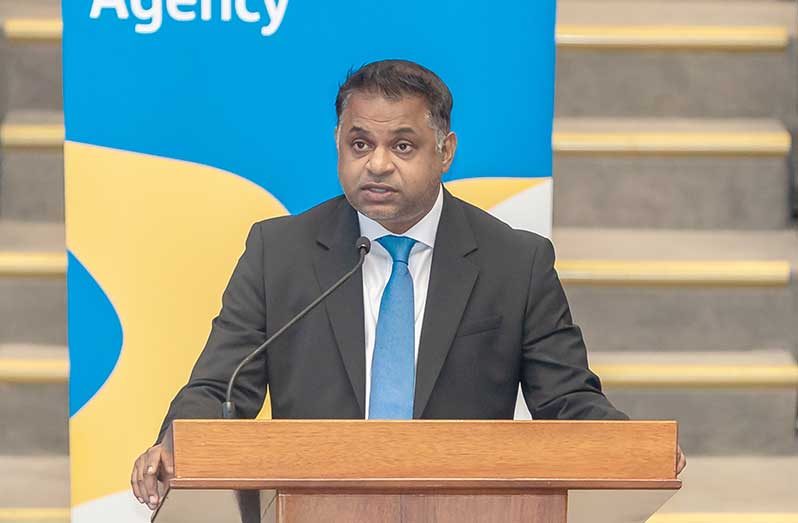
Minister of Public Utilities and Aviation, Deodat Indar, meanwhile, said the forum provides an opportunity for countries to learn from each other and strengthen aviation safety through co-operation.
Indar said Guyana was proud to host the event and highlighted the participation of representatives from approximately 60 countries.
“Aviation safety is not something to compromise with,” he said, noting that countries must work together, learn from each other and provide assistance where necessary.
He said countries faced different economic circumstances and varying levels of institutional and technical capacity, making co-operation essential to strengthening the global aviation safety system.
The Minister further pointed to the rapid expansion of Guyana’s aviation sector, noting that the country had moved from four airlines in 2020 to 16 today.
He said Guyana was also investing in a new terminal at the Cheddi Jagan International Airport (CJIA), additional airports and other infrastructure to improve mobility and connectivity.
Guyana’s broader objective, he said, is to improve connectivity with the rest of the world, develop the country as a regional aviation hub and ensure full compliance with ICAO recommended practices.
Director General of the GCAA, Lieutenant Colonel (Ret’d) Egbert Field, said the hosting of the forum represented a milestone for Guyana and reflected the country’s growing role in regional and international aviation.
Field said Guyana’s aviation sector had expanded rapidly since 2020, with passenger movement surpassing one million and significant investments being made in airports, Terminal Two at CJIA, air traffic control infrastructure and other facilities.
He said the country’s geographical circumstances also made aviation particularly important, given its vast territory and limited road connectivity in some areas.
Field said that while Guyana was pursuing growth, its commitment to safety oversight remained equally strong.
He pointed to Guyana’s performance in its 2024 ICAO audit and its role in regional aviation organisations as evidence of the country’s increasing involvement in aviation safety co-operation.
But he cautioned that no country could address the increasingly complex challenges facing aviation on its own.
“No man is an island,” Field said, arguing that regional safety oversight organisations provide an important mechanism for countries to pool expertise, share resources, harmonise regulations and build sustainable institutional capacity.
He said the forum should therefore strengthen practical co-operation and partnerships among aviation authorities to build a safer and more resilient global aviation system