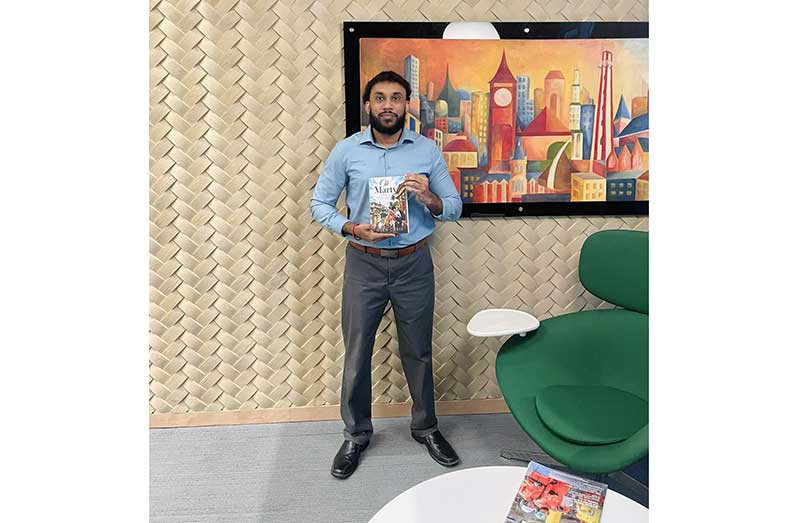
— new novel ‘Oh Marty’ explores dyslexia, childhood struggles and the importance of understanding
GUYANESE author, Deen Chris, whose real name is Deenanauth Christmah, is using his latest novel, Oh Marty, to shine a spotlight on children with learning differences, particularly those whose struggles are often misunderstood by the people around them.
Published in August 2026, the adult literary novel follows Marty, a young boy living with undiagnosed dyslexia, as he navigates humiliation at school, misunderstandings at home, abuse, grief and the growing belief that something is wrong with him because he cannot learn in the same way as other children.
Set against the familiar sights, sounds and culture of Guyana, the novel explores the emotional consequences of growing up with an unrecognised learning difference in a traditional education system.
According to Chris, storybooks become one of Marty’s few sources of comfort, while his friendship with Toto, a stray dog, provides companionship during some of his loneliest moments.
Teacher Amanda, meanwhile, becomes one of the first adults to recognise that there may be more behind Marty’s learning difficulties than laziness or poor behaviour.
Although the novel explores difficult subjects, including abuse and grief, it also highlights compassion, resilience, friendship and the difference one understanding adult can make in a child’s life.
For Chris, the story emerged from a period of personal reflection following years of writing primarily science fiction and fantasy.
After pursuing traditional publishing and facing repeated rejection, he began questioning whether the stories he wanted to tell were being understood.
“That feeling brought back memories of childhood and made me think more deeply about children who grow up feeling misunderstood for reasons they themselves may not understand,” he said.
Those reflections eventually gave rise to Marty’s character.
“I wanted to write about a child whose difficulties are constantly interpreted by adults as something they are not. In Marty’s case, his undiagnosed dyslexia affects his education and his confidence, while the reactions of the adults around him gradually influence the way he sees himself,” Chris explained.
Rather than writing a clinical account of dyslexia, the author wanted readers to experience the condition through the emotions and everyday experiences of a child.
AN UNMISTAKABLY GUYANESE STORY
For Chris, setting the novel in Guyana was an important part of its identity.
Oh Marty draws on Guyanese streets, schools, food, neighbourhoods, language, family relationships, vegetation and everyday Caribbean experiences.
The author wanted Guyanese readers to recognise elements of their own lives and communities within the story.
He believes Guyanese settings and imagery remain relatively underrepresented in Caribbean literature and wanted the novel to reflect the characteristics that distinguish Guyana and the wider region.
Beyond its cultural setting, however, Chris hopes the book will encourage conversations about how children with learning and neurological differences are treated.
He noted that children with dyslexia, attention-deficit/hyperactivity disorder (ADHD), autism and other neurological differences may be misunderstood or labelled as lazy or difficult, sometimes going years without receiving appropriate support.
Through Marty’s experiences, Chris hopes readers will reconsider how they respond to children whose learning needs differ from those of their peers.
BEYOND THE PAGES
The author’s ambitions for Oh Marty extend beyond literature.
Chris is working towards establishing the Oh Marty Foundation, an organisation he hopes will support neurodivergent children and their families across Guyana and the Caribbean.
“I am working toward establishing the Oh Marty Foundation, although the legal registration and development of the organisation will take time. Once established, my intention is for the royalties generated by Oh Marty to help support the Foundation and other organisations working with children who have neurological and learning differences,” he said.
The author explained that families raising neurodivergent children can face significant financial pressures, particularly when specialised assessments, therapy, educational support and appropriate learning environments are difficult to access.
He hopes the novel will not only raise awareness of those challenges but eventually contribute to practical assistance for affected families.
His long-term vision includes helping to establish specialised learning centres and schools where neurodivergent children can receive education tailored to their individual strengths and needs.
Chris also believes there must be a shift in the language used when discussing children with neurological differences.
Rather than focusing solely on their difficulties, he wants greater emphasis placed on their strengths, creativity, abilities and potential.
Through Oh Marty, the author hopes to encourage a more compassionate understanding of children who experience the world and learning differently.
BOOK AVAILABILITY
Oh Marty is available in eBook, paperback and hardcover formats through Amazon, ThriftBooks, Walmart and other international booksellers.
Physical copies are also available at Austin’s Bookstore in Guyana and the Writers Centre in Trinidad and Tobago.
Chris said discussions are continuing with bookstores and distributors across the Caribbean to make the novel more widely accessible throughout the region.
While the book tells the story of one fictional child, its broader message centres on the importance of recognising, understanding and supporting children whose struggles may otherwise go unnoticed.