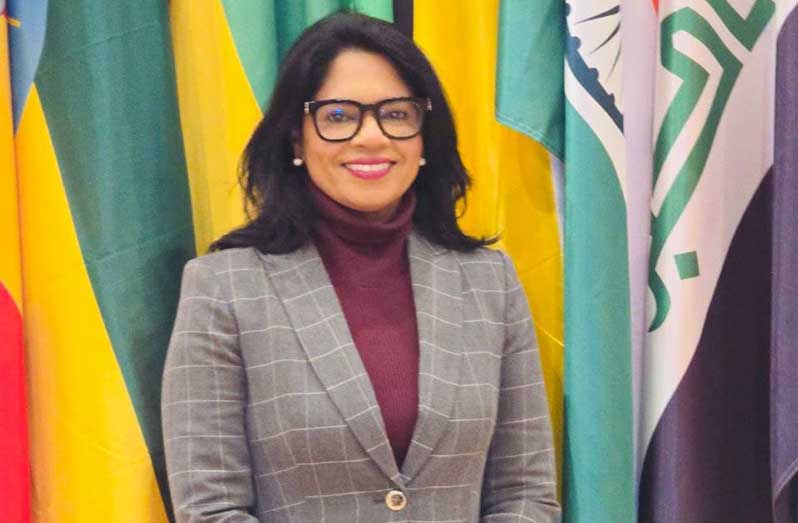
— Education Minister highlights expanded access to education, ethical AI and protection of Indigenous heritage
GUYANA has reaffirmed its support for a more effective, inclusive and accountable United Nations Educational, Scientific and Cultural Organisation (UNESCO), with Minister of Education, Sonia Parag highlighting the country’s investments in education and its commitment to international co-operation.
Minister Parag is representing Guyana at the 225th Session of UNESCO’s Executive Board, being held from October 5 to 20, 2026, at the organisation’s headquarters in Paris, France.
As a newly elected member of UNESCO’s 58-member Executive Board, Guyana is participating in discussions on the organisation’s future direction, including the UNESCO80 Roadmap and the emerging vision of “UNESCO for the People”.
Delivering Guyana’s statement during the plenary debates, Parag reaffirmed the country’s commitment to strengthening UNESCO’s effectiveness while ensuring that its programmes respond to the needs of ordinary people.
“Guyana strongly supports the vision articulated by the Director-General through the UNESCO80 Roadmap and the emerging concept of ‘UNESCO for the People’ – a vision that seeks to make UNESCO more effective, more responsive, more inclusive and more impactful in the lives of ordinary citizens,” she said.
According to a Ministry of Education press release, Parag underscored the importance of education, culture, science and international co-operation in building peaceful, resilient and inclusive societies.
She highlighted Guyana’s efforts to expand access to quality education, particularly in hinterland and riverine communities, through investments in school infrastructure, teacher training, digital learning and technical and vocational education.
“Over the past several years, Guyana has undertaken one of the most ambitious expansions of educational access in its history. New schools have been built across hinterland and riverine communities,” the Minister said.
She noted that these investments are intended to ensure “that every child, regardless of geography or circumstance, can access quality education.”
ETHICAL USE OF AI
Parag also addressed the growing influence of artificial intelligence (AI) and other emerging technologies, stressing the importance of ensuring that technological advancement benefits all sections of society.
“As artificial intelligence and rapid technological change reshape societies, we share the view that these technologies must be governed ethically, inclusively and in a human-centred manner,” she said.
The Minister also emphasised meaningful youth participation in policymaking, the protection of cultural heritage and Indigenous knowledge systems, and stronger international co-operation in responding to climate-related disasters and other crises.
On cultural preservation, she reaffirmed Guyana’s support for “UNESCO’s continued efforts to safeguard both tangible and intangible heritage, strengthen cultural industries, promote intercultural dialogue and give greater recognition to Indigenous knowledge systems.”
Parag also welcomed the contributions of young people from 135 UNESCO Member States to the UNESCO80 consultations, stressing that their involvement must extend beyond consultation to active participation in shaping policies.
“Young people are not merely beneficiaries of policy. They are partners and leaders in shaping the future,” she said.
STRENGTHENING GLOBAL CO-OPERATION
Guyana’s participation in the Executive Board session reflects its commitment to multilateral co-operation and to ensuring that UNESCO’s programmes and policies respond meaningfully to the needs of developing countries and vulnerable communities.
The Minister called for renewed collective action to advance peace, human dignity, human rights and sustainable development, while ensuring that UNESCO remains responsive to global challenges.
“As UNESCO approaches its eightieth anniversary, we have an opportunity not simply to celebrate our past, but to renew our commitment to the future,” Parag said.
“Guyana believes that UNESCO must remain firmly anchored in its constitutional mandate while adapting confidently to a changing world.”