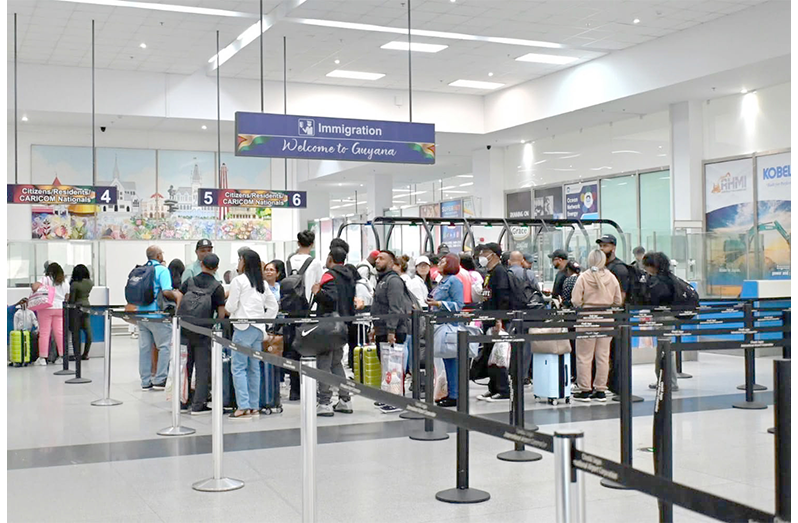
-President Ali says country is no dumping ground, can reject individuals if unsatisfied
PRESIDENT Dr. Irfaan Ali has defended Guyana’s human rights credentials, and insisted that the country is conducting its own independent vetting of foreign deportees arriving from the United States under a new assisted voluntary return arrangement.
In an interview with Al Jazeera, Dr. Ali rejected the suggestion that Georgetown is merely helping Washington to offload its migration challenges.
Pressed on criticism from human rights groups about the scheme, he stressed that Guyana retains full sovereign control over who is allowed in, and that arrivals are not “dumped” on its shores.
According to the President, Guyanese authorities receive the names of intended returnees in advance, carry out their own background checks “to our own satisfaction”, and then agree to accept those individuals. “This is not a situation where the U.S. turns up with a plane and just throw people off on your shores,” he said.
“We can say that we are not accepting this. So that is not being taken away. The agreement is one in which Guyana has full control over what we accept,” he stressed.
Dr. Ali framed the arrangement within a broader defence of Guyana’s human rights record, pointing to what he described as “exceptionally good human rights credentials”.
He highlighted Guyana’s efforts in land-titling and budgetary support to Indigenous communities, and linked this to the way Guyana handles wider migration pressures.
The President noted that the country has been receiving migrants from Venezuela, Cuba, and elsewhere, who, he said, are granted access to social services “without exception”.
He also underscored that the deportee arrangement is being implemented with the involvement of the International Organisation for Migration (IOM), which he characterised as an important global partner in the process.
While acknowledging that “everything in life has an element of risk”, Dr. Ali maintained that Guyana has not set an irreversible precedent, and retains the right to reject future requests to accept deportees.
In a statement last week, the Government of Guyana said it intends to accept only individuals who have chosen relocation to Guyana of their own volition.
“The Government of Guyana will not bear the financial cost of the programme. IOM has confirmed that it will not assume, and that this arrangement will not transfer to it, any of the Government’s responsibilities concerning admission, legal stay, protection or removal,” according to the statement.
The government has said the arrangement does not constitute permanent resettlement: Those relocated will remain in Guyana only while their immigration status is determined, after which they may return to their country of origin or relocate elsewhere.
In a comment to the Associated Press news agency, Guyana’s Foreign Secretary Robert Persaud had said that a group of Cuban and Afghan nationals had arrived in Guyana.
Persaud said that Guyana reached an agreement with the US to receive deportees after months of negotiations.
The deal with Guyana will last for one year, and does not constitute permanent resettlement, Persaud stressed.