






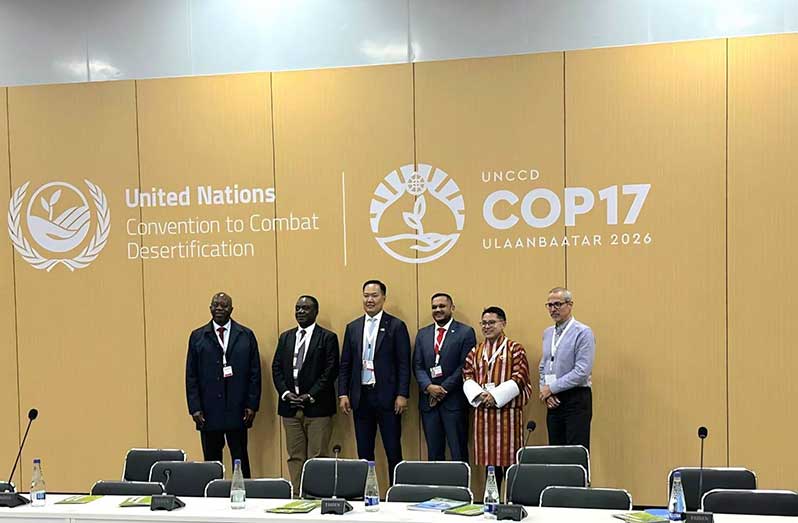
MINISTER of Natural Resources, Vickram Bharrat, on Tuesday, highlighted Guyana’s approach to integrated natural resource management, emphasising the need to connect ecosystems, communities and development policies in building resilience and sustainable livelihoods.
Minister Bharrat made the remarks while participating in a ministerial panel during Land and People Day at the 17th session of the Conference of the Parties to the United Nations Convention to Combat Desertification (UNCCD COP17), being held in Ulaanbaatar, Mongolia.
The conference, which runs from August 17 to 28 under the theme, “Restoring Land. Restoring Hope”, is focusing on issues including desertification, land degradation and drought resilience.
Addressing the panel under the theme, “From Summits to the Floodplains: Connecting Ecosystems and Livelihoods,” Minister Bharrat said Guyana’s experience has increasingly centred on managing the connections among its diverse landscapes rather than treating ecosystems in isolation.
He noted that the country’s forests, highlands, rivers, wetlands, coastal plains and communities form interconnected systems which require similarly integrated policies, investments and institutions.
“Under the leadership of His Excellency President Dr Mohamed Irfaan Ali, Guyana has pursued a development pathway that seeks to combine economic development with the responsible management of our natural capital,” Minister Bharrat said.
He pointed to the Low Carbon Development Strategy 2030 as a key framework guiding this approach, recognising the value of Guyana’s forests and ecosystem services while supporting climate resilience, sustainable livelihoods, food security and biodiversity conservation.
Minister Bharrat said Guyana’s natural resources should not be viewed solely as assets requiring protection, but also as resources capable of supporting resilient communities and economies.
He highlighted the role of the country’s forests in storing carbon, supporting biodiversity, regulating water and sustaining communities, while noting that mangroves and other coastal ecosystems provide important natural protection.
Guyana’s rivers and wetlands, he added, remain fundamental to livelihoods, agriculture and communities.
“From the summits to the floodplains, our landscapes are connected. Our policies, our investments and our institutions must be connected too,” the minister said.
He reaffirmed Guyana’s readiness to share its experience and learn from other countries as international partners work towards ensuring that healthy ecosystems support resilient communities, productive landscapes and sustainable livelihoods.
Minister Bharrat is leading Guyana’s delegation to COP17, where countries are discussing strengthened action to address land degradation and build greater resilience to the effects of drought and other environmental challenges.




