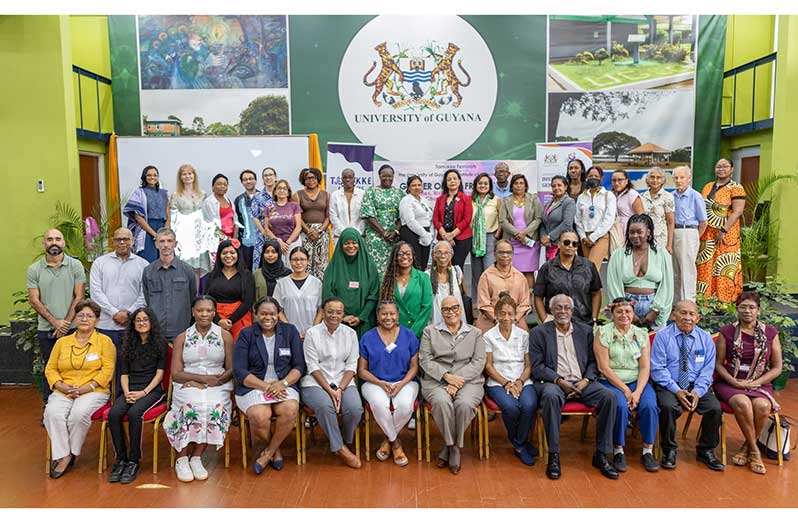
-conference attracted more than 70 participants on first day
GENDER on the Frontlines, a conference developed by Tamukke Feminists in partnership with the University of Guyana’s Institute of Gender Studies, opened on Monday at UG’s George Walcott Lecture Theatre, Turkeyen Campus.
The conference theme, ‘Gender on the Frontlines: role, risk, and urgency in a changing environment,’ comes at a timely period in Guyana as many are reminded constantly of the urgency of defending human rights and confronting the reality that shapes our lives.
At the opening ceremony, it was emphasised that gender is indeed on the frontline, and cannot be separated from questions regarding health, environment, development, and our human rights.
One speaker noted that the risks are gendered, later adding that women, girls, LGBTQ+ persons, indigenous people, people living with disabilities, and other marginalised communities experience the impacts of environment, social crisis in particular and in profound ways.
The speaker added that at the same time, they are not simply victims of this crisis, but are rather organisers, caregivers, advocates, workers, community leaders, and activists who are on the front line of responding.
Being on the front line, however, comes with risks, it was noted. These risks include speaking out against and challenging injustices, demanding accountability, and defending our communities, and can carry real consequences.
Also speaking was Tamukke’s Managing Director Akola Thompson who said that for the duration of the conference, the panels and discussions will spark new perspectives and ideas about how we can pivot towards more community rooted solutions that truly centre around gender justice and well-being.
She also highlighted the need for real and impactful measures to address community concerns, environment changes and impact, especially in indigenous communities.
Meanwhile, IGS’s Head, Dr. Lisa Edwards, mentioned that while these conversations have been happening for years, they are just as important and relevant today. She pointed out that in speaking about gender, it is not just about speaking on violence, but looking at it through the systems, and through this conference.
Chairman of the Transitional Management Committee at UG, Professor Stafford Griffith in his remarks said this conference comes at a “very important and challenging time for rapid development in our country.”
The professor noted that for us in Guyana, we need to put measures in place that will assure the balanced participation of all citizens in the development process, irrespective of gender.
“Sometimes I worry that in these matters of gender, we perhaps need to shift our focus more sharply on the men, because I feel there’s a lot of work, a lot of gender-related work to be done with the men, and I sometimes wonder what it is that is causing the men not to come forward, and probably not to be as assertive in taking opportunities that are available as I believe the women are,” he remarked.
According to the professor, we need to look at the gender issues in our country and pay more attention to what is happening to the men in our society.
The first day of the conference featured a panel discussion that examined land rights, indigenous knowledge in ecological stewardship, and presentations addressing violence, advancing rights, and strengthening institutions for gender equality.
More than 70 persons attended the opening day of the conference, which continues today. It is being streamed on Tamukke’s Facebook page.