–emphasises there was unanimity among all seven judges
CARIBBEAN Court of Justice (CCJ) President, Justice Winston Anderson, has rejected allegations that he sought to influence the outcome of cases before the regional court.
He was specifically addressing claims arising from the court’s July 29 judgement, which dismissed an appeal by Guyanese businessmen Nazar Mohamed and his son, Azruddin Mohamed, and cleared the way for extradition proceedings sought by the United States to resume in Guyana.
In a statement issued on Friday, Justice Anderson said suggestions that he attempted to influence the decisions of other judges were “entirely unfounded and untrue,” stressing that judicial independence remains a fundamental principle of the CCJ.
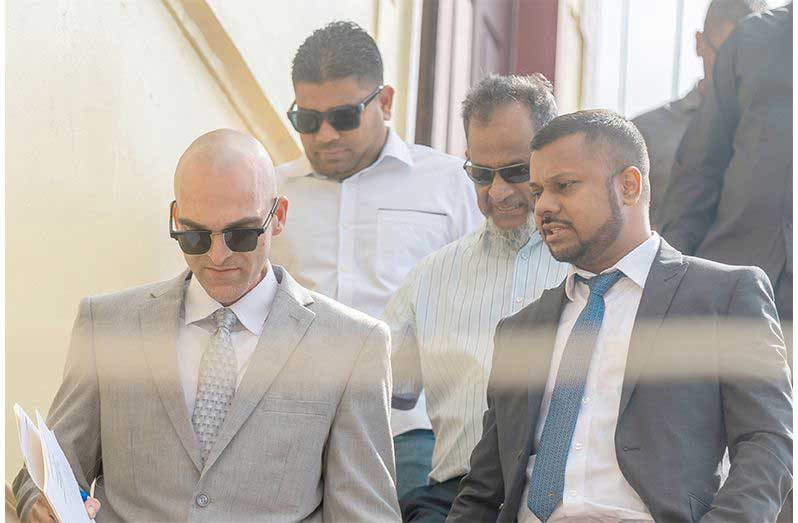
The matter involving the Mohameds before the CCJ was Nazar Mohamed and Azruddin Mohamed v Minister of Home Affairs, Oneidge Walrond, Attorney General of Guyana and Magistrate Judy Latchman, under CCJ Application No. GY/A/CV2026/001.
The case concerns their challenge to the extradition process.
Justice Anderson said the independence of the judiciary is protected by the CCJ’s constituent instruments, the oath taken by each judge and internationally recognised standards, including the Bangalore Principles of Judicial Conduct.
“No Judge of this Court can or should be restrained from expressing his or her judicial views or from deciding any matter according to his or her independent assessment of the law and the evidence,” he said.
The CCJ President said he had taken note of suggestions made publicly that he had attempted to influence the outcome of cases before the Court.
He described those allegations as “entirely unfounded and untrue,” maintaining that judges must remain free to express their views during the preparation and consideration of judgements.
Addressing the Mohameds extradition case specifically, Justice Anderson said references had been made publicly to the preparation of the judgement and to discussions among the judges.
He explained that, like appellate courts throughout the Commonwealth, the CCJ encourages judges to engage in robust and candid discussions before judgements are finalised.
Justice Anderson said, “Judicial conferences frequently involve spirited discussion, differing legal analyses and careful consideration of competing views before a final judgement is settled.”
According to him, the discussions surrounding the preparation of the judgement in the Mohameds case were consistent with that process.
He said judges expressed different views about aspects of the reasoning and how certain issues should be presented in the final judgement.
“That is both normal and healthy within a collegiate appellate court,” he said, adding that such exchanges should not be interpreted as evidence of institutional disagreement.
Justice Anderson went further, stating that no judge of the CCJ should allow himself or herself to be improperly influenced by another judge, including the President.
“No Judge worthy of being on the CCJ Bench would ever allow himself or herself to be unduly influenced by any other Judge, including the President.”
He also disclosed that there was complete unanimity among all seven judges on the disposition of the Mohameds appeal.
He noted, “It is worth noting that in Mohameds v Minister of Home Affairs, there was COMPLETE UNANIMITY among all seven judges as to the disposition of the appeal.”
Justice Anderson said that the CCJ’s Original Jurisdiction does not publish dissenting judgements, noting that unanimity is a standard practice among international courts exercising that type of jurisdiction.
NO JUDICIAL VIEW WAS SUPPRESSED
He therefore rejected suggestions that judicial views had been suppressed or that any judge had been directed to reach a particular conclusion in the Mohamed matter.
“The suggestion that judicial views were suppressed or that any Judge was directed to reach a particular conclusion is therefore wholly without foundation,” Justice Anderson said.
He maintained that judicial independence has been a principle he has defended throughout his career and said he would continue to do so.
The President’s statement comes amid leaked emails concerning the Court’s internal affairs. Justice Anderson said the Court’s independence and the integrity of its judicial deliberations must be protected.
He also condemned the unauthorised disclosure and publication of confidential material relating to the Court’s internal deliberations and correspondence, warning that such disclosures erode public confidence in the judiciary.
Justice Anderson also pledged that the Court would “continue to hear and determine the cases that come before us” and “discharge faithfully” its responsibilities under the Agreement Establishing the Court and the Revised Treaty of Chaguaramas.
He further undertook that the Court would serve the people of the region “with independence, fairness and integrity deserving of the trust and confidence of the Caribbean people.”
The Mohameds extradition case is among the matters specifically addressed by Justice Anderson as he sought to explain the principles guiding decisions made within the CCJ and to reject claims that the Court’s internal deliberations were used to predetermine its outcome.