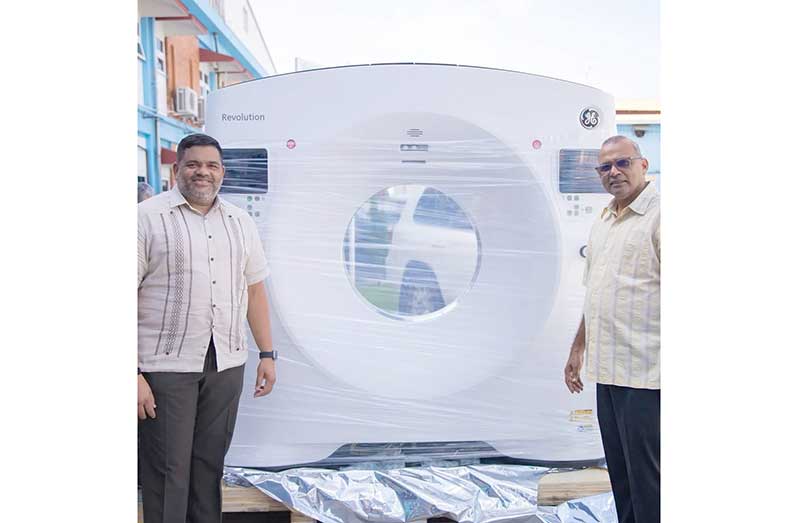
THE Georgetown Public Hospital Corporation (GPHC) is expected to commission Guyana’s first MRI machine in the public healthcare system within the next two months, marking a major expansion of the country’s diagnostic capacity.
GPHC Chief Executive Officer, Robbie Rambarran, said installation of the machine is currently under way, with application training for staff and the implementation of required safety systems to follow before the service can be opened to patients.
Rambarran told the Guyana Chronicle that engineers and contractors estimate that the installation phase will take approximately three weeks to one month.
Once installation is completed, medical and technical personnel will undergo specialised application training to ensure they can operate the equipment safely and effectively.
He stressed that the process cannot be rushed, particularly because the equipment introduces a new modality to the public health system and requires staff to become familiar with its specific operational requirements.
“After the installation, there has to be application training, which will take a little bit of time as well,” Rambarran said, noting that several safety systems must also be put in place.
He said the hospital is therefore targeting a timeline of approximately two months before the MRI service becomes available, encompassing installation, staff training and the completion of safety protocols.
The MRI machine is expected to significantly improve access to diagnostic imaging for patients in the public health system while reducing the need for GPHC to refer patients to private institutions for scans.
Rambarran said GPHC currently incurs significant costs by sending patients requiring MRI examinations to facilities such as Mercy Hospital and Balwant Singh’s Hospital.
Beyond the financial savings, he said having an MRI machine at GPHC will streamline patient care and reduce delays associated with transporting patients between institutions.
“It’s not having the patient move from Georgetown Hospital to Mercy or to Balwant Singh and then come back. It’s a process,” Rambarran said.
He explained that the availability of the machine at GPHC will be particularly important for critically ill patients, including those in the wards and Intensive Care Unit who require urgent diagnostic imaging.
“The patient is here, we do the study, and we make a proper diagnosis so we can treat the patient,” he said.
Rambarran noted that while GPHC’s medical personnel have extensive expertise in their respective disciplines, operating the new MRI modality requires specialised training.
He said staff may have studied MRI technology during their professional training, but the operational requirements differ between equipment and therefore require hands-on application training.
The MRI installation forms part of a wider programme of equipment upgrades and infrastructural improvements at GPHC.
A new CT scanner has already been installed, with overseas specialists currently conducting application training after earlier virtual training sessions.
The hospital is also nearing completion of a new Medical Imaging Centre, which Rambarran expects to be finished within approximately one month.
In addition, GPHC has procured two new mammography machines and an extracorporeal shockwave lithotripsy (ESWL) machine used in the minimally invasive treatment of kidney stones.
A new fluoroscopy machine is also expected to be installed soon, replacing a unit that had been in service for approximately 12 years and was no longer considered economical to repair.
Rambarran said the series of investments reflects the hospital’s ongoing effort to modernise its equipment and strengthen the quality of care available to patients.
“There is a lot of equipment that we are replacing, and a lot of new equipment that we are procuring and adding,” he said.
The MRI machine is expected to become one of the most significant additions to GPHC’s diagnostic services, allowing patients requiring specialised imaging to access the service within the public healthcare system once installation, training and safety requirements have been completed.