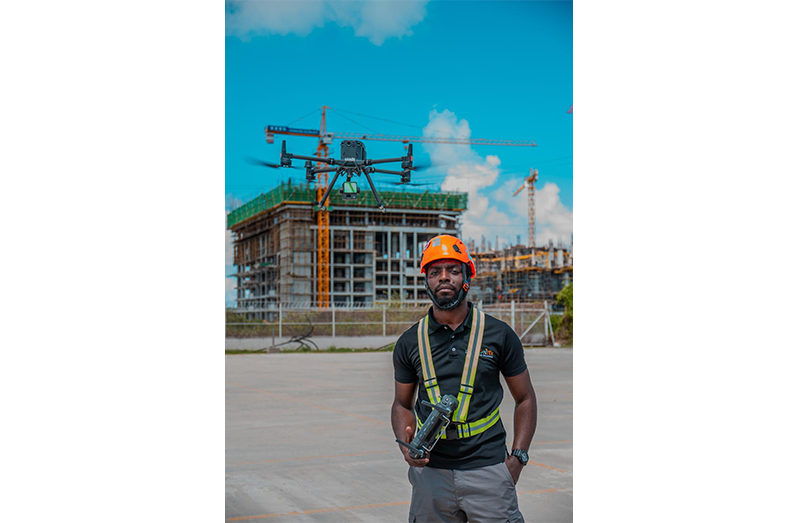
Local drone specialist says the technology is opening new possibilities in infrastructure, agriculture, environmental monitoring and beyond
ONE of the most captivating aspects of Guyana’s Diamond Jubilee celebration was the drone show, featuring hundreds of drones that took to the sky to showcase vibrant patriotic imagery. But while this may seem like a simple creative exhibition, Brian Smith, Founder and Operations Lead of Dragonfly Drones and Geospatial Solutions, and a collaborator on one of Guyana’s first drone shows a few years ago, says that drone work is as precise as it is innovative.

Smith sees drones as far more than flying cameras. They are powerful tools helping engineers design roads, farmers improve crop yields, and agencies monitor the environment, while creating opportunities for Guyana to become a regional leader in drone innovation. Speaking with the Pepperpot Magazine earlier this week, Smith shared how his business became a reality, innovative new ways drones are being used, and why, more than ever, Guyanese should consider entering the field.
Dragonfly Drones is among the most notable names in Guyana’s drone industry. Established amid the pandemic, founder of the company, Brian Smith, says that his love for drones was sparked by an interest in photography. Sharing his journey, he said, “Basically, it started off with me borrowing a drone from a friend and doing photography, taking pictures,” he said.
While he started with just pictures, Smith soon saw the vast capabilities of drone technology and how they could be implemented in Guyana.
As he added, “I spent a lot of time on YouTube and realised that there is a technical space where drones exist that really wasn’t that popular yet, which is using drones in surveying, mapping, technical work and inspections. That’s where I started to get more technical and build the business to where it is today,” he added.
While drone shows in Guyana have become more prominent and increasingly captivating since Smith collaborated with Adrian Allen, Founder of Lunalite Drone Technologies, to launch the spectacle two years ago, this is just the beginning of the work that drones are currently doing in Guyana.
As Smith shared, drones are helping shape Guyana. With more linkage roads and impactful infrastructure being built across the country, drones are being used as eyes in the sky in charting the path for these new ventures.
As Smith shared, “Drones go there within those cane fields and mark points and establish road alignments and all that type of stuff. If you know a cane field is full of snakes, that is hazardous. By using LiDAR technology, we’re able to send different lights through the front sensor to pass through the leaves of the plant and go to the ground,” he said.
The unique use of drones enables people like Smith to gather vital information that engineers then use. As he explained, while historically survey engineers could assess land only from ground level with traditional tools, drone technology provides a more comprehensive view.
As Smith shared, “The survey engineer who designs the road is able to design a road in those conditions. It makes the survey work easier because he does not have to spend as much time in the field. It makes the engineers’ work easier because they’re getting data that’s very accurate. It also makes the entire engineering process simpler because now you have smart data that you can use for drafting, drawing and modelling, making the road design process more efficient.”
Drone technology is also helping keep the country connected by maintaining critical infrastructure.
As Smith shared, “Inspection of infrastructure like telecom towers allows us to check whether they’re rusted, whether components need to be repaired or replaced. Thermal inspections can check the roofs of large buildings to see where leaks are. It’s difficult for a person to go up there, but you can use a drone and map it,” Smith said.
While drone technology is used across sectors from agriculture to health, the general public’s adoption of the technology remains limited. With his Master’s thesis focused on drone adoption, Smith explained that there is still much apprehension surrounding the “eyes in the sky” in Guyana.
As he explained, “We have a problem where people think that drones just take pictures and that’s it. As a matter of fact, it’s just a toy. They don’t understand the technical side of it. Flying is just one part of it. There’s a data aspect to it because you have to process that data.”
Noting that certain security measures are necessary, Smith said that drone technology, once used by professionals, is safe.
As he added, “People are scared and concerned about their privacy being infringed on, or they only see the usual things like pictures. They see a drone and think, ‘Wow, this is interesting,’ but don’t necessarily understand all the elements it takes or all the other careers that exist in the drone space,” he shared.
However, Smith noted that steps are being taken to adopt drone technology in Guyana. As more companies adopt LiDAR technology, there is still much work to be done.
This is why Dragonfly Drones continues to work on education and training, teaching people about the possibilities of drone technology.
As Smith shared, “We are working on the adoption of the technology in Guyana. We do that through various levels. We have Drone Kids and Drone Girls programmes. We raise awareness as well as train ministries and agencies on how to use the technology for different purposes,” he further added, “The Environmental Protection Agency uses drone technology and photogrammetry for land-use planning. Statistics agencies can use drones for land-use mapping and helping to acquire census data.”
As Guyana continues to pave a connected, innovative path forward, Smith says drone technology will play an even greater role.
As he shared, “I believe that there’s almost no place here in Guyana where there isn’t a drone application. I dream of a day where I can use a drone to model one of our ecological sites, put that model on a tablet and send it to the interior. People can actually touch it, interact with it and hear the sounds of the heritage site. That’s all part of drone technology.”
For Smith, Guyana is a nation with endless opportunities for drone technology. Through environmental monitoring, illegal mining detection and security services, he says the role of drones in Guyana is only just taking off.