–emphasises there was never Spanish administration, settlement in Essequibo region
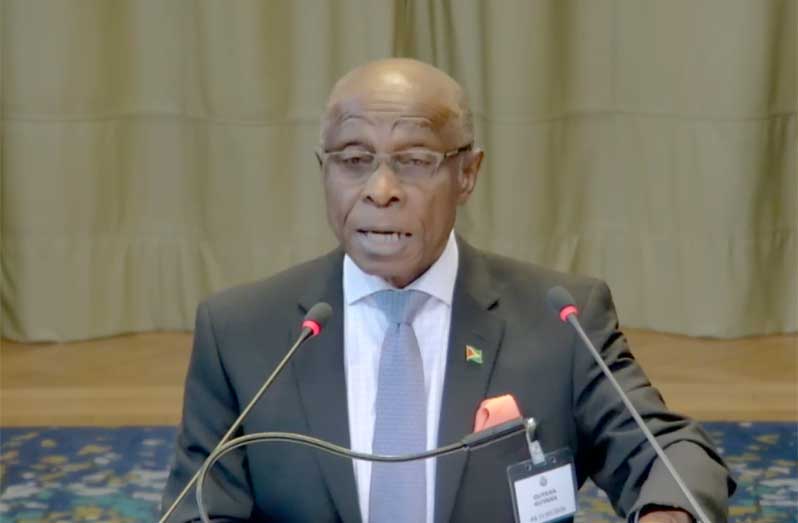
FORMER Foreign Affairs Minister and Guyana’s agent in the border case, Carl Greenidge, has told the International Court of Justice (ICJ) that it was Venezuela—not Great Britain—that pushed for arbitration to settle the long-standing territorial controversy.
Continuing Guyana’s presentation before the court on Monday, Greenidge traced the historical evolution of the controversy, placing particular emphasis on Venezuela’s role in initiating the arbitration process that ultimately culminated in the October 3, 1899 Arbitral Award issued in Paris.
“The history is clear, and established by the evidence before the court,” he said, adding: “It was Venezuela that insisted on arbitration.”
Greenidge related that after years of unsuccessful diplomatic negotiations with Great Britain, Venezuela proposed in 1883 that the controversy be settled through arbitration.
At the time, he noted, Venezuela sought a binding decision from an arbitrator jointly selected by both parties.
However, Britain rejected the proposal in its initial form, particularly over disagreements regarding the scope of the territory to be included in the arbitration.
Faced with this setback, Venezuela escalated its efforts, severing diplomatic relations with Britain in 1887 and seeking external support to advance its position.
According to Greenidge, it was at this stage that Venezuela turned to the United States of America for assistance.
“It was Venezuela that brought the United States into the picture to help it obtain the arbitration agreement with Great Britain that it was unable to obtain on its own,” he told the court.
Greenidge said Venezuela urged the United States to use its influence to compel Britain to agree to arbitration covering the entire territory between the Essequibo and Orinoco Rivers.
Those efforts eventually succeeded, culminating in the signing of the 1897 Treaty of Washington, which formalised the agreement to submit the controversy to arbitration.
“And, ultimately… Venezuela secured the arbitration agreement on which it had been insisting for more than a decade,” he said.
He added that Venezuela not only supported the treaty at the time but also celebrated it as a major diplomatic achievement.
According to him, Venezuela expressed gratitude to the United States for its role in facilitating the agreement and accepted the process without objection.
“Venezuela heralded and celebrated the treaty as the accomplishment of its long-sought objective,” he noted.
Greenidge further pointed out that Venezuela maintained this position for decades, neither questioning nor criticising the treaty or its implementation.
“It neither questioned, challenged, nor criticised the treaty,” he said, referring to the period following the arbitration.
In contrast, he told the court, Venezuela’s current arguments represent a complete reversal of its earlier stance.
“In these proceedings, Venezuela takes exactly the opposite position,” Greenidge said, noting that the country is now attempting to discredit the very agreement it once championed.
He dismissed these claims as unfounded and belated, arguing that they lack legal merit.
Greenidge indicated that Guyana’s legal team would continue to demonstrate the weakness of Venezuela’s arguments as the hearings progress.
HISTORICAL CONTEXT
His presentation also outlined the broader historical context of the territory, tracing its administration from Dutch to British control and highlighting the absence of Spanish settlement east of the Orinoco River.
He related that the Dutch established settlements and administrative control in the region as early as the 17th century, with evidence of their presence reflected in place names that remain in use today.
In contrast, he said there was no comparable Spanish presence in the territory, undermining Venezuela’s claim to historical ownership.
“What Venezuela does not say, and what it cannot say, is that there was any Spanish settlement or administration in this territory,” he argued.
Greenidge also detailed how Britain later assumed control of the territory following the cession of Dutch colonies in the early 19th century, eventually forming the colony of British Guiana.
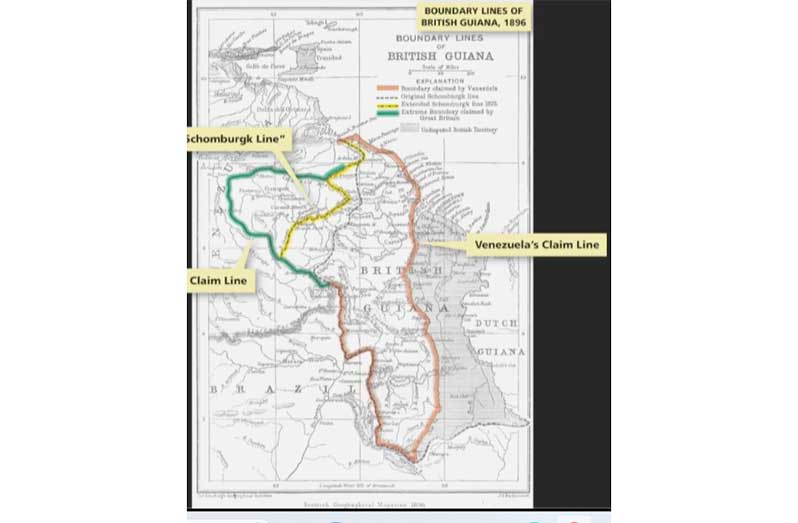
He described subsequent efforts by Britain to define the colony’s western boundary, including surveys conducted by German-born explorer and surveyor Robert Schomburgk, whose findings formed the basis of Britain’s territorial claims.
The Schomburgk Line, he explained, later became central to the arbitration proceedings that resulted in the 1899 award.
Greenidge said Venezuela objected to the line at the time but failed to present evidence of effective occupation or administration of the territory.
Greenidge also challenged Venezuela’s historical claims to the territory, arguing that they were not grounded in evidence of occupation or administration.
He told the court that Venezuela failed to demonstrate any meaningful presence in the area. Instead, he said, it relied on abstract and outdated assertions rather than concrete proof.
“In asserting this claim, Venezuela did not point to any military bases or to settlements it had built, officials it had posted, or taxes it had collected. It pointed to the heavens, quite literally,” Greenidge submitted.
According to him, Venezuela based its position on colonial-era arguments, invoking a papal decree to justify its claim.
“Venezuela invoked the Papal Bull of 1493, issued by Pope Alexander VI, a Spaniard, and declared on that basis that the right of Spain to the territory of America has always been indisputable in the eyes of all nations of the world,” he told the ICJ.
Greenidge contrasted this with Britain’s actions at the time, noting that despite Venezuela’s objections, British authorities continued to administer and settle the territory within the Schomburgk Line while pursuing diplomatic efforts to resolve the boundary issue.
Greenidge reiterated Guyana’s position that Venezuela’s current challenge to the arbitration process is inconsistent with its historical conduct.
He stressed that the evidence before the court demonstrates that Venezuela actively sought arbitration and accepted its outcome for decades.