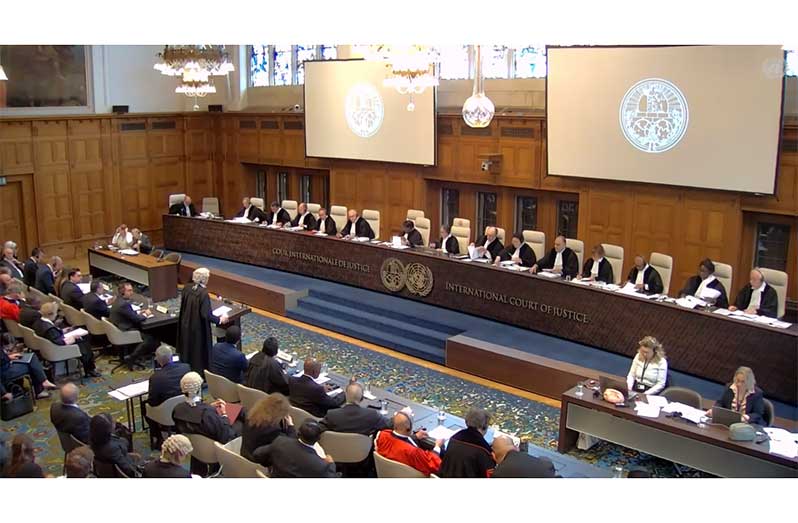
–reaffirms Guyana’s commitment to ICJ ruling, urges Venezuela to do the same
GUYANA’S Minister of Foreign Affairs and International Co-operation, Hugh Todd, told the International Court of Justice (ICJ) that the ongoing border controversy with its western neighbour, Venezuela, carries profound national implications, describing it as a case that goes to the very survival of the country.
Presenting opening submissions on Monday as Guyana’s lead representative before the World Court at the court’s seat at the Peace Palace in The Hague, Netherlands, Todd said the issues at stake go well beyond questions of territory.
“This case has an existential quality for Guyana,” he declared, noting that more than 70 per cent of the country’s sovereign territory is at issue.
“At stake is more than 70% of our sovereign territory, which has been recognised to be an integral part of the country for more than 126 years, including the past 60 years since independence. The Essequibo, as this land is known in Guyana, is named for the Essequibo River, the largest and most remarkable river that runs through it,” he explained.
Todd related that the Essequibo region, long recognised as part of Guyana, represents not only land but also the identity of the nation.
“Guyana would no longer be Guyana without it,” he said, referencing the county’s people, culture, resources and ecological importance.
He said the prospect of losing the Essequibo region would be devastating for Guyanese, as it would mean the country being effectively torn apart.
According to him, it would mean losing not only a vast portion of its territory, but also more than 313,000 people, along with its heritage, cultural traditions, natural resources and unique environment, fundamentally altering the nation’s identity.
Todd emphasised that Guyana’s position is firmly grounded in international law, arguing that the October 3, 1899 Arbitral Award definitively settled the boundary between Guyana and Venezuela.
According to him, the arbitral award followed an extensive legal process involving thousands of pages of evidence and months of hearings before an eminent tribunal.
He further pointed out that Venezuela accepted and respected the award for decades, including through a 1905 agreement that demarcated the boundary.
“For six decades, Venezuela fully respected and complied with that award,” he told the court.
Guyana maintains that the award and subsequent agreement remain legally binding and that Venezuela’s current challenge lacks merit.
“None of the arguments Venezuela has raised, prior to and during these proceedings, against the award and the agreement has any merit whatsoever,” Todd asserted, adding that such claims are “a century too late” under international law.
Describing the hearings as a pivotal juncture, Todd said: “This is a historic moment. This is a moment of truth for Guyana and for Venezuela.”
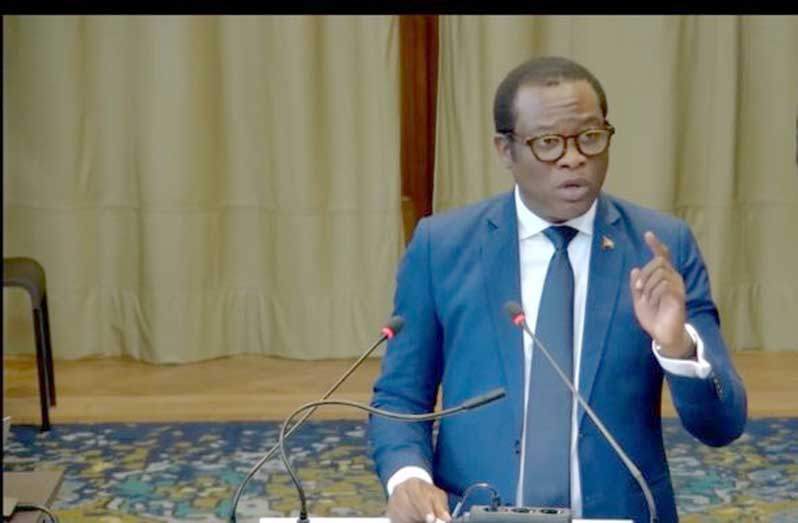
He also reminded the court that Guyana has consistently pursued peaceful resolution through legal means, culminating in the present proceedings.
Todd also used the opportunity to trace the long legal and diplomatic journey that has brought Guyana to this stage, noting that the country has exhausted all avenues under the 1966 Geneva Agreement before turning to the court.
He said that the decision to approach the ICJ followed a determination by the United Nations Secretary-General in 2018 that judicial settlement was the appropriate means of resolving the controversy.
Todd stressed that Guyana’s pursuit of a legal resolution reflects its unwavering commitment to a peaceful settlement.
He reiterated that the country remains confident that international law supports its position and will ultimately uphold the validity of the 1899 Arbitral Award.
KEY FIGURES
The minister paid tribute to key figures who played instrumental roles in advancing Guyana’s case, including the late former Commonwealth Secretary-General and distinguished Guyanese statesman, Sir Shridath Ramphal.
He also honoured the late Ambassador Elisabeth Harper, whom he described as “the heart and soul” of Guyana’s earlier appearances before the court.
Moreover, Minister Todd reaffirmed Guyana’s commitment to abide by the ruling of the ICJ, while expressing hope that Venezuela will adopt a similar position.
Todd told the court that the country has placed its confidence in international law and the judicial process to resolve the long-standing controversy.
Todd underscored Guyana’s respect for the court’s authority, noting its appreciation for previous rulings that upheld the court’s jurisdiction and the admissibility of Guyana’s claims.
He described these decisions as grounded in “the court’s faithful application of international law.”
However, he contrasted Guyana’s approach with Venezuela’s actions, accusing its neighbour of repeatedly attempting to derail the proceedings.
He recalled objections to jurisdiction and admissibility that were rejected by the court in 2020 and 2023.
VENEZUELA’S ESCALATION
According to Todd, Venezuela later escalated its actions by staging a referendum in 2023 aimed at rejecting the court’s authority and asserting sovereignty over the Essequibo region.
Despite provisional measures issued by the court to prevent such steps, he said Venezuela proceeded with actions that directly contravened those orders.
These included executive decrees, legislation, and plans to integrate the territory into its administrative framework.
Todd warned that these developments have had serious implications for Guyana’s security and development.
He pointed to increased military activity near the border, including the construction of bases and deployment of troops, describing the situation as a growing threat.
“This has been a blight on our existence as a sovereign state from the very beginning of our existence. It has been a threat to our peace and security, exacerbated in recent years by the ominous growth of Venezuela’s military activities, including the construction of new bases and airfields, and the deployment of aircraft, heavy weapons, and troops to the border area,” Todd said.
The minister said the controversy has also hindered economic progress, noting that uncertainty has discouraged foreign investment.
“Foreign investors, in particular, have been reluctant to risk their capital in such circumstances, and far too little investment has been the consequence,” he related.
Reiterating Guyana’s position, Todd stressed that the 1899 Arbitral Award and the 1905 boundary agreement remain valid and binding, and that Venezuela is obligated to respect them.
He submitted: “It is Guyana’s submission that the 1899 Award is without question legally valid and binding on the parties, and that the 1905 boundary agreement is legally valid and binding on the parties.”
The minister went on to note: “Venezuela is obligated under international law to accept and respect that border, and to refrain from any activities that infringe on the territory across that border.”
As the case enters its final phase, he expressed hope for a definitive resolution grounded in law.
Guyana, Minister Todd said, remains steadfast in its commitment to the judicial process and to upholding the rule of international law.
The country now awaits a final and binding ruling on the validity of the 1899 Award and the established boundary from the world’s highest court.
The ICJ is the principal judicial organ of the United Nations, tasked with resolving legal disputes between states and issuing advisory opinions on international law, with its judgments binding on the parties involved.