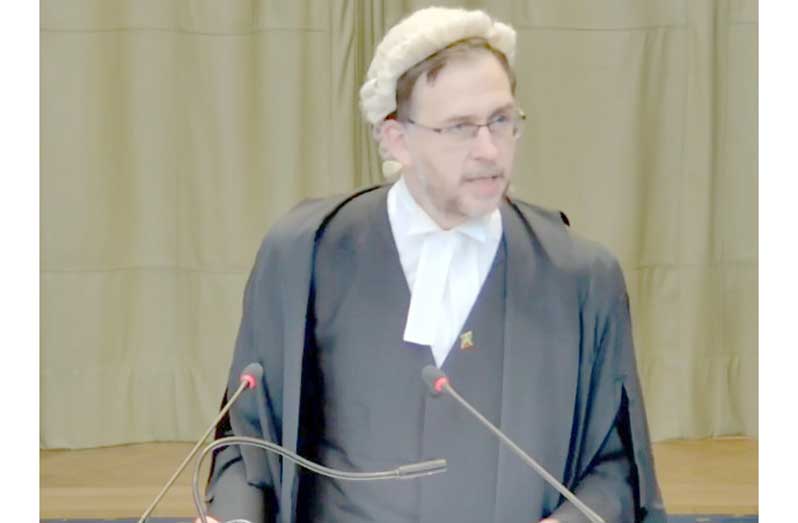
–British King’s Counsel tells court; says final ruling could lay foundation for ‘enduring peace and security’ in the region
BRITISH King’s Counsel Edward Craven has urged the International Court of Justice (ICJ) to impose remedial measures on Venezuela, including ordering the withdrawal and destruction of official maps depicting Guyana’s oil-rich Essequibo region as Venezuelan territory.
Making submissions on Guyana’s behalf, Craven argued that Venezuela has repeatedly defied the court’s provisional measures and must now be compelled to reverse those actions.
“Those orders are of course binding and they create international legal obligations for Venezuela,” he told the World Court.
Craven stressed that Venezuela’s conduct since December 2023 demonstrates a pattern of deliberate and persistent non-compliance with binding court orders.
“In short, the factual record demonstrates that from the moment the court made its first provisional measures order… Venezuela deliberately, repeatedly and flagrantly violated the provisional measures indicated by the court,” Craven said.
HE told the ICJ that Venezuela has repeatedly violated the court’s provisional measures by openly rejecting its jurisdiction, holding a 2023 referendum, and issuing decrees to annex Guyana’s Essequibo county.
He said Venezuela created a new “Guayana-Esequiba” state, updated official maps, expanded military presence, and passed laws asserting control over the territory.
Despite clear orders to refrain from such actions, he noted that Venezuela continued legislative, military, and administrative steps that sought to alter the status quo.
At the heart of Guyana’s request for remedial measures, he said, is the need to restore the status quo prior to those breaches.
Craven outlined two key remedies being sought. First, that the court formally declares Venezuela in violation of its orders. Second, that it requires Venezuela to undo all measures taken in breach of those orders.
“The court should order Venezuela to revoke… each and every law, decree and other domestic act which has been enacted or taken in violation of those provisional measures orders,” he submitted.
This, he noted, includes legislation purporting to incorporate Guyana’s territory into Venezuela and to extend Venezuelan jurisdiction over it.
Craven went further, calling for the removal of official representations of the territory from Venezuela’s national materials.
“The court should also order that Venezuela must withdraw and destroy the official maps that purport to depict Guayana-Esequiba as part of Venezuela,” the King’s Counsel stated.
He argued that such measures are necessary to ensure full reparation under international law and to reverse the effects of Venezuela’s actions.
“These measures are requested because Venezuela is under the obligation… to re-establish the situation which would, in all probability, have existed if those breaches had not been committed,” Craven explained.
Drawing on past rulings of the court, he said similar orders have been made where unlawful acts remained in force, requiring states to rescind measures and restore the prior legal position.
Craven maintained that compliance would not be burdensome.
“An order in these terms is a logical, reasonable and legally inescapable consequence of Venezuela’s breaches,” he said.
Guyana has asked the ICJ to issue a series of declarations affirming its sovereignty and conclusively settling the decades-old border controversy with Venezuela.
During submissions, Craven told the court that the declarations sought are critical given the scale of Venezuela’s claims and their implications for Guyana.
ABSOLUTELY CRUCIAL
“As the court will appreciate… the court’s declarations in this case are of absolutely crucial importance to Guyana,” he said.
Craven argued that Venezuela’s position—challenging the 1899 Arbitral Award and the boundary it established—is without merit.
“He added: “Venezuela’s contention that the 1899 award is void… [is] entirely without merit.”
He told the World Court that Venezuela’s case lacks both factual and legal support.
“Venezuela’s attack on the validity of the award and the boundary which it established is devoid of factual or legal support,” Craven said.
“It is, to be clear, nothing less and nothing more than an attempt to provide a fig leaf for the annexation of Guyana’s sovereign territory, territory which has formed an integral part of Guyana since long before its emergence as a sovereign state some 60 years ago,” he said.
According to him, Guyana is asking the court to formally affirm that the 1899 Arbitral Award is valid and binding, and that the boundary established by that award and the 1905 agreement is the lawful frontier between the two states.
“These include adjudging and declaring that the 1899 award is valid and binding upon Guyana and Venezuela, and that the boundary established by the award and the 1905 boundary agreement is the boundary between the parties,” he outlined.
Guyana is also seeking a declaration confirming its sovereignty over the territory west of that boundary.
“They include adjudging and declaring that Guyana enjoys full sovereignty over all the territory between that boundary and the Essequibo River.”
He stressed that Venezuela must respect that sovereignty and territorial integrity in accordance with the established boundary.
The King’s Counsel emphasised that these declarations are necessary to uphold international law and the authority of the court.
“We submit that those elements are required in order to vindicate the rule of law, the authority of the court and the sovereign rights of Guyana, as well as to fulfill the mandate of the Secretary-General of the United Nations when he selected the court as the means for resolving the dispute back in 2018,” he said.
He further noted that a clear ruling would finally resolve the controversy.
“A judgement in the terms sought by Guyana will provide the key which finally unlocks the resolution of this decades-long dispute,” Craven stated.
According to him, the ICJ’s decision could also lay the foundation for lasting peace.
“The court can, with its judgement in this case, provide the foundation for enduring peace and security in the region,” he said.
Craven added that such declarations would place Guyana’s sovereignty beyond doubt and bring long-needed certainty.
“They will bring complete clarity and certainty to the legal status of the parties’ boundary,” he said.
Guyana’s first round of oral arguments has now concluded, with further hearings expected as the case continues. Venezuela will present its first round of arguments on Wednesday, May 6.
The second round of oral arguments is scheduled for Friday, May 8, when Guyana will present further submissions, while Venezuela is set to conclude the hearings on Monday, May 11.