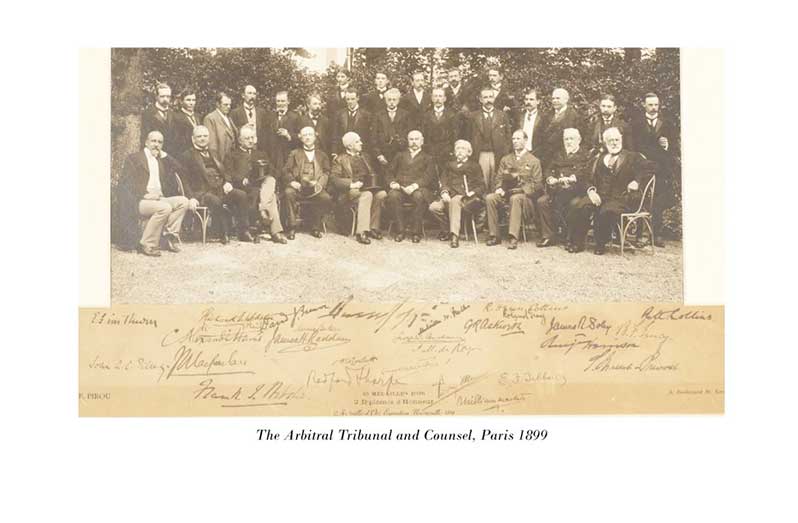
DISTINGUISHED international lawyer Paul Reichler has dismissed Venezuela’s claims of collusion between the United States of America and Great Britain as implausible and unsupported.
He told the International Court of Justice (ICJ) that the historical record instead confirms the legitimacy of the 1897 Treaty of Washington and the October 3, 1899, Arbitral Award it produced.
Presenting submissions in the ongoing border controversy case, Reichler said Venezuela’s argument that the treaty was tainted by fraud or conspiracy cannot withstand scrutiny.
“Mr. President, neither Venezuela’s contention of fraud nor its contention of error withstands scrutiny or is even plausible,” he argued.
Reichler described the allegation of collusion as illogical, noting that it would require the court to accept that the United States abruptly abandoned its longstanding support for Venezuela and instead sided with Britain.
He contended: “They strain credulity, requiring you to conclude that the United States… made a complete volte-face… by switching sides and supporting Britain’s interest in the disputed territory to the prejudice of Venezuela’s.”
The attorney maintained that documentary evidence tells a very different story—one in which Venezuela actively sought arbitration and relied on U.S. support to secure it.
“It is a fact that Venezuela requested the protection of the United States in order to resist Great Britain’s conduct and reach a peaceful solution to the territorial dispute,” he told the court.
Reichler added that arbitration would not have materialised without that support.
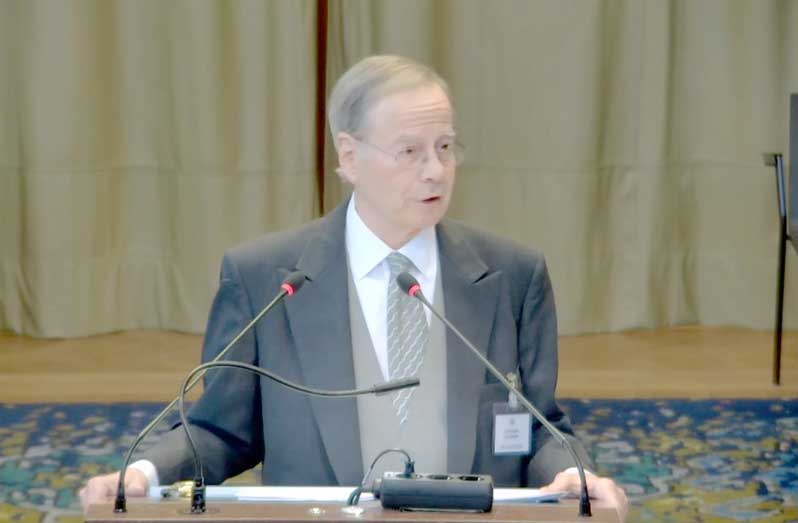
“It was clear that the possibility of submitting the dispute to arbitration could have materialised only with the support of the United States,” he stated.
Reichler further argued that Venezuela was not excluded from the treaty process, as it now claims, but was instead actively involved and represented throughout.
He told the World Court that the evidence indicates Venezuela relied on then U.S. Secretary of State Richard Olney and President Grover Cleveland to protect its interests.
Reichler pointed to contemporaneous records showing Venezuelan representatives were consulted and their positions incorporated into negotiations.
“This is entirely fallacious. It is completely refuted by the documentary evidence, as you will now see,” Reichler asserted, dismissing Venezuela’s claims.
He also highlighted that Venezuela accepted and complied with the 1899 Arbitral Award for decades after the process it had championed concluded.
“As the court is well aware, Venezuela accepted, respected, and complied with the 1899 Arbitral Award for more than 60 years,” he noted.
The 1897 Treaty of Washington, he explained, was the lawful basis for arbitration between Venezuela and Great Britain, culminating in the award that fixed the boundary between Guyana and Venezuela.
“I will address you on the 1897 Treaty of Washington by which they agreed to arbitrate their territorial dispute… resulting in the award of October 3, 1899,” Reichler submitted.
He stressed that Venezuela only began challenging the treaty decades later.
Reichler told the ICJ: “It was not until 1963, 66 years after it ratified the treaty, that Venezuela first began to find fault with it.”
The validity of the 1897 Treaty remains a central pillar in the broader case concerning the legitimacy of the 1899 Arbitral Award, which legally established the boundary between Guyana and Venezuela.
Reichler’s submissions sought to reinforce Guyana’s position that the treaty—and by extension the award—was lawfully concluded and remains binding under international law.
As hearings continue, the ICJ is expected to weigh these historical and legal arguments in determining the merits of Guyana’s case.
In accordance with the 1966 Geneva Agreement, Guyana and Venezuela engaged in decades of Good Offices efforts under the auspices of the United Nations Secretary-General in an attempt to reach a peaceful resolution.
However, on January 30, 2018, after the process failed to yield meaningful progress, the Secretary-General determined that the Good Offices process had run its course and selected judicial settlement by the ICJ as the next means of resolving the controversy.
The case was formally filed by Guyana on March 29, 2018, seeking a final and binding ruling affirming the legal validity of the 1899 Arbitral Award and the boundary determined thereafter. Rulings of the ICJ are binding on parties.