






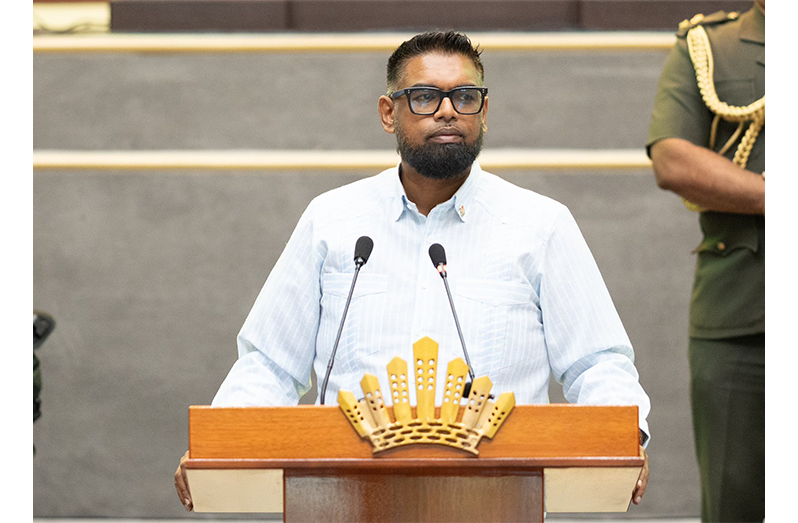
–President Ali says, urges private sector to make adjustments to benefit consumers
PRESIDENT Dr Irfaan Ali has reiterated that his administration is maximising the economic tools at its disposal to cushion the impact of rising fuel costs and is now calling on the local private sector to demonstrate social responsibility by moderating profit margins.
Delivering the feature address at the Georgetown Chamber of Commerce and Industry (GCCI) Annual General Meeting held last week, President Ali said the government has already “maximised its adjustment tool” by maintaining a zero per cent excise tax on fuel, even as global energy prices and freight costs have increased.
He stressed that the government had also preserved concessions that were in place during the COVID-19 pandemic.
“We have maximised our adjustment tools because we have zero per cent excise tax on fuel. So, we have already maximised that adjustment. We’ve already maximised the adjustment on freight costs. During the pre-COVID period, we have never removed that benefit, so you maximise the tools available, the macro-economic tools, and here is where social responsibility from businesses comes in. When the State has maximised its tools, the private sector must support” he said.
The President disclosed that the state-owned GuyOil is currently operating at a deficit in order to stabilise domestic fuel prices. He signalled that while the government is willing to bear some of the strain, the company must at least be allowed to operate at break-even to ensure sustainability.
Against this backdrop, Dr Ali issued a pointed appeal to private fuel retailers, some of whom he said were enjoying profit margins of 30–35 per cent at the pump on refined fuel.
“This is the time for you to make some adjustments in the interest of the consumers. These are difficult conversations, not easy conversations, but they’re necessary conversations, and this is what true partnership between the government and the private sector looks like and must feel like… it is true partnership through which the people see the benefit every time there’s an interaction between the government and the private sector,” he said.
ENERGY PLATFORM
For Guyana, President Ali noted that these external shocks underline the urgency of building self-reliance, regional co-operation and a more secure energy platform.
“We cannot continue to look beyond our hemisphere for solutions when we have so much resources within the Western Hemisphere, if we are to really secure a sustainable future for ourselves,” Dr Ali said.
The President related that current realities highlight now more than ever how crucial it is for Guyana to strengthen its energy infrastructure.
He warned that the country could not rely on just these fiscal fixes. Instead, he argued, Guyana must press ahead with structural projects designed to permanently reduce exposure to volatile fuel imports, particularly the gas-to-energy initiative.
President Ali told stakeholders that the country must move ahead with key plans for an oil refinery, a second gas plant and deep-water port.
“If we can have greater, bigger capacity coming in, then we will always be shooting in the dark,” he lamented, adding: “Now I believe we should return to the conversation of a refinery for national security.”
Turning his attention to domestic policy, President Ali underscored the scale of the government’s current interventions to cushion households and businesses from spiralling energy costs.
“We are fortunate to the extent that soon our energy will come from our own gas, natural gas. We’ll have cooking gas, refined gas that we will have control over the prices and supply and, of course, the safety of the transport and logistic link,” he said.
“Later this year, when the gas and energy project comes on stream, we’ll begin to see the tangible benefit of that vision,” President Ali added.
These developments, he said, will contribute to greater overall stability in the energy market and reduce the country’s exposure to external shocks.




