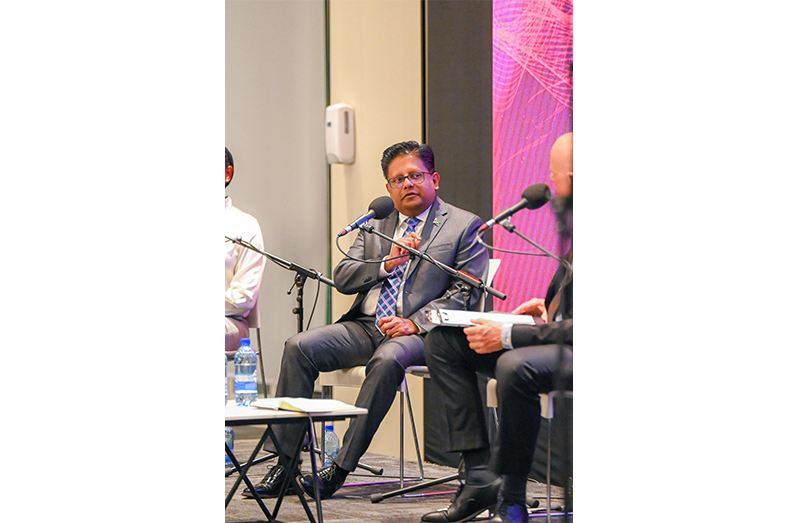
–Dr Singh says; encourages Guyana’s youth to capitalise on growing economy
–Urling advises young professionals to align skills, careers with emerging opportunities
YOUNG Guyanese were encouraged to remain in the country and take advantage of what Finance Minister Dr Ashni Singh has described as an unprecedented period of opportunity in the nation’s history.
During a recording of the BBC’s World Questions in Georgetown earlier this week, Dr Singh emphasised that the country’s rapidly evolving economic landscape presents possibilities that were unimaginable just a few years ago.
“There are no other opportunities like any other time in our history,” Dr Singh said, responding to a question about how the government plans to encourage young people to stay in Guyana rather than migrate.
The Finance Minister underscored that the current moment offers prospects and initiatives that previously did not exist in the country’s history.
Among these initiatives, he highlighted the PPP/C’s provision of free tertiary education, which removed financial barriers to higher learning and is equipping more citizens with the skills needed in the evolving economy.
Dr Singh also pointed to the introduction of various cash transfer programmes, explaining that these measures are designed to provide financial support to households.
“We are literally living in this era of opportunity,” Dr Singh said.
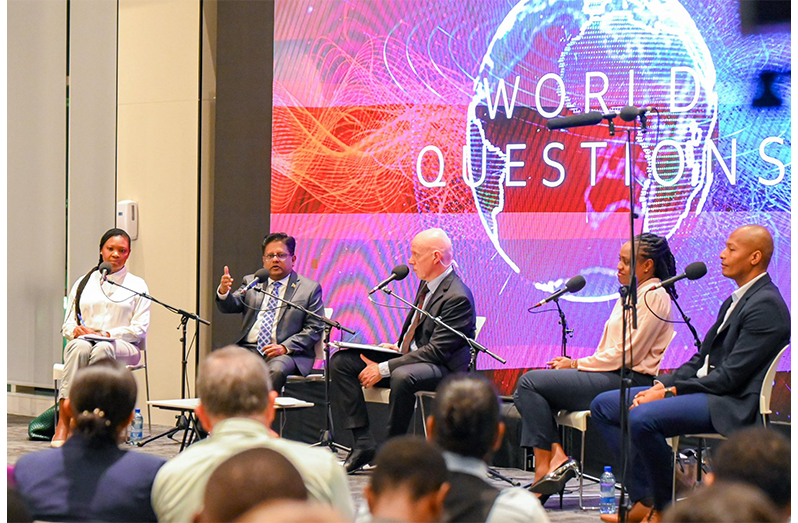
However, concerns about a shortage of skilled labour remain.
Guyana’s private sector is struggling to find enough skilled workers to meet the demands of the rapidly expanding oil-and-gas-driven economy, Secretary of the Private Sector Commission, Clinton Urling, said.
In his contribution to the discussion, Urling cited research by the Centre for Local Business Development which identified a shortfall of around 52,000 skilled professionals needed to support the emerging sector. He noted that other studies on labour and migration suggest the true gap may be even larger.
He urged young Guyanese, including those considering migration, to look carefully at where skills are most needed and to align their training and careers with these emerging opportunities.
At the same time, he urged the government to intensify investment in vocational and technical education, particularly in areas directly linked to industry demand, to ensure the country can fully benefit from its unprecedented economic transformation.
According to recent data from the Bureau of Statistics, unemployment had dropped sharply from 12.8 per cent in 2020 to 6.8 per cent in the fourth quarter of 2024.
Data also showed a reduction in female unemployment from 14.4 per cent to under nine per cent, as gains were evident across both urban and rural areas, signalling more equitable regional development.
President Dr Irfaan Ali had attributed the most recent gains to a diversified economic strategy and targeted government policies.
Dr Ali had noted that rising earnings were not confined to the oil and gas sector. He cited large increases in average wages across multiple industries: agriculture, forestry and fishing up 84 per cent; information and communication up 88 per cent; construction, 71 per cent; and arts, entertainment and recreation 114 per cent, among others.
The Head of State also acknowledged and referenced international assessments warning of labour shortages as the country grows.
He referenced an International Organisation for Migration (IOM) analysis that estimates Guyana will require as many as 160,000 workers to meet medium-term development needs, and a local study pointing to a gap of about 52,396 workers.
Dr Ali said the findings underscored the need for workforce planning, skills development and targeted recruitment to sustain the country’s expansion.