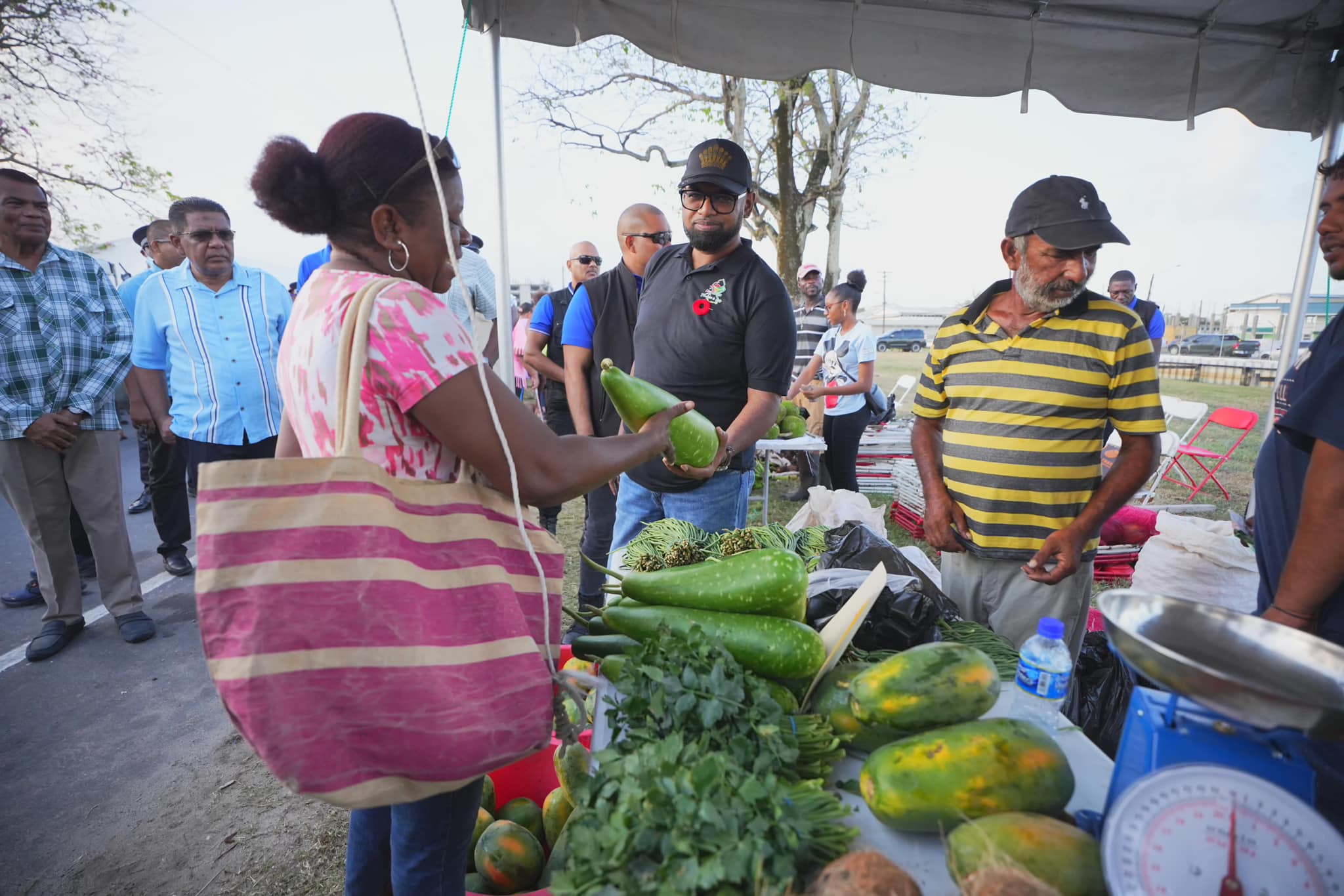
–among initiatives geared at improving production, reducing food prices
THE Government of Guyana continues to direct attention towards enhancing farm incomes, lowering food prices for consumers, and further establishing the country as the Caribbean’s leader in food security.
Crucial among these initiatives is the proposed permanent farmers’ markets, which signify a major change in how agricultural products reach both local and regional consumers.
This approach is expected to eliminate costly middlemen, reduces post-harvest losses, and helps stabilise prices for buyers and sellers.
Unlike the usual weekly markets that are only open periodically, the permanent arrangement will give farmers consistent access to consumer demand.
This reliability lets producers confidently plan their production volumes, invest in improvements, and negotiate better prices due to improved market stability.
For consumers, these markets ensure a steady supply of fresh, locally-produced food at lower prices than traditional retail channels, where multiple middlemen take a share.
This initiative is designed, according to analysts, to support three connected market areas – domestic food consumption, regional export opportunities, and value-added agricultural products.
This multi-channel strategy aims to maximise producer income while ensuring that price cuts help ordinary Guyanese households, who rely heavily on affordable local food.
The permanent farmers’ markets are part of a broader five-year agricultural modernisation plan, which was outlined by Senior Minister in the Office of the President with Responsibility for Finance, Dr Ashni Singh, during his presentation of Budget 2026 to the National Assembly, on Monday.
Dr Singh outlined a vision that includes regional food hubs, mega food parks, modernised port facilities with cold storage, and agri-tech and agro-industrial complexes.
All these elements are meant to improve the competitiveness and efficiency of Guyana’s agricultural sector. A regional food hub will act as a central processing and distribution centre, boosting supply chain efficiency across Caribbean markets and allowing Guyanese producers to reach larger consumer bases.
Mega food parks will attract agri-industrial businesses, helping convert raw agricultural products into processed foods, beverages, and specialty items that offer higher profits and export potential. Modern port facilities with cold storage will enable quick export of perishable goods, reduce waste and expand access to international markets. In addition to this infrastructure, the government will invest in agri-tech and agro-industrial complexes.
These innovation hubs will promote the use of smart technologies like precision agriculture, data analytics, water management systems, and renewable energy solutions. These tools help farmers enhance yields, cut costs, and reduce their environmental footprint while improving overall competitiveness.
To boost output and maintain the supply, the government, according to Dr Singh, plans to develop 100,000 acres of new arable land, tapping into significant productive capacity in underused areas.
This land expansion will be paired with targeted incentives aimed at supporting large, medium, and small-scale farming operations fairly. The Senior Minister highlighted that the transformation “will continue to work to improve production and productivity, enhance market access, and increase farm and household income” across all farming sizes.
Dr. Singh also emphasised that agriculture and food security are central to Guyana’s economic strategy for resilience.
Over the next five years, the government aims to “reinforce agriculture as a major part of Guyana’s diversification efforts” and strengthen its position as a leader in food security in the region.