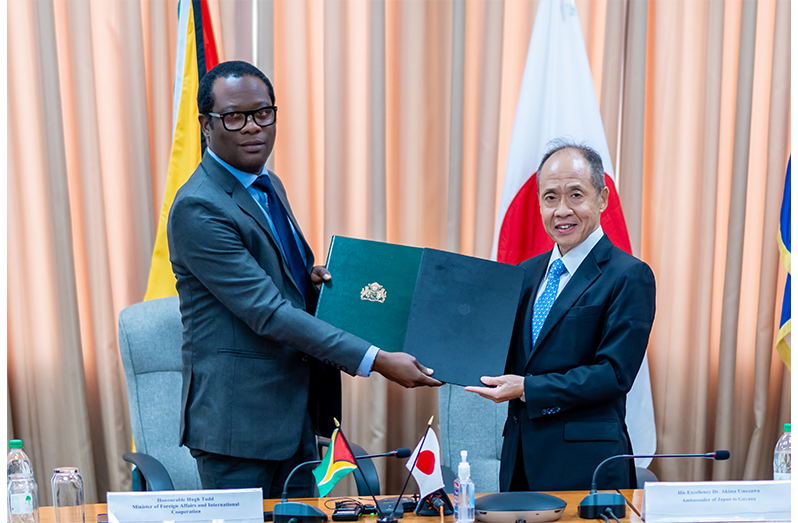
GUYANA and Japan, on Thursday, signed a Concessional Loan to Co-Finance the country’s Climate Resilient Water and Sanitation Infrastructure Improvement Programme with the Inter-American Development Bank (IDB).
According to the Foreign Affairs and International Co-operation, Hugh Todd, the project aligns with Guyana’s people-centered development model and the United Nations Sustainable Development Goals (SDGs), particularly SDG six on clean water and sanitation.
He noted too that the initiative underscores Japan’s commitment to supporting smaller, vulnerable countries like Guyana, emphasising democracy, good governance, and human development.
The J¥5.2 billion loan which converts to $7.2 billion will see the building out of sophisticated water infrastructure to serve the expanding development along the East Bank corridor.
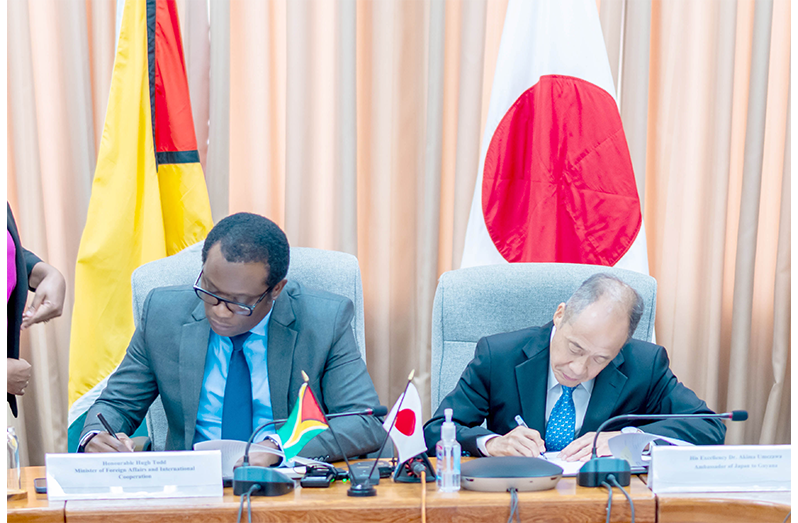
Todd underscored that while the ceremony was simple, the initiative carries “great impact” for citizens.
He highlighted that Guyana and Japan have enjoyed nearly 60 years of cordial and fruitful interstate relations, during which Japan has consistently supported Guyana’s development, particularly in human development and building human capital.
“Guyana is very focused on governing for the people of Guyana and for all. And this is not the first project that we’ve had under this framework. We’ve had investments in region two, three and seven, and bringing it to region four is important also because this is the most heavily populated region,” Todd said.
Japan’s Ambassador to Guyana, Akima Umezawa, cited the country’s rapid economic rise, noting that the country has recorded some of the world’s highest growth rates over the past four years.
This progress, Ambassador Umezawa said, must be matched with investment in essential services, particularly water supply.
Backed by Japanese expertise and official development assistance, the initiative will draw on state-of-the-art technologies, including advanced membrane filtration, highly precise pipeline systems, accurate measuring devices and sophisticated sludge treatment.
He pointed to Japan’s own experience, where modern water systems now cover virtually all households, provides a model for Guyana’s long-term development.
“I’m convinced that today marks a historic moment, taking a significant step towards the future of Guyana-Japan relations. Everyone knows that access to safe drinking water is one of the fundamental human needs essentials for our lives and health as a basic human right recognised by the United Nations,” he said.
A Japanese company, Toshiba, has already constructed four large-scale water plants in Guyana: three in Region Three, one in Region Two and another in Region Seven.