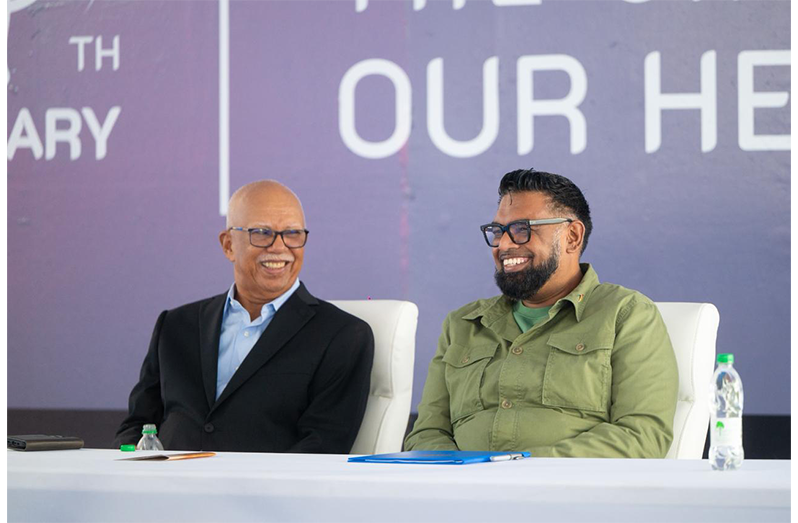
PRESIDENT, Dr Irfaan Ali on Sunday disclosed that he has engaged Banks DIH on the integration of more locally produced rice and other products in its value-added production.
He made this disclosure while giving the feature address at the commissioning of the Banks DIH large-scale Malta Bottling Plant, where he highlighted how the household name has become a diversified powerhouse.
“I’ve already had discussions with Mr Reis and his team on how they can utilise more of our rice production in their value chain and the products that they produce, and they’ve assured me that they are working on a plan that will not only utilise more rice, but a lot of the products that we are targeting. So, Banks DIH and others can and must play a decisive role in shaping Guyana’s manufacturing future. These firms carry with them decades of experience, established brands, trusted relationships and critically, financial depth,” President Ali said.
Guyana’s rice sector, the second most vital agricultural industry, has experienced remarkable growth in the last five years.
The growth of the sector is due to careful planning and solid investments made by the People’s Progressive Party/Civic (PPP/C)-led government. This momentum will continue with the government identifying agriculture as one of the key pillars of a diversified economy.
Since 2020, the government has rolled out a series of strategic interventions designed to shield rice farmers from escalating input costs, volatile prices, and logistical challenges.
These measures, supported by billions of dollars in public investment, have been critical in maintaining productivity and protecting farmers’ incomes.
One of the most significant forms of assistance came through fertiliser support. As global prices surged, the government distributed urea fertiliser valued at $3.1 billion, from a total allocation of $3.8 billion, easing the financial burden on farmers and allowing uninterrupted cultivation.
Moreover, the PPP/C government has launched a $2.1 billion assistance programme to support rice farmers, providing a $300 per bag subsidy for paddy as part of ongoing efforts to strengthen Guyana’s agricultural sector.
This initiative is a key commitment from President Ali to ease farmers’ financial burdens and ensure the long-term sustainability of the rice industry.
The initiative fulfils a commitment made by the President, ensuring that rice farmers receive $300 per bag of paddy as support to offset production costs and stabilise incomes. As part of this exercise, approximately $480.5 million was distributed to 1,618 rice farmers in Region Five (Mahaica–Berbice).
This intervention forms part of a wider national programme, representing a total government investment of approximately $2.1 billion, aimed at sustaining rice production, enhancing food security, and reinforcing the resilience of one of Guyana’s most important agricultural sectors.
Recently, at Anna Regina last Friday, 570 fisherfolk in Region Two received a one-off G$150,000 grant.
President Ali had announced the initiative, which also includes the removal of taxes on essential fishing materials such as fuel and seines. This year, over 6,996 fisherfolk nationwide will benefit from the programme.
LEADER IN FOOD PRODUCTION
President Ali recently stated that Guyana is positioning itself to become the Caribbean’s leading food-production and distribution hub, as the country leverages its raw agricultural output, expanding agro-processing capacity and major infrastructural investments to reach global agro-industrial scale.
He explained that this ambition is closely tied to strategic partnerships, including with Brazil’s Roraima state, which has significant agricultural capacity at a global scale.
He highlighted too recent investments aimed at strengthening the entire food ecosystem, from production to processing, storage and distribution.
Among them is the abattoir at Onverwagt, which is capable of processing between 60 and 100 animals per day, supported by the ongoing development of cold-storage facilities.
“We now have the food ecosystem being developed to support large-scale processing, production, storage, and distribution. So, we are also building out the infrastructure. We’re talking about the airport at Lethem so we can export directly to the Caribbean. We are looking at creating an agro-industrial hub in Lethem to bring raw produce, add value, and handle all packaging for the Caribbean and North American markets, “he explained.
According to President Ali, these initiatives are part of a broader, integrated plan to modernise agriculture and scale up exports.
In addition, agro-industrial hubs are also planned for Berbice and Essequibo, while new port facilities at Parika and Charity will enable direct shipping of agricultural goods to the region.
The President said these developments demonstrate how investments in infrastructure, new agricultural lands, technology and market integration are being pursued simultaneously.
Looking ahead, President Ali expressed confidence that agriculture, alongside tourism, will drive unprecedented growth over the next five years.